




Speculation has grown that China’s latest Type 076 amphibious warship, which will serve as a drone carrier and is capable of launching fixed-wing fighters, has begun testing its advanced electromagnetic catapult.
The Sichuan, which is currently being fitted out at Hudong-Zhonghua Shipyard in Shanghai, was pictured on Chinese social media with its state-of-the-art launch system pointing towards the open waters of the Yangtze River, rather than facing inward towards the dock.
The photo, claimed to have been taken on Tuesday night, was circulated from Wednesday morning, capturing the shipyard and the vessel’s bridge well lit, indicating activity during the evening hours.
The Shanghai Maritime Safety Administration earlier issued a notice to mariners, designating a small rectangular no-entry zone from October 20 to October 29, directly in front of the shipyard’s dock entrance.
The warning stated that “underwater activities” would take place within the zone daily from 9am to 5pm.
Given the size and location of the exclusion zone, as well as the repositioning of the vessel, it is speculated that the Sichuan has been conducting sled tests of its carrier’s Electromagnetic Aircraft Launch System (EMALS) during the specified period.
The sled test uses a heavy, wheeled metal carriage to simulate the mass and structural stress of an aircraft at full speed to evaluate the EMALS performance.
In each launch, the sled is ejected into the water. This suggests the “underwater activities” may refer to the recovery of the test vehicle.
Earlier witness reports had shown the covers had been removed from the vessel’s catapult and that a radar system had apparently been installed, signalling that the ship was ready for sea trials.
The Sichuan is the world’s first, and so far, only amphibious assault ship to have an EMALS. Only the USS Gerald Ford-class aircraft carriers and the Chinese Type 003 aircraft carrier, the Fujian, are known to have operated the advanced system.
Compared to ski jumps, the EMALS could allow more frequent launches as well as heavier planes. It is also more energy-efficient and flexible than the steam catapult used on most carriers of the US Navy, which enables the launch of different sizes of drones.
Last month, the People’s Liberation Army Navy released a video of three fixed-wing aircraft launched and retrieved by the Fujian, currently undergoing sea trials and expected to enter service very soon.
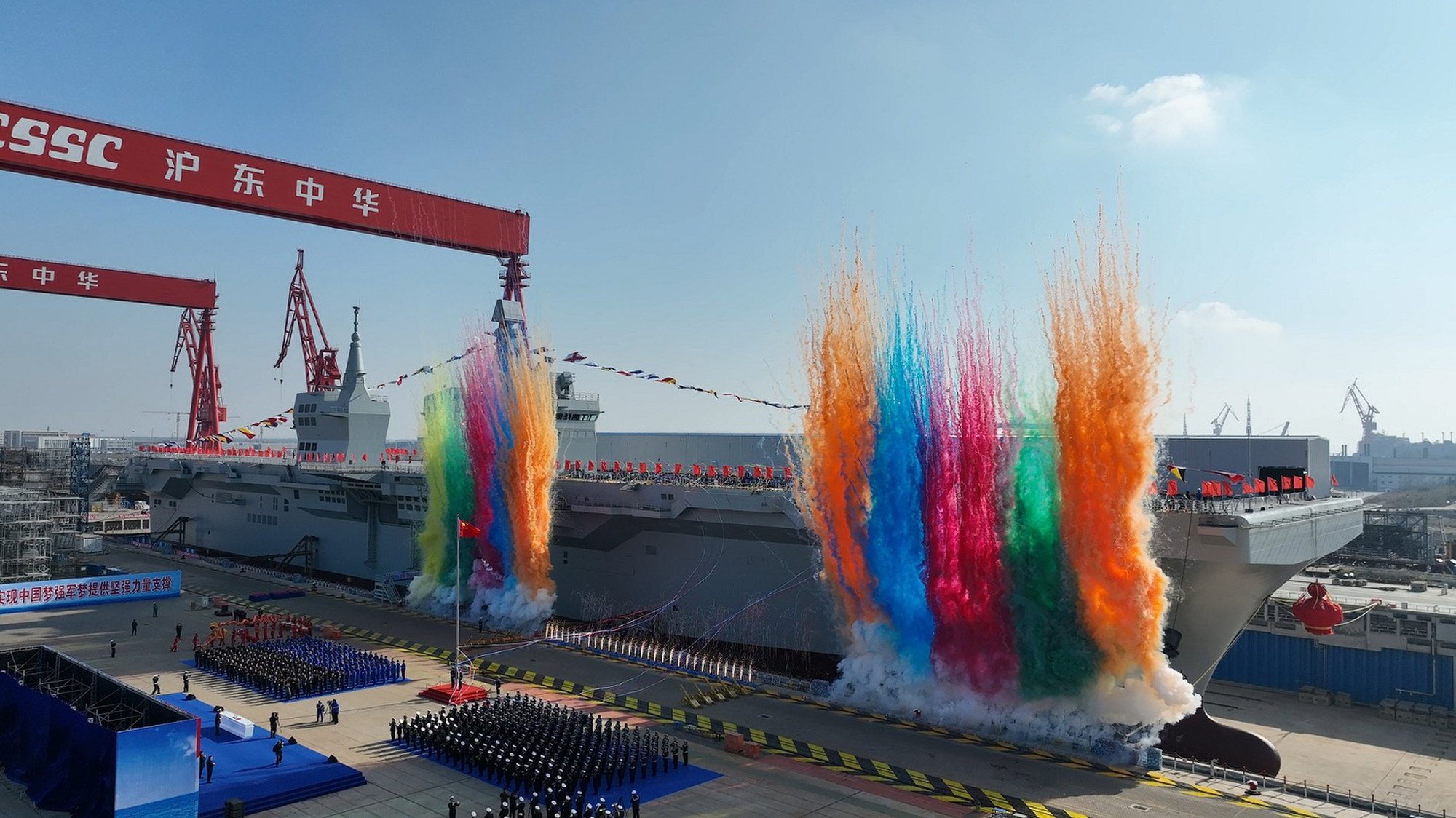
The Sichuan, launched in December last year, has an estimated displacement of over 40,000 tonnes and is equipped with one catapult of the same length as those on the Fujian.
The Chinese navy has said the Sichuan would primarily be a “drone carrier”, where uncrewed systems such as the GJ-11 stealth combat drones will be based. However, manned aircraft could still be operated from its full-length catapult and flat flight deck if required. - SOUTH CHINA MORNING POST


