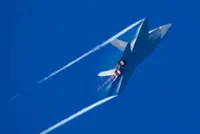
A new Chinese stealth flying-wing drone, possibly a next-generation bomber, has been spotted flying for the first time.
A video of the large stealth “cranked kite” drone, unofficially dubbed the GJ-X, has circulated on Chinese social media since October 19.
It appeared to be the same aircraft – or one with a very similar design – captured in satellite imagery taken in August at China’s Malan airbase in Xinjiang Uygur autonomous region, according to a report by The War Zone earlier this week.
The Malan base aircraft’s wingspan was estimated to be around 42 metres (138 feet), placing it in a very rare category for stealthy uncrewed aircraft, as noted in a previous report by the military website.
This size puts it on par with the Northrop Grumman B-21 Raider, an American stealth strategic bomber with a wingspan of 40-42 metres. The B-21, currently in development, is expected to be capable of delivering both conventional and nuclear payloads and will form the backbone of the future US bomber force alongside the B-52.
The purpose of the new Chinese drone remains unclear. Some military observers said it was a very large unmanned combat air vehicle focused on kinetic operations, while others said it was an unmanned stealth bomber, according to the report.
In a video posted online last month, Chen Xi, a Chinese military watcher and commentator for Shenzhen TV, said the drone spotted at the Malan base was “a medium-range strategic bomber”.
“The next-generation H-20 bomber hasn’t been released yet, but now we have a strategic-level medium-range bomber the same size as the B-21,” Chen said.
In 2016, China announced the development of a new long-range bomber, later dubbed the H-20 stealth bomber. Lieutenant General Wang Wei, deputy commander of the Chinese air force, said in March last year that the bomber would be revealed “soon”, while US defence assessments suggest the H-20 might not debut until the 2030s.
The War Zone report said the aircraft in the Malan base images had “split rudders” similar to those on the American B-2 stealth bomber. It also noted a small, off-centre hump above the jet’s tail, suggesting it had a twin-engined design.
The new model is among a handful of new unmanned aircraft China is testing.
The design of the GJ-X bears clear similarities to a drone called the CH-7, or Caihong-7, that was displayed at China’s Zhuhai air show in November last year.
The CH-7 drone has a wingspan of 27.3 metres, a maximum take-off weight of 8 tonnes, and a cruise speed of 0.5 Mach, making it a high-speed reconnaissance aircraft, according to a report by Xinhua in May.
China showcased seven new drones in its military parade held in Beijing last month. Their specific roles were revealed this month by the Chinese magazine Modern Ships.
The first row of the parade’s drone section displayed a reconnaissance strike drone widely believed to be a naval variant of the GJ-11, while the second row showed a different type of reconnaissance strike drone.
According to the magazine, the third row had two types of “unmanned wingman” drones, which are designed to collaborate closely with crewed fighters.
The fourth row showed two “unmanned air superiority fighters”, and the final row showcased a “carrier-based unmanned helicopter”, it said. These drones are primarily designed to perform diverse combat tasks such as battlefield reconnaissance, surveillance and strike missions, according to the magazine.
It added that the new reconnaissance strike drones, unmanned wingmen and carrier-based unmanned helicopters featured in the parade were designed for covert strikes, wide-area coverage and autonomous coordination. - SOUTH CHINA MORNING POST