
A flooded hotel lobby and promenades engulfed by seas whipped up as Super Typhoon Ragasa bore down on Hong Kong provide timely lessons for urban planning in coastal and other low-lying areas, experts have said.
They called for flood-resilient features and higher breakwaters on Wednesday after a storm surge and downpours associated with Ragasa battered the city’s coastline, inundating streets and promenades. Storm surges flooded restaurants, parks and even the lobby of the 425-room Fullerton Ocean Park Hotel Hong Kong.
An online video showed water crashing through the glass doors of the seaside hotel in Aberdeen, with the carriageway outside the lobby covered in mud and debris and the decorative wooden facade ruined. But the hotel said it was open as usual because its main lobby on the first floor and other facilities were unaffected.
Professor Yau Yung from Lingnan University, a professional member of Britain’s Royal Institution of Chartered Surveyors, said he believed that strong waves and possible debris would damage the glass doors and the facade.
The luxury resort, which boasts unobstructed views of the South China Sea, opened in 2022 and survived Super Typhoon Saola, which battered Hong Kong in 2023.
Yau noted that the builders might not have expected decorative materials to withstand such a powerful force as Ragasa, as structural safety was the most important focus.
He suggested that existing buildings could add temporary metal shields to block water, while future ones could incorporate flood-proof designs, such as relocating electrical and mechanical facilities to higher floors and keeping structures away from the coast.
“Hong Kong does not have special regulations for coastal buildings and construction to minimise the impact of waves and floods for design flexibility,” he said.
“The government can consider introducing advisory design guidelines, rather than a compulsory rigid rule. In cases of good building management, the impact of flooding can be very limited.”
He added that the government could consider conducting work at a district level in extensive flood-prone areas, including improving underground drainage systems and breakwaters.
Tony Za Wai-gin, past chairman of the building division of the Hong Kong Institution of Engineers, said the height of breakwaters in low-lying areas should be increased to provide better protection.
“Low-lying areas may not have tall enough breakwaters to cope with more extreme weather,” he said.
The Fullerton’s design takes into consideration inclement weather by building its main check-in lobby on the first floor and centralising its main facilities on the third floor.
The venue also has a higher wall on the seashore and is equipped with a floodgate.
A source told the Post that the hotel’s main entrance was more than three times higher than normal sea levels, and the entrance was located about 20 meters (65.6 feet) from the edge of the seawall.
However, Ragasa triggered higher-than-normal coastal water levels, with some reaching around 3.5 metres to four metres above chart datum. The water level at Tolo Harbour was raised by one to two metres above normal to four to five metres.
Professor Benjamin Horton, dean of the school of energy and environment at City University, said Hong Kong was moving into a future of more frequent and intense super typhoons, which could result in severe damage when a storm surge coincided with high tides.
Horton warned that the situation would worsen against a backdrop of rising sea levels, and urged the government to implement nature-based solutions to adapt, such as having mangroves and oyster reefs along the shore to act as natural barriers.
“If we build infrastructure properly, we can protect people in Hong Kong ... we improve the marine environment [and] water quality,” Horton said, adding that mangroves could also absorb carbon dioxide. “It’s a win, win, win.”
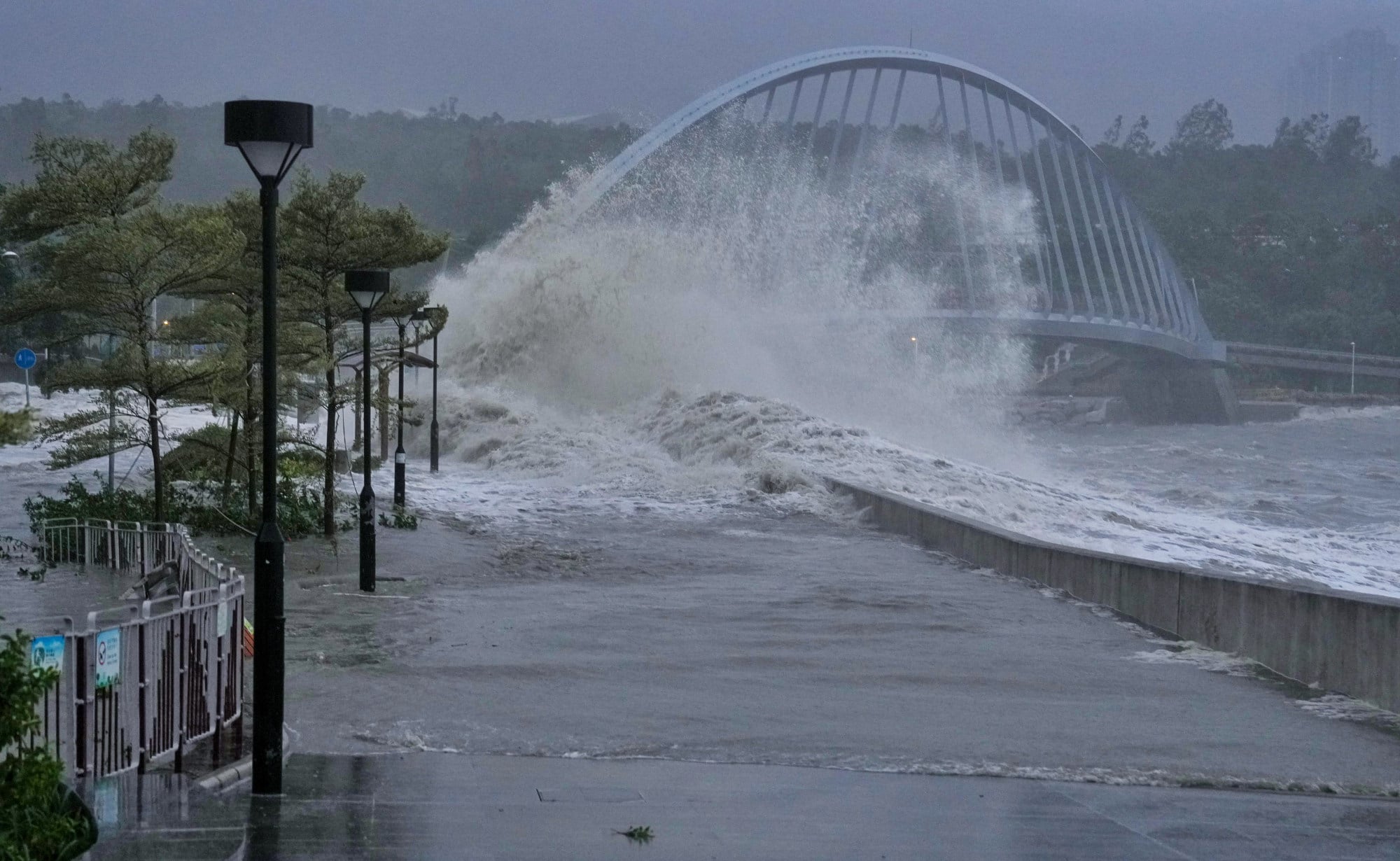
A paper submitted to the legislature by the Development Bureau in May suggested that larger foundations could be built for new wave walls and that their height should be increased as needed to cope with climate change.
The paper projected that by 2050, the rise in sea levels would range from 0.20 metres to 0.23 metres, depending on whether greenhouse emissions ranged from intermediate to very high.
Paul Chan Yuen-king, president of the Hong Kong Institute of Landscape Architects, said the city could have more public spaces equipped with water retention capacity.
He cited the example of swales – sunken areas that can store water on rainy days and act as community facilities on sunny ones – noting that it was a quicker and cheaper option than building underground stormwater storage facilities.
He said it took billions of Hong Kong dollars and a decade to build one underground stormwater storage facility with a 50,000 cubic metre (1.76 million cubic foot) capacity, while a one-hectare (2.5-acre) vegetated swale could store 10,000 cubic metres of water, for less than one-tenth of the facility’s cost and time.
“The city has around 2,000 hectares of urban parks. Many are old with mediocre facilities. We propose enhancing 5 per cent of that and incorporating such elements into it,” he said.
According to authorities, a Port Works Design Manual published by the Civil Engineering and Development Department provides general technical and application guidance for professionals engaged in the design, construction and maintenance of port structures in the city. -- SOUTH CHINA MORNING POST