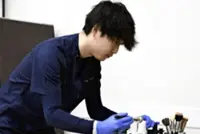
TOKYO (The Japan News/ANN): Embalming, the process of preserving a dead body, is becoming a more common practice in Japan.
The procedure uses a combination of disinfection, preservation and cosmetic restoration, offering families one more opportunity to see their loved ones as they were in life.
“It is our duty to restore the deceased’s likeness,” said Yoshihiro Naoshima, a 33-year-old embalmer at Hokuriku Embalming Service in Kanazawa, who has handled around 1,500 cases.
While Naoshima was in his final year of high school, his father, 42, died suddenly from an aortic dissection. This tragedy ultimately spurred his decision to enter the funeral industry.
Unable to accept the reality of his father’s death, he had found solace in a funeral home employee who took the time to listen to him talk about his father. The experience left a lasting impression on him, and he realised that being involved in funerals meant supporting people emotionally and spiritually.
He joined a funeral company in Osaka at the age of 23.
An experience that left a big impression on Naoshima as an embalmer was the case of a mother of two who died after being hit by a car. Her body was severely damaged, with multiple facial wounds and fractures. The father was reluctant to let his two young children see their mother in that condition.
Naoshima used cotton and other materials to restore the shape of her face. He sutured her wounds, making sure that the stitches could not be seen, and smoothed out the texture of her skin.
The father wept when he saw the body, telling Naoshima: “I’m so glad I can let my children see her. Thank you.”
The two children quietly placed letters addressed “To Mom” inside the casket.
This experience affirmed Naoshima in his role as an embalmer. “I have a responsibility to ensure that the bereaved have no regrets about their final farewell,” he said.
According to the International Funeral Science Association of Japan (IFSA), the number of embalming cases in Japan first exceeded 10,000 in fiscal year 2000, up from 191 in fiscalyear 1988 when the first facility was established. This increase was partly due to the attention embalming received after the 1995 Great Hanshin Earthquake.
The number surged to 53,041 in fiscal year 2020 amid the Covid-19 pandemic, as it helped prevent the transmission of viruses to family members. By fiscal year 2024, the number had further climbed to 82,068, and the number of facilities had increased from 48 to 90 in just 10 years.
However, there is a shortage of practising embalmers. To become certified, one must either attend a two-year vocational school and pass the IFSA certification exam or obtain a licence overseas.
As at April, the number of actively working embalmers stood at just 237, out of a total of 350 people who were certified. “Considering the number of (embalming) procedures, we ideally need twice as many people,” IFSA secretary-general Yuji Kato said.
Naoshima said: “Embalming allows the bereaved to say their final goodbyes to their heart’s content. It also helps people to cope with their sadness.”
According to the Health, Labour and Welfare Ministry, the number of deaths in Japan reached about 1.576 million in 2023, a 50 per cent increase over 20 years. In Ishikawa prefecture, the number of deaths followed this trend – rising from about 10,000 in 2003 to about 15,000 in 2023. -- THE JAPAN NEWS/ASIA NEWS NETWORK