BEIJING: US President Donald Trump’s free hand domestically and open admiration for Chinese President Xi Jinping could make him the wild card capable of shifting the relationship between the world’s two largest powers from rivalry to cooperation, American scholars have said.
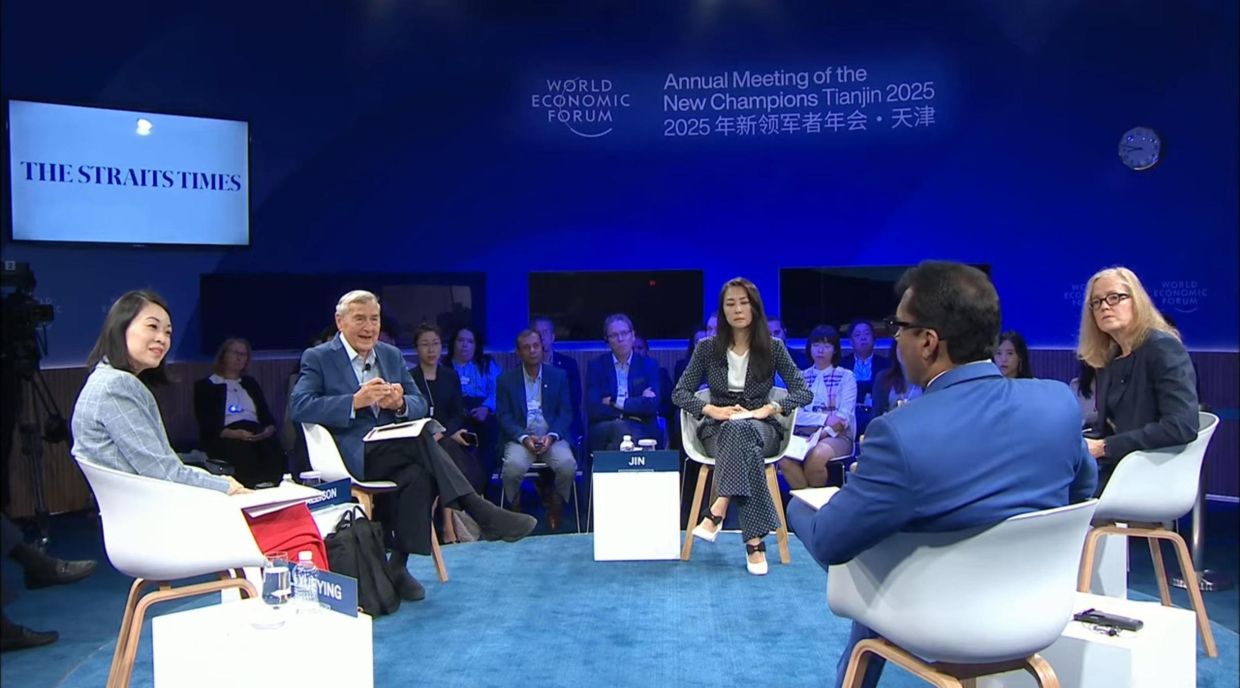
Speaking at a session developed in collaboration with The Straits Times at a World Economic Forum event in Tianjin on Thursday (June 26), Harvard professor Graham Allison pointed out that Trump is not a China hawk.
“If you look at the campaign last year, there were a thousand people running for office in the country in which 80 per cent of the people have a negative view of China,” he said, referring to the US general election in 2024.
“Only one person had positive things to say about China. This was Donald Trump.”
Prof Allison noted that Trump had said to Xi that when China and the United States work together, they can solve most of the world’s problems.
He said he believed that Trump is determined to be a “great deal maker” and a “great peacemaker”.
“If he is going to succeed in that mission, the opportunity for Trump and Xi to surprise us on the upside, I think, is enough to be hopeful,” said the national security analyst who has served under former US presidents Bill Clinton and Ronald Reagan.
Prof Allison’s optimism stands out in the current climate.
Since Trump began his second term in January, the US-China rivalry has intensified – most notably with the US’ imposition of unprecedentedly high tariffs on Chinese goods – leading many observers to take a pessimistic view of the world’s most consequential relationship.
His optimism is also striking, given that he is famous for popularising the “Thucydides Trap” – a concept that draws upon historical pattern to suggest that conflict becomes likely when an established power feels threatened by a rising power.
Another American scholar at the same session shared his optimism.
Professor Monica Toft of The Fletcher School of Law and Diplomacy said Trump has significant leeway to take a softer approach on China, given that most Americans are not interested in foreign policy and that Congress and the courts are unlikely to challenge him.
“If President Trump decided he could align US interests more closely with China – without giving away the store – he has both the prerogative and the opportunity to do that,” she said.
Prof Toft noted that global politics today is shaped by two strongmen – Trump and Xi – who share a personal rapport.
“They talk to one another, they respect one another, they admire one another,” she said. “It could be an extraordinary period for humanity if they can find a way to collaborate and coordinate on certain issues.”
Speaking at the same session, Professor Jin Keyu from the Hong Kong University of Science and Technology also saw bright spots in an otherwise gloomy picture of the US-China rivalry.
“I do not agree with the view that they are in a new Cold War,” she said.
She said while China and the US may be politically opposite and economically competitive, there is a need for them to cooperate to provide global public goods.
“There is space to collaborate, whether it’s on the risk of artificial intelligence, climate, data transparency, and so forth,” she said.
At the session titled “Geopolitics: An Unfolding Story”, moderated by ST Foreign Editor Li Xueying, the panel also discussed the erosion of the “nuclear taboo”, a normative belief that the use of nuclear weapons is unacceptable, even in situations where it might be strategically advantageous.
This concept was brought into sharp focus by recent conflicts. In June, the US and Israel attacked Iran to destroy its nuclear weapons development programme.
In 2022, Russia invaded Ukraine, which found itself less able to defend itself because it had given up its nuclear capabilities decades ago.
Professor Happymon Jacob, who teaches nuclear disarmament at the Jawaharlal Nehru University in India, pointed out that while the taboo against the use of nuclear weapons remains, the taboo against the possession of nuclear weapons appears to be collapsing.
“Ukrainians would say we made a mistake in giving up our nuclear weapons,” he said at the same panel. “The Russians will tell you that we have nuclear weapons, thousands of them. There is no way we are going to be defeated in this war.”
He noted how South Korea, faced with the threat of nuclear-armed North Korea, is also thinking about developing nuclear weapons. - The Straits Times/ANN