US President Donald Trump pushed back Wednesday on a new acronym making the Wall Street rounds to describe a way to profit from his fitful negotiating style, Taco, short for “Trump always chickens out”.
Trump, who was evidently not aware of the term when asked about it in the Oval Office by a reporter, responded with equal parts sarcasm and indignation.
The Taco trade refers to an investment strategy that benefits from the rise in share prices after the US president relents.
“Oh, isn’t that nice. I’ve never heard that,” he said, referring to the term first coined by a Financial Times columnist. “You mean because I reduced China from the 145 per cent that I said, down to 100, and then down to another number, and I said you have to open up your whole country?”
“And because I gave the European Union a 50 per cent tax tariff and they called up and they said, ‘Please let’s meet right now, please let’s meet right now,’” he added. “You call that chickening out?”
Trump then asked rhetorically whether it would be better if he instead maintained tariff levels “at a ridiculous high” like 145 per cent tariff imposed on China.
“We were doing no business because of the tariff, because it was so high. I knew that,” he said. “It’s called negotiation!”
The former real estate developer then offered evidence that his rapid-fire negotiating style – which has paralysed companies, stymied consumers and roiled global markets – was working.
He pointed to trillions of dollars in investments that countries in the Middle East pledged on his recent visit to that region.
As he has in the past, Trump slammed the reporter, Megan Casella of CNBC, who asked the question: “Don’t ever say what you said,” the former reality show host said. “That’s a nasty question. To me, that’s the nastiest question.”
Analysts said use of the acronym could backfire if the president, fearful of looking weak, maintains exorbitant tariffs with China and others without relenting, further destabilising the global economy.
“Because President Trump believes himself to be a singularly skilled deal maker, he is sensitive to any suggestion that foreign counterparts are outmanoeuvring, even manipulating him, especially when it comes from one of the constituencies to which he pays closest attention: analysts on Wall Street,” said Ali Wyne of the International Crisis Group, a Belgium-headquartered think tank.
“He does not want to be seen as bending to President Xi Jinping,” Wyne added. “Nor, however, does he want to face the political and economic fallout of an indefinite trade escalation with a strategic competitor that is far more capable of retaliating than when he first assumed the presidency.”
The publicity could also undercut Wall Street’s ability to profit on the “taco trade” as the stock-rebound pattern becomes more apparent. “The first rule of the taco trade is that you don’t tell Trump about the taco trade,” said Peter Berezin of BCA Research, a Canada-based market research company.
Investors have pointed to a pattern behind the Taco reference.
Trump imposed “reciprocal” tariffs on dozens of countries of up to 50 per cent on April 2, which he dubbed “Liberation Day”, before announcing a 90-day reprieve a week later during which the tariffs would be lowered to 10 per cent.
He hit Chinese imports with successive waves of tariffs in April that eventually reached 145 per cent – prompting Beijing to respond with " title="" target="_self">125 per cent levies of its own – before dropping them to 30 per cent
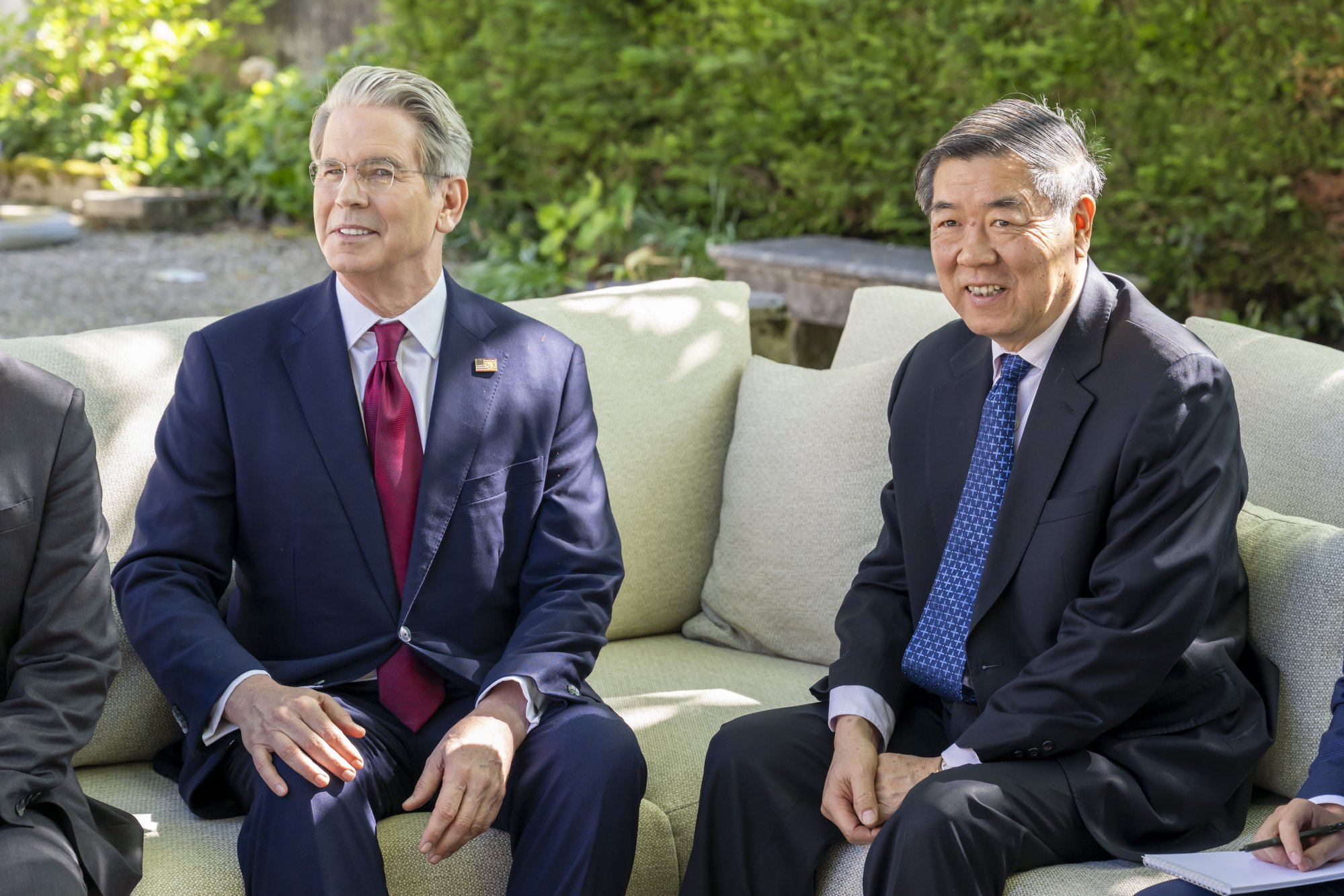
Even before US Treasury Secretary Scott Bessent and Chinese Vice-Premier He Lifeng sat down in Geneva to negotiate a tariff truce between their countries on May 10 and 11, Trump signalled he would accept a much lower level, indicating that 80 per cent “seems right”, leading analysts to suggest he was negotiating against himself.
On Canadian goods, he threatened to impose 25 per cent tariffs, including on steel and aluminium, before announcing a one-month pause.
And last week, he threatened to impose a 50 per cent tariff on the EU starting in June before announcing days later that he planned to delay the taxes until July 9, giving more time for the two sides to negotiate.
“These retreats are so frequent that investors should rationally expect them,” wrote Paul Donovan of UBS, a Switzerland-based bank, as stocks in Europe jumped on Monday.
Tuesday, with US markets open again after a holiday, the S&P 500 saw its biggest increase in weeks, prompting Chris Beauchamp of IG Group, an online trading company, to observe: “Taco trade triumphs once again.”
Later on Wednesday after the Oval Office press conference, Trump reflected on the EU tariffs.
“They will say, ‘Oh he was chicken, he was chicken, that’s so unbelievable,’” the president said. “I usually have the opposite problem. They say I am too tough.”
Trump administration officials have framed his mercurial approach as a way to maximise leverage and force other countries to come to the negotiating table.
But as the taco comment suggests, some investors have started to expect the president to back down on his more significant threats.
Speaking later on CNBC, Casella said “Wall Street loves an acronym”, adding that “the idea here is just that, yes, the markets will go down when he makes a threat, only to rebound, often even higher, once the threat is off the table”.
As for Trump calling her question “nasty”, Casella said it was “a badge of honour, I guess”. - South China Morning Post