
SINGAPORE: Over a bowl of Teochew fishball noodles, PAP candidate Daniel Liu is getting an impromptu language lesson from a senior volunteer. She tells Liu, 40, who is Hokkien by descent, that while Teochew might sound like Hokkien, it has a lighter intonation – the kind you might hear on an opera stage.
Liu spent over a decade serving in Nee Soon GRC, where Hokkien is the go-to dialect at temple dinners and grassroots events.
But since his move to Aljunied GRC in February 2025 – where Teochew is more commonly spoken – he has been racing to pick up the basics of the dialect. With Polling Day on May 3 fast approaching, he knows he has a short runway to get up to speed and speak to residents in the dialect that resonates most.
His senior volunteer, however, has a teaching trick up her sleeve.
Lately, as Liu makes his rounds at the food centre at Blk 105 Hougang Avenue 1, he has been caught off guard by store owners calling him “dua gu” before chatting with him in Teochew. “Dua gu” means “big cow” – a Teochew translation of the Mandarin term “da niu”, which sounds like his name, Daniel. Given his albinism, dialect banter is something he rarely encounters.
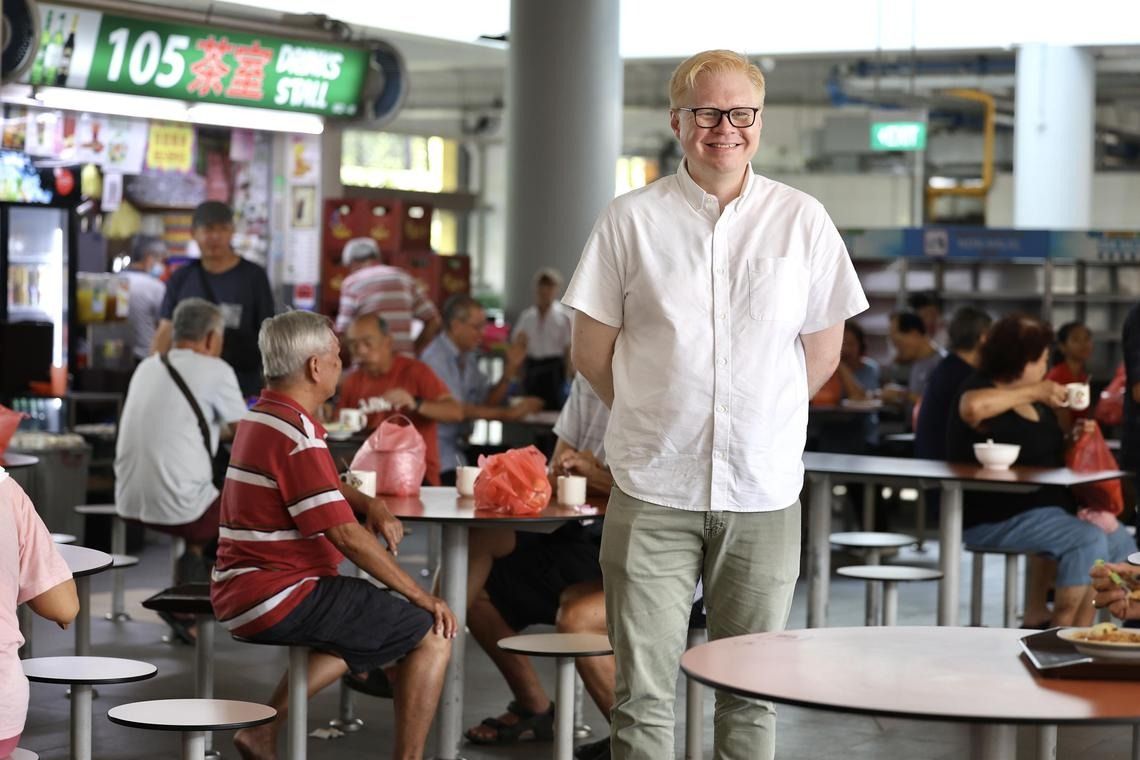
It turns out that his senior volunteer had prepped the store owners, pulling an old trick in language learning: total immersion, Hougang style.
Liu – who has been sharing snippets of his dialect-learning journey on social media – tells The Straits Times not to expect a full-blown speech in Teochew from him any time soon. But as a new face on the ground, he has found that speaking the dialect helps him connect with some residents: “Sometimes it allows them to open up a bit more.”
Since the introduction of the Speak Mandarin Campaign in 1979, Chinese dialects have been discouraged in public life. They make a comeback only on three occasions – a public health crisis, a campaign targeted at seniors and during a general election.
Yet, as Mandarin becomes the lingua franca among Chinese Singaporeans and English the common language of citizens across races, one question lingers: Does it matter to Singaporeans that their politicians try to speak and connect with them in Hokkien, Teochew, Cantonese, Hakka, Mandarin, Malay or Tamil?
Liu is not the only politician making overtures to his constituents in dialect.
On Nomination Day, both WP incumbent Dennis Tan and PAP candidate Marshall Lim opened their remarks to Hougang SMC residents not in one of Singapore’s official languages, but in Teochew.
It was a nod to the strong Teochew roots in the area – and, for the WP, a tribute to the fiery Teochew orator and former party chief Low Thia Khiang, who was the long-time Hougang MP from 1991 to 2011.
Hokkien coach K.C. Tan, who previously taught the dialect at community centres, says that language learning requires long-term investment and that preparation for this election would have happened before the hustings.
When teaching Hokkien for daily use, he makes a distinction between the classical form and a more colloquial version. The latter resonates better with seniors and is more relatable on the ground, he says.
Veteran Teochew radio newscaster Lim Ngian Tiong, who teaches the dialect at the Teochew Poit Ip Huay Kuan, has young students but is not convinced that dialect-speaking politicians can sway young voters.
“The roots of the language are not deep enough,” he says.
Still, for some young voters, hearing familiar dialects on the campaign trail strikes a chord.
Many grew up with dialect-speaking grandparents, and that nostalgic connection can be powerful. To them, it is more than just words – it is a bridge across generations and a sign of authenticity that builds trust.
PAP’s Liu says that his generation missed the boat for the current surge in interest in learning dialects.
“I think there’s a real big renaissance in dialects... A lot of my volunteers who are younger can speak dialect very, very fluently,” he says, adding that he could possibly “get the younger ones to teach me”.
For Ben Tan, a soon-to-be undergraduate who grew up in a Cantonese-speaking household and founded the group Singapore Dialects, a recent lively exchange in Parliament hit close to home and struck a chord.
During a spirited debate in March, Manpower Minister Tan See Leng surprised the chamber by switching to Cantonese in response to Non-Constituency MP Leong Mun Wai’s persistent grilling on underemployment and the transparency of employment statistics.
Quoting several lines from the 2004 Andy Lau film Blood Brothers, Tan cheekily conveyed his exasperation at having to repeat himself, sparking laughter and a lively buzz both in the chamber and online.
The episode also reignited conversation about the role of dialects in Parliament – and when, if ever, they should take the spotlight. In response, Leong offered a rejoinder to the minister in Cantonese.
Living with his family in Nee Soon GRC, Ben Tan was surprised to hear the moving vehicles broadcasting political messages not only in the official languages but also in Hokkien, Teochew and Cantonese during campaigning.
“To the younger generation, it’s interesting because we seldom hear dialects broadcast in the open. It highlights the fact that dialects are still relevant.”
In response to ST’s query, PSP said that “we are able to reach out to voters in different languages and dialects”, citing party chairman Tan Cheng Bock as a “seasoned campaigner in Hokkien” and Wendy Low and Stephanie Tan as conversant in Cantonese.
One 24-year-old voter spotted at One Punggol – who declined to reveal his name – was impressed by WP Punggol candidate Harpreet Singh’s Teochew, and his stories of growing up in a Teochew-speaking kampung at Hougang “lark kok jio”, or sixth milestone.
The pre-enlistee, who grew up speaking Hokkien to his grandmother, says: “Being able to speak dialects means something to me as somebody who works in the active ageing sector. It is the first step of building rapport with my clientele and the demographic that I work with.”
He believes that dialects still appeal to the young, “especially if someone speaks with a lot of vigour and conviction”.
For PAP’s Jalan Besar candidate Josephine Teo, who is also Minister for Digital Development and Information, her fluency in multiple languages and dialects including Cantonese, Hakka and Hokkien is a big advantage in the Kreta Ayer-Kim Seng ward.
She spoke Hakka with her grandmother, learnt Cantonese from Hong Kong drama serials, and eventually married a Hokkien man. She says: “If Hakka is the language of my values, Cantonese is the language of my aspirations.”
She sings a Cantonese theme song by the late Hong Kong singer Roman Tam for a wuxia drama series, which she says helped teach her “what a good person is and what righteousness is”.
Teo fondly recalls the unique Hakka phrases she learnt growing up, including “tai ong pong” (big fool), “see luke foh” (irrational person) and “mm foon siang” (muddle-headed). The expressions reflect a dialect rooted in rationality, she says.
After Budget 2025, she made videos explaining the highlights of the Budget in Cantonese and Hakka to reach out to senior residents. She also fronted a video in Cantonese encouraging seniors to get vaccinated against Covid-19 in 2020.
For residents like 79-year-old Quek Swee Huat, who speaks only Hokkien, a polyglot candidate like Teo is not just nice to have – it is essential.
The Jalan Besar GRC voter says: “I can only understand it if she speaks in Hokkien. Many of us who did not go to school would not be able to understand Mandarin. Her Hokkien is very good.”
For others, like 77-year-old Lee, a Teochew retiree and Hougang SMC voter, dialect is not a dealbreaker.
“I don’t think not speaking dialect is a disadvantage in this age, although it’s true that speaking Teochew will give a sense of closeness. But most Chinese people can speak Mandarin now.”
During the annual debate on ministry budgets in 2023, Hougang MP Mr Tan raised a question: Were there plans to allow the use of Chinese dialects and encourage younger people to speak them?
Echoing this call, WP youth wing executive committee member Kelvin Yap penned an article in party newsletter The Hammer. He argued that “policy should be geared towards removing the stigma that dialect carries from the Speak Mandarin Campaign while creating space for more exposure to dialect”.
This focus on language diversity has taken centre stage in the run-up to GE2025.
PAP’s Sengkang GRC candidate Bernadette Giam’s short Tamil address on Nomination Day drew praise from Home Affairs and Law Minister K. Shanmugam, who said “many Tamils are both proud and gobsmacked” by her effort. Singapore Democratic Party chairman Paul Tambyah also impressed by speaking in Mandarin to reporters.
Of course, it is also a longstanding tradition for major party leaders and candidates, especially those from the PAP and WP, to use Malay words or spend a few minutes addressing crowds in the language at rallies.
Heritage consultant and researcher Lynn Wong says: “I do like seeing how multiple languages and dialects are used with gusto by politicians of different age groups to arouse sentiments. (It is) a reflection of our multicultural fabric.” - The Straits Times/ANN