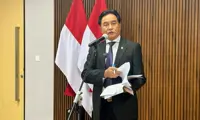
JAKARTA: The Social Affairs Ministry is considering a controversial proposal by West Java Governor Dedi Mulyadi to make vasectomy a requirement for individuals seeking government assistance and scholarships.
A vasectomy is a procedure in which a man’s tubes that carry sperm are cut or blocked to prevent pregnancy, effectively making a man sterile. It is considered a permanent form of birth control, although in some cases, it can be reversed through another surgical procedure, though success rates for reversal are not guaranteed.
"Integrating family planning in the government assistance programme is a good idea, but we still need time to study the proposal in detail. There’s a set process for distributing government aid, and we can’t change it on a whim," Social Affairs Minister Saifullah Yusuf said on Wednesday (April 30), as reported by Kompas.
Dedi recently proposed the idea to Saifullah, highlighting that many underprivileged families have numerous children despite struggling to provide for their basic needs.
"I met a child selling cakes at a town square in Majalengka Regency. When I spoke to his father, he was unemployed, had 10 children and his wife was pregnant with their eleventh," he said on Monday. "[...] If they can't provide a decent standard of living for their children, they should stop having more," he added.
Dedi further stated that limiting the number of children among underprivileged individuals would help ensure that government assistance is distributed more equitably, rather than being concentrated on families with many children.
“We want all government assistance to be tied to family planning. If your children want to apply for a government-funded scholarship, you must be using contraception. To qualify for housing repair subsidies, you must also practise family planning if you are of reproductive age,” he said.
He also argued that vasectomy would be an ideal form of contraception for underprivileged families, explaining that "men should also bear responsibility for reproduction," and that women sometimes forget to take their contraceptive pills.
Dedi also announced that men who agree to undergo a vasectomy would receive an incentive of Rp 500,000 per person.
However, Abdul Haris, the Deputy Head of the National Commission on Human Rights (Komnas HAM), criticised the proposal, calling it discriminatory and a potential violation of human rights.
"Requiring a vasectomy to qualify for government assistance is overly burdensome for underprivileged families. If the government enforces this policy, it could infringe upon human rights. Vasectomy should be a voluntary decision," he said on Thursday as quoted by Tempo.
The Indonesian Ulema Council (MUI) has issued a statement declaring vasectomy haram (forbidden) for Muslims if the intention is to permanently sterilise a man.
"It is only allowed under very strict conditions, such as when an individual has a specific medical condition. Even then, there must be a guarantee that the man can regain his reproductive capacity," said Asrorin Niam Sholeh, Head of the MUI Fatwa Committee, on Thursday.
"However, since at the moment vasectomy reversal surgery cannot fully guarantee the restoration of a man's reproductive function, it remains haram," he added.
Success rates for vasectomy reversal can vary, with studies suggesting that sperm return to semen in 70 per cent to 90 per cent of cases.
Factors such as the time since the procedure, scar tissue and the surgeon’s skill can all affect the success rates.
Asrorin said the government must be objective and transparent in educating the public about vasectomy, including the risks and expensive reversal procedure.
He also remarked that contraception should not be used to permanently prevent individuals from having children. - The Jakarta Post/ANN