
JAKARTA: In a dark stable under a heaving highway in Indonesia’s capital, trucks rumble past emaciated carriage horses tied to pillars in ramshackle wooden stalls, their ribs protruding.
The steeds are used to pull traditional wooden carriages known as delman, once a staple of colonial-era transportation, but now fading from view in Jakarta in an era dominated by ride-hailing apps.
Now limited to just a few areas of the city, only several hundred delman horses remain to ferry tourists on weekends or public holidays.
Animal rights activists say the conditions under which the horses are kept are harsh, and that the practice must end.
“Thank God, in here, at least the horses are protected from the sun’s heat and rain,” 52-year-old carriage driver Sutomo said under the highway.
On central Jakarta’s bustling streets, horse-drawn carriage bells can be heard clinking in rhythm with clopping hooves that compete with the blare of car engines and horns.
But Sutomo says a 4.5km jaunt around Indonesia’s national monument, or Monas, can fetch just 50,000 rupiah (US$3.07) – a trip he makes only two or three times a day.
“When income is low, my son, who works at a company, shares some of his salary. Thank God at least that can cover food for my family. But for the horse, we have to reduce its food,” he said.
Rights groups say such limited income has forced owners and some who rent the horses to ignore proper horse care, leading to malnutrition and poor living conditions.
There are about 200 carthorses still in service at around 20 stables, according to estimates, including one squalid encampment holding 15 horses. It was surrounded by garbage and plastic debris next to a smelly, polluted river.
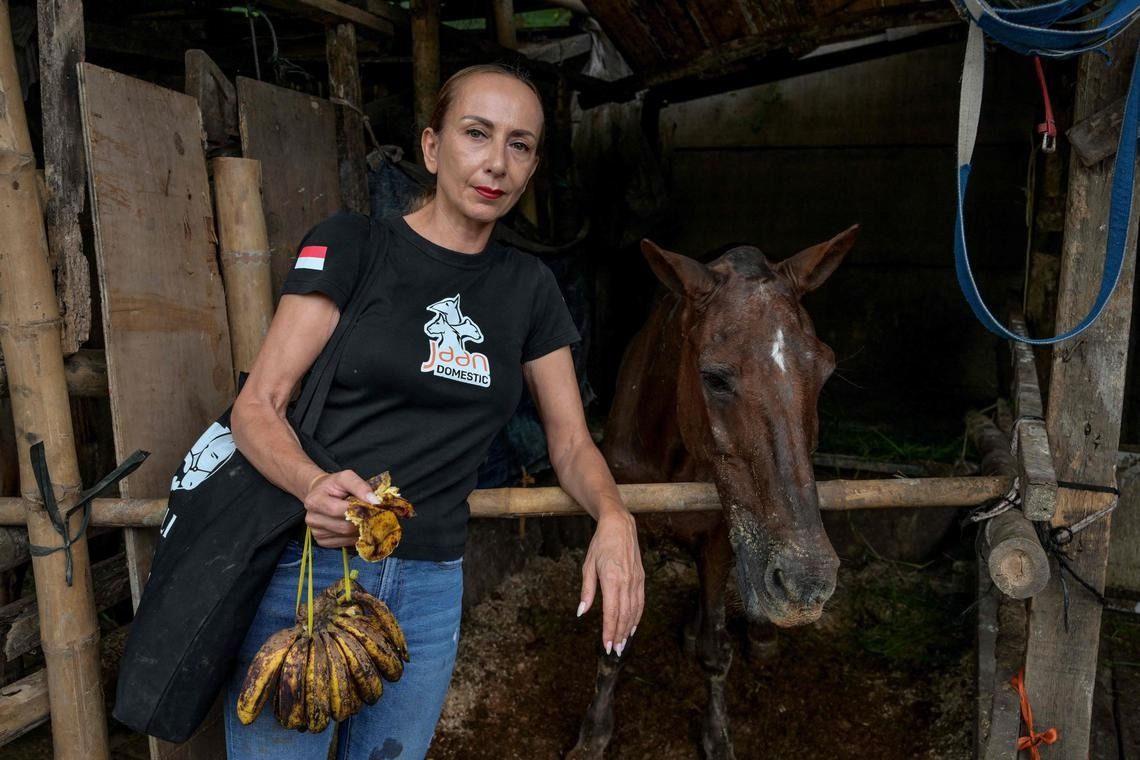
“The conditions are really, really bad,” said Karin Franken, co-founder of Jakarta Animal Aid Network (Jaan), a non-governmental organisation that has been advocating for delman horses since 2014.
“They are not treating the horses very well (but) very aggressively, very rough.”
‘Extreme abuse, neglect’
To a tourist’s eye, the delman can appear as a colourful addition to the city, adorned by decorations and small bells that jingle when the horse moves.
But some owners still rely on harmful traditional medications, including puncturing the horse’s muscles with bamboo sticks to pass a rope through to “cleanse” its blood.
During the Covid-19 pandemic, some horses also died of starvation, said Franken, calling for the delman to be gradually phased out.
“The life as a delman horse, especially in Jakarta, is really terrible,” she said.
While there is a national law on animal protection, there is little monitoring of violations, according to Jaan.
The local government said it remained committed to animal welfare but needed more help.
“We need support from other parties... to be able to provide services such as free medical check-ups,” said Suharini Eliawati, head of the Jakarta Food Security, Maritime and Agriculture Agency.
“The owners must obey the rules in animal welfare protection.”
Franken said Jaan also tries to educate the delman workers on how to provide better treatment for the horses, in exchange for free medical care for the animals.
But many people do not comply on grounds of tradition or financial issues.
“They can barely take care of themselves and their families, let alone horses. It’s very sad for both,” Franken said.
“There still are, unfortunately, cases of extreme abuse or neglect.”
Young delman drivers are open to moving to other jobs like ride-hailing motor-taxi drivers, but older ones are more stubborn “because they say it’s the only thing they can do”, said Franken.
Some are likely to keep trying to make a penny, despite pushing their equine breadwinners to the brink.
“I like animals. I also like this job,” said delman owner Novan Yuge Prihatmoko, as he guided his horse through West Jakarta, adding that he can earn 150,000 rupiah a day.
“I feel comfortable, so why not? I just keep doing this for a living.” - AFP