




US President Joe Biden defended his recent description of Chinese President Xi Jinping as a “dictator” on Thursday during a joint press conference with Indian Prime Minister Narendra Modi, whose track record on human rights and press freedom has made some in Biden’s Democratic Party uneasy.
Biden said the “idea of my choosing and avoiding saying what I think is the facts with regard to [our] relationship with India, with China, is not something I’m going to change very much”.
The American president said pointed public comments about the Chinese leader have not undermined progress made by US Secretary of State Antony Blinken following a recent meeting with Xi and other senior Chinese officials in Beijing.
Do you have questions about the biggest topics and trends from around the world? Get the answers with SCMP Knowledge, our new platform of curated content with explainers, FAQs, analyses and infographics brought to you by our award-winning team.
Biden said Blinken had “had a great trip to China”, adding that he himself expected to meet Xi “sometime in the future, the near term”.
Biden believed his remarks had not “had any real consequence”, he continued, and described a perceived collapse of US relations with China as “hysteria”.
“We had an incident that caused some confusion,” Biden said, referring to the downing of a suspected Chinese spy balloon over American territory in February.
On Tuesday, Biden during a campaign stop in California called Xi a “dictator” and China a country with “real economic difficulties”.
China condemned the US president’s characterisation of the Chinese leader as “erroneous, absurd and irresponsible”.
Later, when asked to square his statement about Xi with his silence on Modi and India’s treatment of religious minorities and crackdown on dissent, Biden said one of the “fundamental reasons” that US-China relations were not in the same space as US-India relations was that “we’re both democracies”.
“It’s the common democratic character,” Biden said.
White House says invitation to Modi ‘is not about sending a message to China’
“We believe in the dignity of every citizen, and it is in America’s DNA. And I believe it is in India’s DNA,” he added.
But advocacy groups have voiced concerns about the persecution of minorities in India as well as the suppression of critical voices and journalists under Modi’s Hindu-nationalist government.
A report this year by Freedom House, a US government-funded non-profit organisation, described India as “partly free” for the third consecutive year. It said “democratic rights in India remain under pressure, particularly for marginalised groups”.
In January, Modi’s government banned a BBC documentary on communal riots that erupted in 2002 while Modi served as the chief minister of the Indian state of Gujarat.
The Indian foreign ministry condemned it as a “propaganda piece, designed to push a particular discredited narrative”.
Former US President Barack Obama in a recent interview observed that the protection of Muslim minority in Hindu-majority India was “worth mentioning”.
If he were meeting Modi, Obama said, he would assert that not ensuring the rights of minorities would eventually prove “contrary to India’s interests”.
More than 70 Democratic lawmakers on Tuesday wrote to Biden urging him to take up human rights concerns with Modi.
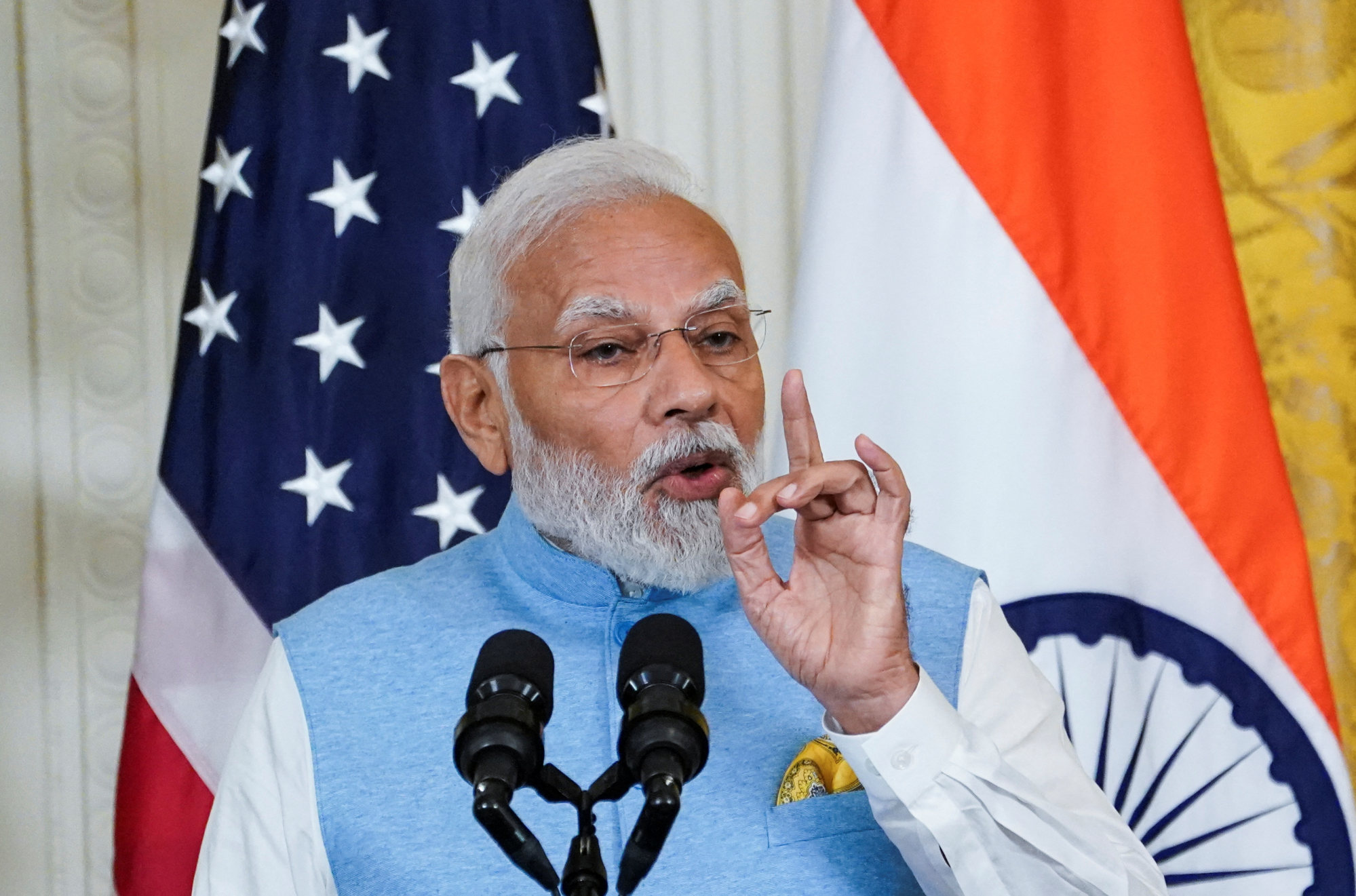
Modi, who has not held a single press conference since he became prime minister in 2014, took a question from an American journalist on Thursday during the briefing with Biden.
Rejecting concerns about human rights issues in India, he said there was “absolutely no place for discrimination on the basis of religion, caste or creed” and that the country had proved that “democracies can deliver”.
The US-India partnership would be “grounded in respect for human rights, and shared principles of democracy, freedom, and the rule of law”, according to a joint White House statement.
Visiting the US on a state visit from June 22 to 24, Modi received a 19-gun salute during a lavish welcome ceremony on Thursday. The White House event was attended by more than 7,000 people, including some 3,000 people of Indian descent.
India’s Gandhi takes a swipe at ‘nasty’ Modi in US for his ‘not Indian values’
Both leaders addressed the attendees, each vowing to bolster US-India ties during a time altered by the coronavirus pandemic.
“The challenges and opportunities facing the world in this century require that India and the United States work and lead together,” Biden said. “And we are.”
Biden added that the partnership with India had “invigorated and elevated” the US-led Quadrilateral Security Dialogue, a four-nation grouping that includes Japan and Australia and functions as a counterweight to China’s rising clout in the Indo-Pacific.
Without naming China, the joint statement on Thursday said Biden and Modi during their bilateral meeting had “expressed concern over coercive actions and rising tensions, and strongly oppose destabilising or unilateral actions that seek to change the status quo by force” in the region.
The two “emphasised the importance of adherence to international law”, particularly as reflected in the United Nations Convention on the Law of the Sea, and the maintenance of freedom of navigation and overflight, including in the East and South China seas, according to the statement.
The announcements made on Thursday spanned the seas and the stars, from semiconductors to critical minerals and from defence to the World Trade Organization.
US-based General Electric will jointly produce F414 jet engines with India’s Hindustan Aeronautics. It marks a greater transfer of American jet engine technology to a non-treaty ally than ever before. India will also buy 31 MQ-9B drones worth US$3 billion.
“The decision taken by General Electric to manufacture engines in India through transfer of technology is a landmark agreement,” Modi said at the press conference.
The move “opens up new job opportunities in both countries” and would “give our defence cooperation a new character in the times to come”, he added.
This year US and Indian space agencies will develop a strategic framework for human space flight cooperation. The two sides have further agreed to a joint mission to the International Space Station in 2024. In addition, New Delhi will join the Artemis Accords, a US-led effort to return humans to the moon by 2025.
Another key agreement will allow US Navy ships operating across theatres to service and undergo major repairs in Indian shipyards.
On the tech front, American chip maker Micron Technology will set up a US$2.75 billion semiconductor assembly and test facility in India.
US regional strategy is an ocean short compared with China, critics say
The facility follows the launch in May last year of a US-India initiative on critical and emerging technology to deepen cooperation in artificial intelligence, quantum computing, semiconductors and wireless telecommunications.
The development comes less than a month after China imposed restrictions on Micron, saying the American chip maker failed a review by Beijing’s cybersecurity authorities.
It also transpires amid fierce competition between Beijing and Washington for supremacy in advanced semiconductor technology. Micron was blocked from key infrastructure projects in apparent retaliation for Biden’s ban on the export of cutting-edge semiconductor technology to China.
Meanwhile, the office of the US Trade Representative announced on Thursday that Washington and New Delhi had agreed to terminate six outstanding disputes at the WTO. India will also remove retaliatory tariffs on certain US products such as chickpeas, lentils and almonds.
In releasing Biden’s green-energy transition goals and reducing reliance on China for critical minerals used in batteries that power electric vehicles, Washington will support New Delhi’s membership in a US-led mineral security partnership meant to strengthen critical minerals supply chains.
India gets a ‘free pass’ on rights concerns as US-China rivalry deepens
Other members of the grouping are Australia, Britain, Canada, Finland, France, Germany, Japan, South Korea, Sweden and the European Commission.
“We have also decided that in the midst of global uncertainties, India and America will, as trusted partners, create reliable, secure, and resilient global supply chains and value chains,” Modi said.
Later in the evening, the Indian leader addressed a joint session of the US Congress. At least four Democratic lawmakers boycotted his speech, urging others to do the same and “stand up for human rights”.
The day culminated in a formal state dinner for Modi at the White House, with all senior Biden administration officials slated to attend.
More from South China Morning Post:
- With China in mind, Biden and Modi to seal deals from space to chips, 5G to critical minerals
- India’s ‘topmost priority is peace’, Modi says in US of Russia-Ukraine war stance
- India revives debate over Modi promise to replace religion-based laws ahead of 2024 polls
- US nears deal to build fighter jet engines in India ahead of Modi’s White House trip
For the latest news from the South China Morning Post download our mobile app. Copyright 2023.
Already a subscriber? Log in
Get 20% OFF The Star Digital Access
Cancel anytime. Ad-free. Unlimited access with perks.


