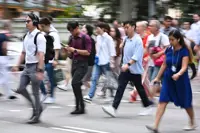
ONE in every two employees in the city-state has been grappling with longer working hours since the Covid-19 pandemic started two years ago.
And a third of those who work overtime put in more than two extra hours a day, a study commissioned by The Straits Times has found.
The top reasons for the extended hours are difficulties drawing boundaries with work-from-home arrangements, increased tasks such as more paperwork, and covering for colleagues who have quit.
But labour experts point out that even though people reported spending more time at work, their actual workload may not have changed much.
Instead, those who work from home may have to juggle personal commitments such as looking after their children during regular work hours, they add.
Dr David Leong, managing director of human resource firm PeopleWorldwide Consulting, said: “Under such contexts, workers can be stressed and therefore deem that they spent more time at work.”
He said some staff also had to take on more responsibilities, with their firms letting go of people amid an uncertain economic outlook.
The poll was conducted this month to get an idea of the amount of time that employees devote to work daily after the pandemic hit Singapore.
The findings are not surprising, observers said. Overseas, studies have found that Covid-19 has disrupted job schedules, with people more likely to work on weekends and outside the nine-to-five hours.
National University of Singapore senior economics lecturer Kelvin Seah said: “Under the traditional work-from-office arrangement, it is easier to disconnect from work at the end of the day.
“People don’t feel like they need to check and respond to e-mails or attend any more meetings. But with work-from-home arrangements, the line between work and home is blurred.”
A third – 33% – of employees who clock in more time during the pandemic spend at least 10 hours a day at work, the survey revealed. This is up from 8% before the pandemic.
Fifty-nine per cent of professionals, managers, executives and technicians log longer hours, versus 37% of non-PMETS.
The poll, by consumer research firm Milieu Insight, surveyed 1,076 workers. Overall, 84% chalk up seven or more hours daily.
Observers gave mixed reactions when asked if staff would continue to put in more work hours this year.
Some felt employers were paying more attention to work-life balance, while others said employees might still have to cope with longer hours with hybrid work arrangements being the norm.
ManpowerGroup Singapore country manager Linda Teo said: “What we have learnt from working through the pandemic is that we need to spend time preparing for different scenarios... and figuring out how to continue thriving amid the fluid business situation.”
The mental health of workers was a concern, she added, especially with the end of the pandemic being nowhere in sight.
“Employees are increasingly getting burnt out,” she said.
Nearly half the workers – 49% – feel the amount of time they spend at work is too much.
Business manager James Ong, who has been working from home, puts in 11 hours of work a day, up from nine hours previously. But he attributes that to the flexibility given by his firm to attend to family matters during regular work hours.
“There is an understanding that people have responsibilities outside of work,” said the 36-year-old, who took turns with his wife to look after their two kids when schools switched to home-based learning.
“Some may have to hold their child during online meetings; others may need to settle urgent matters first and get back to work later.
“It is all part of the new normal.” — The Straits Times/ANN
Already a subscriber? Log in
Get 20% OFF The Star Digital Access
Cancel anytime. Ad-free. Unlimited access with perks.