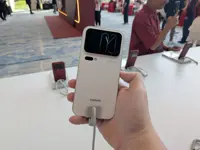
BERLIN: Wait, does that iPhone have a ... screen on the back, too?
Xiaomi, the Chinese manufacturer known for its cheeky copies of Apple features, is launching the Xiaomi 18 Pro, a phone that looks like a two-screened iPhone you've never seen before.
This latest flagship has a fun party trick. While taking photos on what is probably one of this year's best cameras on a mid-sized smartphone, you can see yourself in a small display on the back of the phone.
It might feel like a gimmick, but at the very least the screen lets you keep your phone turned face down on a desk to avoid distractions, while you still keep an eye on the time, the weather or your calendar.
It's also handy for face-to-face translation. Xiaomi's AI translation app will transcribe what you're saying and put an instant translation on the rear screen for someone else to read.
The second screen is also a quiet move to replace the iPhone as the default for content creators: Anyone who wants to film themselves with high-end smartphone cameras while seeing themselves will be interested in this phone.
A screen that blocks nosy neighbours
There's another curious feature in this phone, a so-called privacy display, which makes it difficult for someone sitting beside you on a bus or plane to read what's on your phone.
The impressive thing is that you can turn this feature on for specific apps, like chat or banking apps. Xiaomi does this by deactivating certain pixels in the display so that the screen is much darker when seen from the side.
In a further privacy feature, the phone uses its selfie camera to check if someone behind you is looking at the screen and gives you a notification when it spots prying eyes.
Features like this feel like a privacy win, but the feeling is dulled somewhat when you are confronted with the deluge of pre-installed Xiaomi bloatware apps that ask for your data.
Tap "Agree" to Xiaomi's prompt to "Enjoy a better lock screen" and you'll soon unlock your phone to a feed of ads and online content that feels at least partially AI-generated.
A stellar camera
Whatever you think of the privacy display and the rear screen, the real reason to buy this phone is the camera.
Two massive 200-megapixel lenses (a zoom and a main shooter) backed up by a 50-megapixel ultra-wide deliver impressive sharpness and light balance, even when zooming on distant landscapes.
Built-in AI features do much of the work here, and also let you make edits like deblurring and deleting unwanted details in the background.
Meanwhile Xiaomi's addition of a new AI button on the phone seems promising, especially at a time when AI is creeping deeper into many people's everyday routines.
In practice, however, it's quite limited at launch, only giving you the choice of transcribing notes or translating a conversation – both only in Xiaomi apps.
Alternatively you can toggle silent and do not disturb modes, or turn on the privacy display. For asking a chatbot a question, you can still hold the lock button, like on most other phones. We can only hope Xiaomi makes the AI button more useful with updates.
Can it beat an iPhone 18 Pro?
What about integration into Apple's ecosystem? The appeal of having a smartphone that seamlessly connects to your other Apple devices is a major draw for the iPhone. But even here, Xiaomi is doing its best to give users signature iOS features.
Tap your Xiaomi against an iPhone, and you'll instantly be able to share files, just like with AirDrop.
Xiaomi's 18 Pro also has its own version of Apple's Liquid Glass design, screen mirroring on Apple devices, the iPhone's double or triple back tap to launch certain features, AI tools mirroring Apple Intelligence's Writing Tools... the list goes on.
However: The MagSafe magnetic rear, 3D face scanning for more security when unlocking, Emergency SOS and a LiDAR scanner - these are a few of the features that Xiaomi hasn't yet been able to copy onto its phone.
Xiaomi's camera and hardware are certainly in the same league as Apple, while the privacy display and rear screen are either nifty additions or gimmicky, depending on your view.
Ultimately, the phone manages a compromise between both worlds – once again doing its best to limit iPhone envy in Android users.
Colour options and price
In terms of hardware, Xiaomi's phone feels made for people who like to compare specs and pick the phone with the highest numbers.
Expect a crisp bright display (120-Hz LTPO AMOLED with 4,000 nits brightness), fast unlocking (ultrasonic fingerprint reader), smooth processing (Snapdragon 8 Elite Gen 6 with 12GB of RAM), heavy-duty dust and splash protection (IP68) and a massive 6,000-mAh battery that can be rapidly recharged with 90W.
The Xiaomi 18 Pro is available in four colour options – red, black, white and blue – with a hefty starting price tag of €1,399 in Europe (RM4,799 in Malaysia). You can pay more (RM5,299) to double up storage to 512GB.
Xiaomi is also offering a bigger version, the 18 Pro Max, with a larger battery, a 6.9-inch main display and a marginally better camera and processor. This model costs RM5,999 for 256GB internal storage and RM6,499 for 512GB variant.
If you aren't sold on the rear camera and privacy display but like Xiaomi's Apple-esque design, the Xiaomi 17 Ultra is the next best thing, with one of 2026's best smartphone cameras and a price just over €1,000 (starts from RM5,499 in Malaysia). – dpa