
It is a Saturday afternoon at a neighbourhood mall in Kuala Lumpur, where 18-year-old Wong Li Yang and 12-year-old Muhd Hadif Muayyad Hilal Yahya are locked in a one-on-one battle.
Li Yang thrusts a hand forward, prompting Muhd Hadif Muayyad to swerve to the left to dodge an incoming attack. The pair continue their rapid movements to the sounds of arcade-style fighting games, complete with swooshing attacks and electronic zaps, until Muhd Hadif Muayyad emerges victorious with a 2-0 score.
To passing shoppers, the sight may seem unusual. The two players dart around and make sudden gestures, yet no physical balls or weapons fly between them.
The action becomes clearer on the large screen behind them, which offers spectators a glimpse of the augmented reality (AR) view. A glowing energy ball shoots from Li Yang towards his opponent, who raises a virtual shield to block the attack.
Once the round ends, the players remove their headsets and unstrap their wrist sensors, taking a breather from the virtual battle.

“This is digital dodgeball, a technology-driven twist on the traditional sport,” says Malaysian Association of Dodgeball (MAD) vice-president Otto Wong during a public demonstration at the mall.
In traditional dodgeball, players throw balls at opponents to eliminate them while dodging incoming throws to stay in the game. Digital dodgeball replaces the physical balls with virtual projectiles, allowing players to attack and defend through AR technology.
Datuk V. Radhakrishnan, president of MAD, says the growing popularity of e-sports among younger people prompted him to consider how digital gaming could be combined with traditional sports.
“Could we bring the excitement and seemingly limitless possibilities of gaming into a sport like dodgeball? Ultimately, it is about finding new ways to attract more people to the sport,” he says.
In 2024, Otto introduced Hado, an augmented reality (AR) sport originating from Japan, to MAD. Players wear headsets fitted with smartphones and wrist sensors that track their movements, allowing them to launch virtual energy balls and deploy shields as they move around a physical playing area.
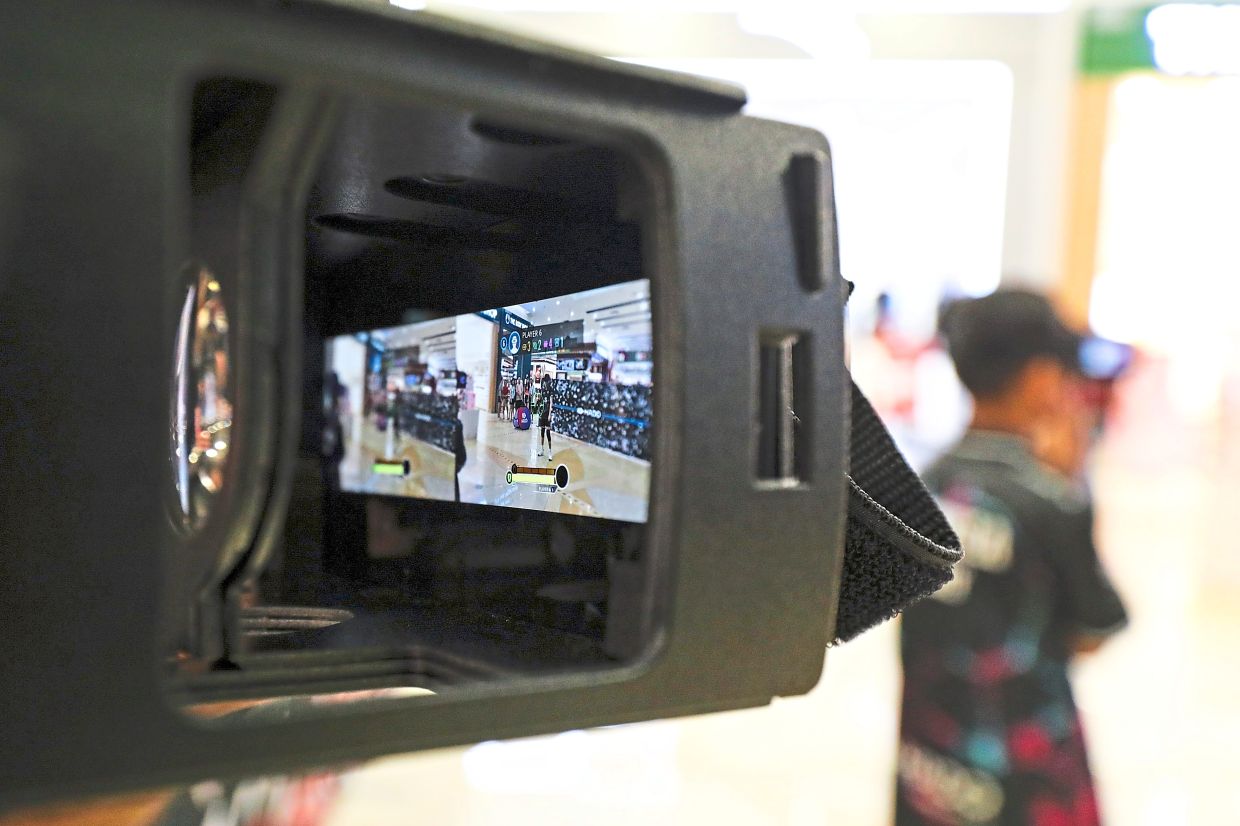
The headset acts as both a display and a camera, showing players virtual energy balls and shields overlaid on their surroundings, alongside on-screen indicators of their remaining targets and available resources.
“I explained to MAD that, since Hado involves throwing energy balls and dodging attacks just like dodgeball, we could introduce it to our players as a new way of playing the sport,” Otto says.
Hado takes its name from “Hadoken”, a signature move in the Street Fighter video game series in which the characters Ryu and Ken Masters launch energy balls at opponents. Otto says the Japanese term “hadou” also refers to a wave or movement of energy.
Radhakrishnan agreed with the idea but felt the sport needed a more familiar name to appeal to Malaysians.
“Instead of calling it Hado, we decided to call it digital dodgeball because otherwise it would be confusing,” he says.
Gear up
While the concept may be easy to grasp, mastering the game requires more than simply throwing virtual energy balls.
Each round lasts 80 seconds, during which players must attack, defend and dodge incoming shots while managing their virtual resources.
Coach Mohd Shazril Mohd Azlan Guna says each player has four virtual petals that serve as targets. When an opponent’s energy ball hits a petal, it disappears. Losing all four results in a knockout, temporarily removing the player from the game before they return with their petals restored.
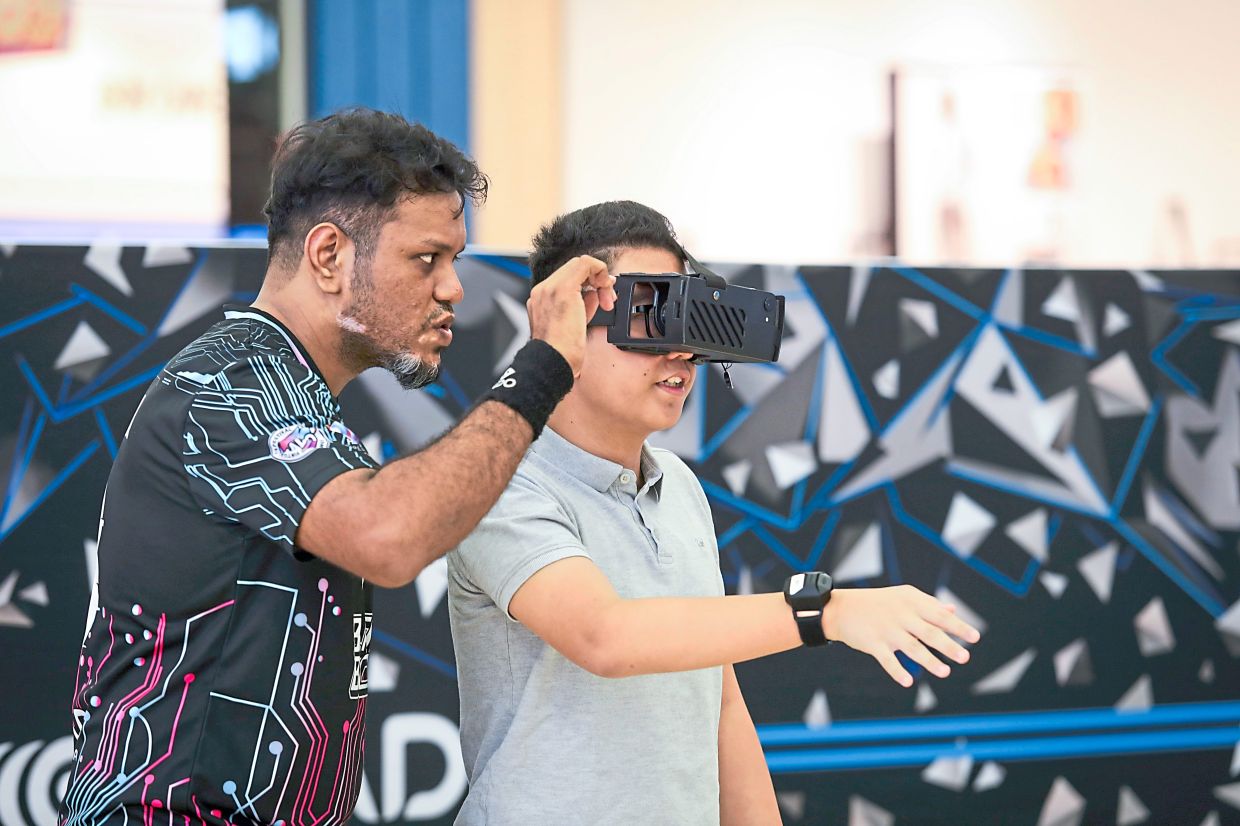
To launch energy balls, players raise their hands to charge their shots before thrusting their arms forward to fire. They can deploy shields to block incoming attacks while allowing their own energy balls to pass through.
Charging a shield requires players to point their wrist sensors towards the floor and wait for a green bar on their interface to fill. They then swipe upwards to deploy it. Players must also move sideways or jump to avoid incoming shots, making quick decisions as they balance offence and defence.
“The player with the most knockouts at the end of the 80-second round wins the match,” Mohd Shazril says.
Otto, who also coaches the sport, says there is no timeout during the round, leaving players to manage their stamina and tactics until the clock runs out. Although digital dodgeball is a non-contact sport, it demands constant movement and concentration.
“It is a simple game to learn but difficult to master. Some players focus too much on attacking without thinking about how to defend themselves. They need to know when to strike, when to protect themselves and when to dodge,” he says.
The challenge is also getting players from different backgrounds to embrace the hybrid format.
“We tried gamers and they complained that digital dodgeball is too physical or has too much movement for them. Then we tried with dodgeball players and they felt it’s too much like a video game as no physical balls are being thrown here and there,” Mohd Shazril says.
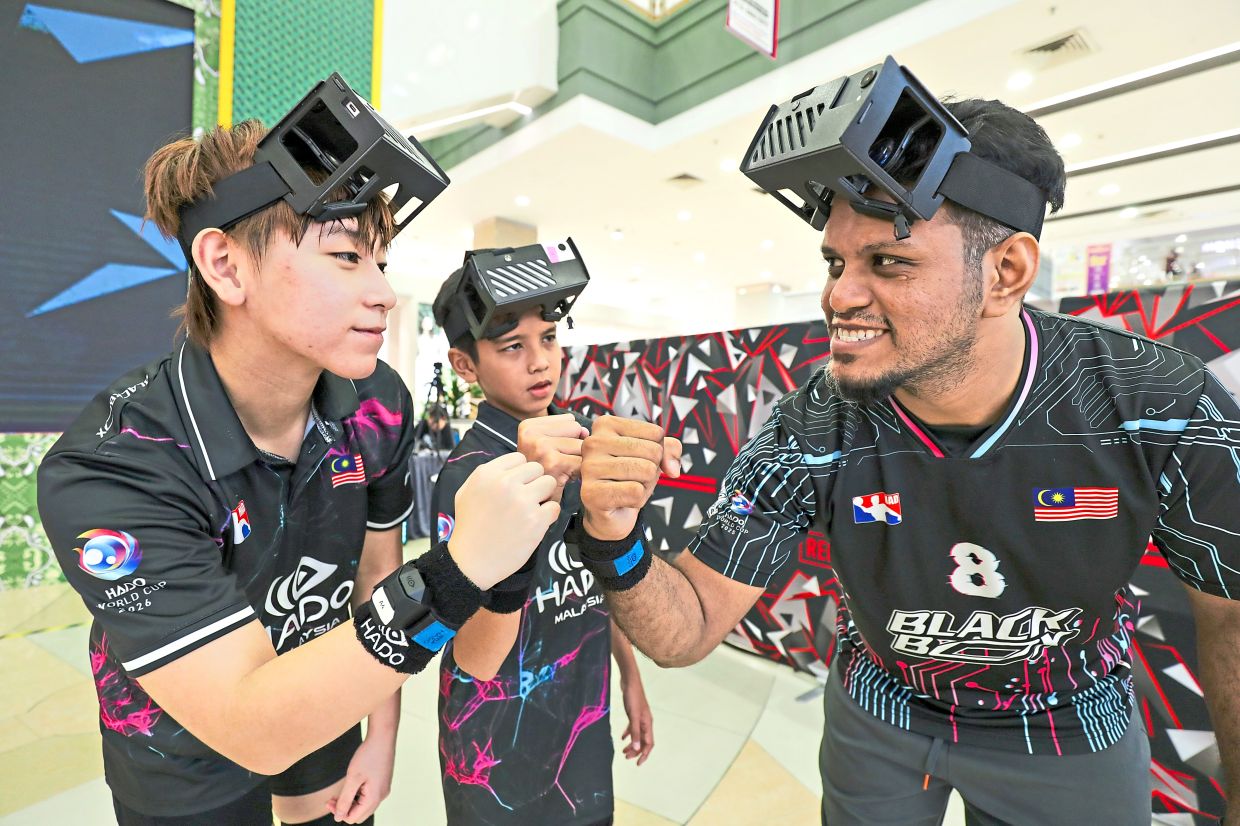
From Nov 20 to 22, Li Yang and Muhd Hadif Muayyad will join 10 other players to represent Malaysia at the Hado World Cup in Shanghai, China. The tournament features 24 teams from countries including Japan, South Korea, China, Spain and the United States, with the winning team set to receive 100,000 yuan (RM61,514).
Players like Muhd Hadif Muayyad were selected through a digital dodgeball training programme organised by the Pahang Dodgeball Association in July. The full team was formed in September, with players chosen for their movement skills and ability to follow and execute instructions, Otto says.
This will not be Team Malaysia’s first appearance at the Hado World Cup. Mohd Shazril represented the country in the 2018 and 2019 editions, both held in Japan.
“Our best achievement so far has been reaching the quarter-finals in 2018 and winning the Best Challenger Award, which is given to the best non-Japanese team,” he says.
Now 29, Mohd Shazril first discovered the sport through an open call for players on Facebook back in 2017.
His advice to the new team is simple: “Stay fit because there is no idle time in the game.”
High score
Digital dodgeball is part of a wider push to integrate technology into sports, opening up new ways for people to train, compete and stay active.
In September, VR taekwondo made its debut as a medal event at the 2026 Aichi-Nagoya Asian Games. Malaysia competed but did not secure a podium finish.
At home, the Youth and Sports Ministry has chosen digital technology and artificial intelligence (AI) as the theme for this year’s National Sports Day (Hari Sukan Negara), highlighting efforts to incorporate both into sports development and encourage wider public participation.
In a report, Youth and Sports Minister Dr Mohammed Taufiq Johari said the theme reflects current technological advancements and the potential of digital technology and AI to make sports more accessible and engaging.
The ministry had planned to showcase several technology-driven sports at the National Sports Day celebration, including VR taekwondo, drone soccer and digital dodgeball. However, due to unhealthy air quality at the time, the event scheduled for Oct 10 at Bukit Jalil was postponed to Nov 7-8 at Pavilion Damansara Heights in conjunction with Hari Sukan 2.0.

“We believe digital sports will continue to grow, but it is important to maintain a balance between the physical and digital aspects of the game. The goal is to ensure that players remain physically active while benefiting from the technology,” Radhakrishnan says.
For MAD, the challenge now is to translate growing interest into wider participation. Otto says the association has been introducing digital dodgeball to schools and universities, but persuading institutions to invest in the technology remains a hurdle.
“I admit that most schools still prefer traditional sports and are not ready to invest in new technology,” he says.
The setup requires the proprietary Hado system, smartphones mounted on headsets and wrist sensors. MAD currently uses iPhone 17e smartphones, but the overall equipment setup can cost up to RM100,000.
The system does not require high bandwidth and can operate through a mobile hotspot when a school has no reliable WiFi connection, Otto says. However, there is currently no affordable, entry-level consumer version that would allow people to play and practise at home.
Against these challenges, recognition by the Youth and Sports Ministry offers a boost. Otto says MAD is pleased that digital dodgeball had been selected to be showcased at Hari Sukan Negara, describing it as an important step towards gaining wider support for the sport.
Radhakrishnan says MAD is also bidding for digital dodgeball to be featured at the 2027 Malaysia Games (Sukma), which could give the sport another platform to reach a wider audience.
“I believe it’s important to be open to how technology can help to develop new interests and encourage more people to be active. Otherwise, I’d be concerned if a sport is left to die because they can’t stay relevant in an era where most people prefer to look at their screens,” he adds.
For Li Yang, digital dodgeball holds special significance after a knee injury forced him to give up playing basketball as a state player.
“I still remember being told that I have to give up as a state player because of a meniscus tear in my left knee. I felt so down. It happened a year ago when I collided with another player during training,” he says.
He later took up digital dodgeball, finding greater confidence due to the no-contact element. As a gamer, Li Yang also enjoys the challenge of combining physical movement with virtual gameplay.
“It’s still highly challenging and exciting. My strategy is to attack my opponent right from the start to throw them off,” he adds.