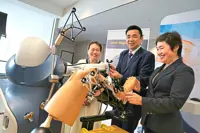
SEOUL: The robot waves at me. I tentatively wave back. Staring into its glassy black face, I can’t quite tell if it is actually responding to what I’m doing or just following commands from a handler standing a few feet away.
I offer my hand, and it mirrors the gesture. When I try to shake its gloved hand, its arm does not budge.
I’m at Galaxy Robot Park in South Korea, experiencing the future – or, at least, a vision of one.
By now, millions have seen viral videos of humanoid robots. At their best, they beat athletics world records and perform complicated synchronised dances. At their worst, they run headfirst into walls and burst into flames. Some have accidentally kicked and slapped children.
The implicit promise of robots that look like us is that one day, they will be able to act like us, too. Many see them as the ultimate embodiment of the artificial intelligence (AI) revolution.
But how close are we to that future? And what role do we want robots to play in it?
This park in Seoul – opened in the summer by Galaxy Corp, an entertainment and technology company that represents major K-pop singers – offers one version, in which robots not only ease our burdens but also entertain us, dance alongside us and act as our companions. That future is nearly here, it suggests.
Central to this vision is Unitree Robotics, the Chinese company behind the humanoids in most viral robot videos and the park’s biggest draw. Unitree’s flagship G1 model is one of the most widely available humanoid robots in the world. At about US$13,500 (RM55,196), it is also one of the more affordable options, considering some companies’ models have six-figure price tags.
A statue of the G1 dressed as an astronaut towers over the park grounds. It’s a statement as grandiose as it is muddled: Why would a robot need a spacesuit? It feels like a reflection of a key aspect of the humanoid robotics industry – a mismatch between vision and reality, between a form that suggests intelligence and bodies that still functionally lack any.
Machines already assemble products in factories, serve us food and vacuum our floors. Automated cars drive us around. People go on reality television shows to see if they can fall in love with AI companions.
But the next frontier is robots that can do whatever we want, whenever we want it, autonomously.
To this end, many envision robots that look like us, with the assumption that they are best suited to navigate a world built for humans. The form also has a particular resonance, a connotation of sentience that was once the stuff of science fiction.
“There’s a weight of possibilities mapped onto these humanoid robots that a lot of us carry around,” said John McCormick, an artist and professor at Swinburne University of Technology in Australia who is programming his own Unitree robots.
That potential is reinforced when we see robots dance with humanlike fluidity, like Unitree’s have done on America’s Got Talent or at China’s Lunar New Year gala. But such performances engender unrealistic expectations of what these robots are capable of, McCormick said, adding that their moves appear complex, but they are still mostly following preprogrammed routines.
They can also be less impressive in commercial settings than tightly controlled and programmed showcases, as I realised while watching Galaxy Robot Park’s main draw: a 50-minute dance and martial arts extravaganza starring 10 humanoid robots.
Overall, it wasn’t quite as impressive as something like the Lunar New Year gala in China, where Unitree robots performed nonstop acrobatics.
That likely speaks to the difference between one-off events that the company dedicates all its resources to perfecting and what the robots can do in commercial settings involving multiple daily performances, said Alan Fern, a robotics professor at Oregon State University.
“If you’re going to have them doing backflips and crazy stuff, you’re going to break more robots, and that’s going to be expensive,” he added.
Right now, anything practical we might want a humanoid robot to do can be done better by a more specialised, less humanoid machine. An assembly robot in a factory, for example, does not need legs or a face.
That is apparent at Galaxy Robot Park, where the most useful machines are the least lifelike.
I order a cocktail from a bartender that is two arms mounted on a giant sphere. The arms pump shots of gin, orange juice and yuzu juice into a container and shake it up. The resulting drink is room temperature and very, very strong.
But at some point in the future, it will no longer be cost-effective to build a specialised robot for every possible scenario, Fern said, adding that the goal is to make autonomous, general-purpose robots that are not perfect at one task but simply good enough for everything.
To get there, investors are betting that humanoids will have a technological breakthrough, like the AI industry did in 2022 with the release of ChatGPT. But it’s unclear how long that might take, Fern said. AI models had the whole of the Internet to train on, he added, but there is no massive quantity of training data for humanoids.
At the park, robots that could “think” for themselves still felt very far away. Take, for example, the robot that I shook hands with. It looks like it could be acting autonomously, but look closer: Its handler, with his hands casually behind his back, is holding a controller. Other humanoid robots at the park were also being controlled, more visibly: a boxing robot that jabs and kicks, and a soccer robot that visitors can command to kick a ball.
There is also the question of what kind of future we imagine with robots. Do we want them to be dancing with us as well as doing our chores? What happens when the novelty wears off?
Visitors to the park in Seoul had mixed feelings. Brenda Stone, 57, from Colorado, said she found the robot performers impressive but did not think she would be back. Stone said she attended performances and concerts to see people with all their imperfections. “AI would be perfect,” and not in a good way, she said. – ©2026 The New York Times Company
This article originally appeared in The New York Times.