NISHIKAWA: The colour of the cherry blossom hovers between pink and white. The blooms peak briefly. It’s hard to explain why Japanese love the cherry blossoms, called sakura. But they do, deeply.
Robots do not appreciate the soft evanescence of the sakura. Nor do they understand why a snowbound town in northern Japan has dedicated itself to the cultivation of a winter variety.
But the residents of Nishikawa have discovered – at least, they thought they had discovered – that they need robots for their sakura. There are not enough workers in town. The average age of a Nishikawa farmer is 73. Who else will work in the most depopulated town in one of the most depopulated prefectures in one of the most depopulated nations on Earth, if not for an amalgamation of aluminium, steel and hard plastic?
“We had to do something,” said Mitsuya Kaneko, 53, the head of the Nishikawa cherry blossom farmers union, whose parents, ages 75 and 84, still plod through the snow to prune and package winter sakura in a largely unheated shed. “We cannot just die out.”
After watching his hometown shrink and its farmers stoop ever steeper with age, Kaneko worked with the local government to bring technology to Nishikawa. Agricultural officials ordered a robot that would allow the farmers to more easily transport and load bundles of cherry blossoms onto trucks.
Pochi, as the robot was named, arrived on Christmas Day, a cheery yellow container on wheels that looks less like a sophisticated robot and more like an oversize Lego construction. The price tag was about US$15,000 (RM61,395).
Since then – for all the buildup and excitement from robot boosters and local politicians from Yamagata prefecture eager to uncork central government funds for rural revitalisation – Pochi has mostly slumbered unloved in a corner of a greenhouse.
The prevailing attitude toward the robot, which can negotiate mountain terrain and carry 600 pounds, was encapsulated by Hideki Shida, 84, another Nishikawa farmer. Even as Kaneko showed off how Pochi, with the slightest flick of a wrist, followed him like an obedient dog, Shida trundled past conspicuously, pushing stacks of cherry blossoms on a metal cart, his body angled with effort.
“I do things the old way,” he said, casting a dismissive look at Pochi.
By the 1980s, Nishikawa, like much of the rest of Japan, had grown fast. Families moved to the snowy backcountry, eager to cultivate farmland. Japan’s Agricultural Ministry helped to protect them from overseas competition. Yamagata prefecture dedicated itself to growing luxury crops, literal fruits of postwar prosperity.
Japan’s economic bubble burst in 1992, the same year that the bullet train finally arrived in Yamagata. Discount shops popped up alongside the vendors of expensive fruit. Japan’s farming population, which had already dwindled because of industrialisation and economic development, shrank further, just as Japan’s demographics fell off a cliff. The country’s birthrate hit a record low in 2025, and the Japanese population, now 123.8 million, is projected to fall below 100 million by 2060.
Across Yamagata, local officials have tried out various robot – and robot-aspiring – solutions to the precipitous demographic decline. The 48-year-old mayor of Nishikawa, Daishi Kanno, secured US$40,000 (RM163,720) in funding for Pochi and other “smart agriculture” innovations.
The promise of robots has excited Yamagata researchers for years. The prefecture produces about 70% of Japan’s cherries, and there is a chronic shortage of harvesting labour. Searching for solutions, a local fruit magnate contacted Yuichi Tsumaki, a professor of robotics and mechatronics at Yamagata University, about designing a cherry-picking robot. The government kicked in with funding.
Tsumaki explained the delicate mechanics of cherry picking: Without the stem, the harvested fruit spoils quickly, yet picking it with the stalk depends on the gentle rotational pressure of a human hand.
In anticipation, Zenyu Saito, the fruit magnate, had trained his cherry trees to grow on trellises, like grapevines, so that a robot could more easily access the fruit. Saito’s farm is now filled with flat-topped cherry trees that dangle fruit at a pleasing, consistent height. All that is missing is the cherry-picking robot. He had given Tsumaki four years to develop the robot. It has now been 10.
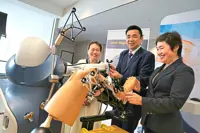
One morning in his laboratory, the professor looked decidedly nervous. After a delay of several months, he and his student researchers were about to show what a decade of robot innovation could do for Yamagata. One graduate student carefully attached five magnetised fake cherries to a fake tree. A robotic arm slid forward and plucked the ersatz cherries with their stems.
On the second attempt, the robot stalled with a cherry suspended in midair. On the third, the robot got stuck in a fruitless spiral, plucking the air with nothing in its gripper. The fourth effort failed, too. On the fifth, five fake cherries were again harvested.
Saito is now 80. He is weak and on kidney dialysis. His son, who is taking over the business, isn’t interested in robots.
Japan may have once led the world in robotics, creating the first humanoid robot in 1973, but it has fallen far behind China, with its soccer-playing, somersault-flipping machines. Even Pochi, the supposed saviour of Nishikawa’s cherry blossom farmers, harbours an embarrassing origin story: The robot was made in South Korea.
Pochi isn’t the only unloved robot in Nishikawa. A grass-cutting robot meant to trim the sakura orchards keeps getting foiled by weeds. Local authorities say they are experimenting with a deployment of pesticide-spraying drones, but things haven’t progressed far. And an earlier, clunkier version of Pochi – a machine that doesn’t even merit a name – is even less respected than its cousin is.
Still, one local farmer likes Pochi very much. Osamu Shida, 74, named the robot after the Shiba dog he once owned. He, practically alone among the workers, stacks his cherry branches on the machine and marvels at how easy it is to transport his sakura.
“I feel like Pochi’s papa,” Shida said. “I like to have Pochi follow me around.”
Late one afternoon, Shida was out in his fields with his snowblower, clearing a field for future planting. As the sun set, Shida returned to his family farmhouse. The air was cosy from a wood-burning stove and the toasty aroma of sweet potatoes being roasted by his wife, Kimie, an ethnic Korean originally from China whom he met through a matchmaker 25 years ago. Her granddaughters, also born in China, sprawled on the couch, scrolling on their phones.
“There aren’t many children left in Nishikawa anymore,” Osamu Shida said.
Unlike most others in Nishikawa, though, the couple hopes they can pass on the farm to the younger generation. Perhaps they’ll export winter sakura across Asia. They are certainly less wary of robots.
“Maybe we should just retire and live a peaceful life and look out at the snow,” Kimie Shida said.
Osamu Shida grunted. “Not yet,” he said. “We still have work to do.” – ©2026 The New York Times Company
This article originally appeared in The New York Times.