
HAMBURG: Three days before its launch, the developers of survival game Solarpunk posted an unusual warning.
"We know that some players might look at the wishlist numbers and expect a massive survival game made by dozens or hundreds of developers,” wrote German two-person studio Cyberwave on Steam. "But that’s not what Solarpunk is.”
More than 1.2 million gamers had added the game to their Steam wishlists, the demo had been played more than half a million times – and Cyberwave wanted to make sure no one bought Solarpunk with false expectations.
This is not a player-versus-player game. It is not a major story campaign. It is not even a game with hundreds of hours of playtime, but rather "a quiet, cosy and focused survival craft sandbox, made by a tiny team with a lot of love.”
The developers' openness was unusual for the industry but is symptomatic of a game that steadfastly goes its own way.
Stranded on a floating island – patience required
At the start of Solarpunk you wake up alone on a small floating island. There's no companion, no voice acting, no story, just a survival guide and a handful of simple tasks. Gather branches, smash stones and build a workbench.
Then you’re on your own.
The starting island is small and can be fully explored in 10 minutes. You’ll search in vain for hidden caves or secrets. There’s wood, stone, some clay and iron ore and that is all.
The game saves its surprises for later.
Anyone looking for depth or variety right from the start will indeed be disappointed. Getting started requires patience. The tutorial helps, but feels a bit sparse in places. A friendly non-player character to occasionally lend a hand would have been a welcome addition to this somewhat faceless early phase.
Eco-approach: with nature, not against it
The central design principle of Solarpunk is its ecological approach. If you fell trees, you replant seedlings. Energy comes initially from wood, later from solar panels and wind turbines.
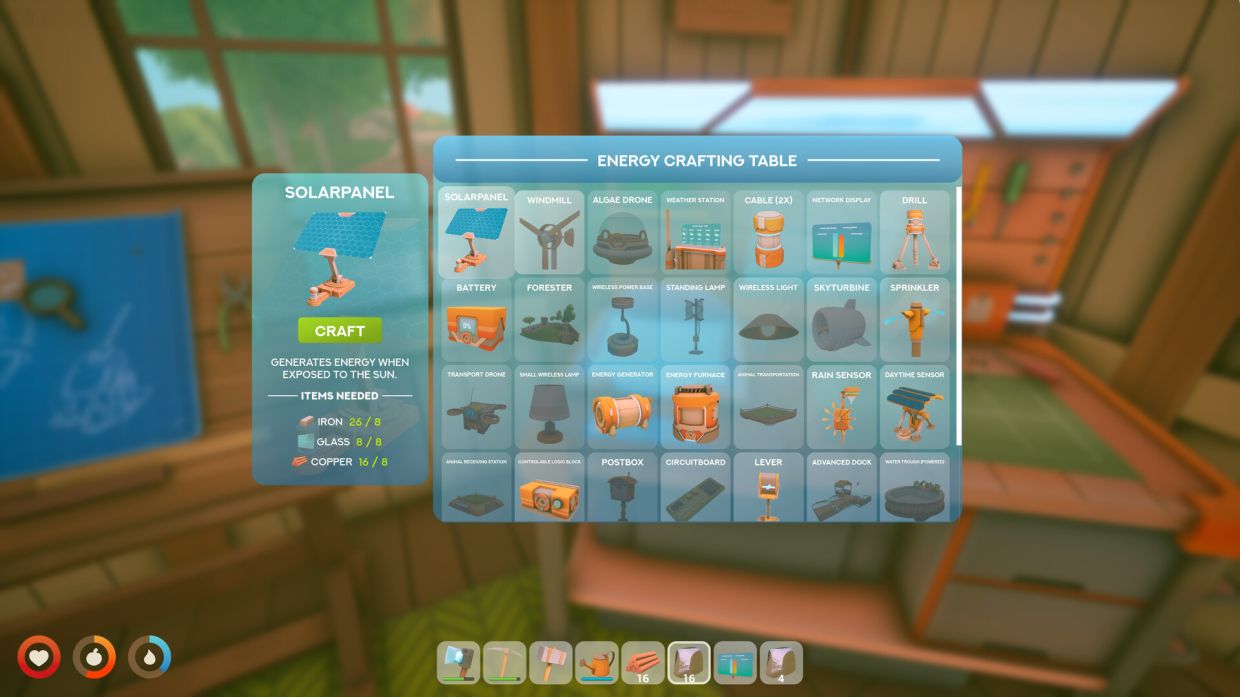
The weather directly influences energy production: on cloudy days, solar panels generate less electricity, whilst storms can benefit wind turbines or damage fields. So, if you want to run your growing settlement efficiently, you’ll need to keep an eye on the sky too.
Eventually, a solar-powered drill replaces your pickaxe, but it only works during the day and requires regular airship trips to collect the harvest.
Transport drones and wireless power grids complement the automation system and add more depth beneath the cosy surface than you may initially expect. Want to optimise production chains? There's plenty here to tinker with.
But for those who seek rapid progress, there's a problem: building the airship requires materials such as cotton. Yet this is scarce on the island.
Once the few naturally grown specimens have been harvested, you wait patiently until a seed becomes two, then three. This feels less like slowing down and more like a forced standstill, which is the most significant criticism of Solarpunk.
Brilliant airship concept and spirit of discovery
An airship is the heart of the game, and one of its best ideas. The controls are complex at first, but easy to learn thanks to on-screen prompts. They quickly strike a happy balance: you never feel like a master of the skies, but you’re never completely helpless either. The flight between the islands takes a few minutes, and docking at airship stations requires care.
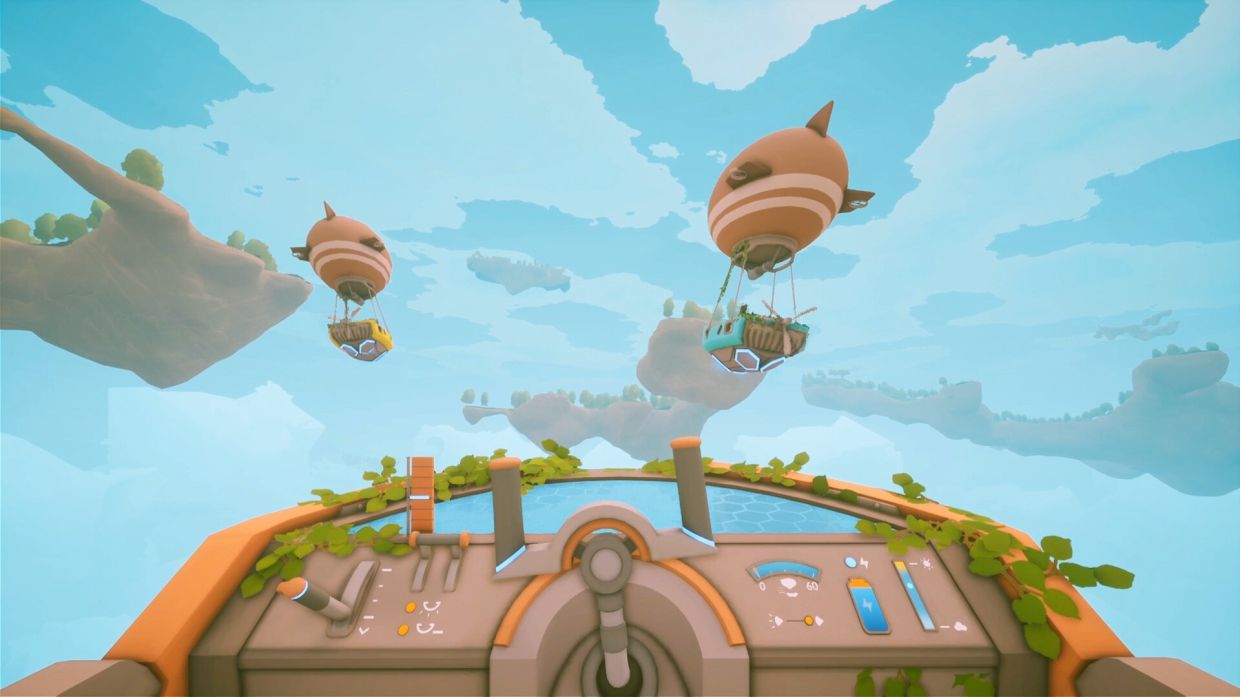
The islands themselves are surprising in their variety. Some serve as trading posts, where a robot merchant assigns tasks and rewards you with new blueprints. Others are purely resource deposits you fly to regularly. Still others have a character all of their own.
Solarpunk makes one thing clear: if you want to get ahead, you have to set out. Exploration is not an option, but a necessity.
Wooden shelter becomes an estate but character stagnates
Over time, your own base develops from a simple wooden shelter into a well-designed estate. New building materials, windows, decorations, furniture and additional storeys expand the design possibilities. The selection of furnishings is impressive. Like interior design? You will find a real playground here.
Farming follows similar principles. Different plants have different requirements; raspberry bushes, for example, are particularly recommended as their fruit alleviates both hunger and thirst. In co-op mode with up to four players, Solarpunk finds its true strength: you share tasks, the farm grows faster, and the building process takes on a social rhythm that suits the game well.
What’s still missing from the multiplayer experience, however, are things like gestures or customisable clothing. In general, more customisation options for your own character might be better.
Atmosphere as greatest strength
What sets Solarpunk apart from similar titles is its atmosphere. The green of the meadows, the blue of the sky, the hum of the solar panels and the rustle of the wind create a world that invites you to linger. The visuals live up to what the promotional images promised. Here, we do not have glossy illusions but a cohesive, handcrafted game world.
This makes what is still lacking all the more evident. The feel of the game during basic actions is somewhat unsatisfying: chopping at a bush with an axe yields hardly any visual feedback: no particle effects, no visible damage to the object.
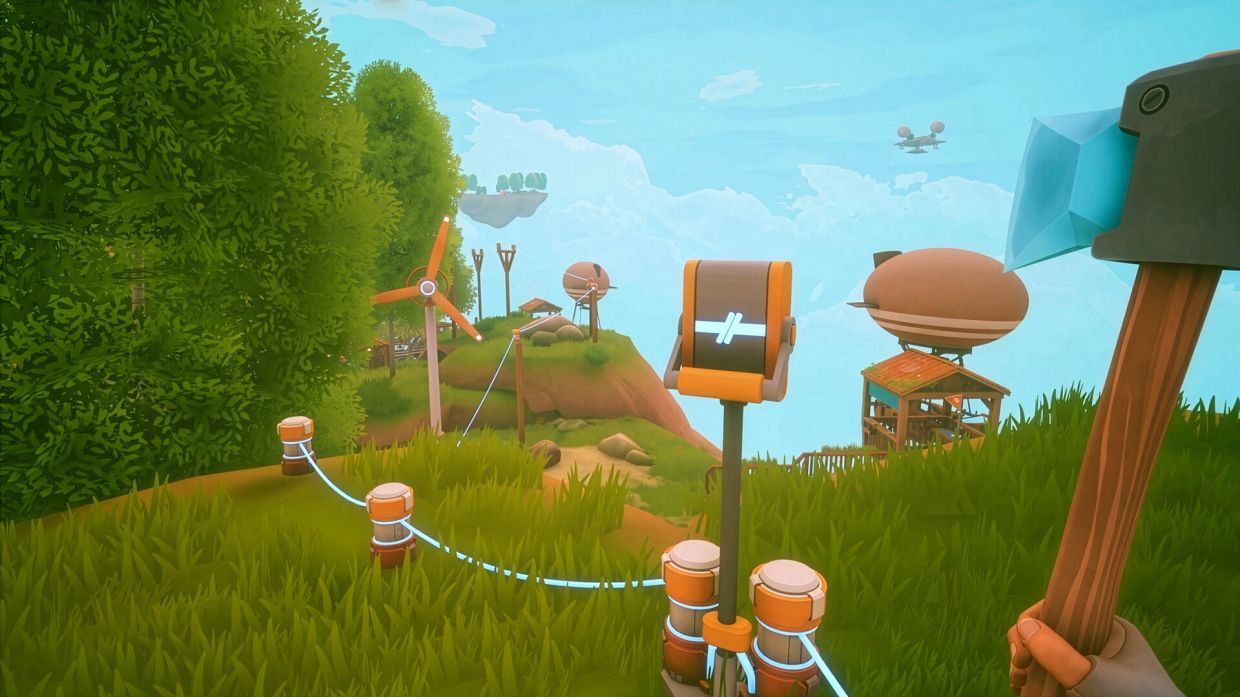
Tooltips are often missing, so you’re sometimes unsure which item you’re looking at. On the PC, detailed graphics options are also lacking. Instead of individual settings, there’s only a general quality level. Anyone wanting to adjust specific graphics aspects is left high and dry.
These are real weaknesses but they are not insurmountable problems. Cyberwave has already shown with its previous title, A Game About Digging A Hole, that the studio responds to player feedback. And the openness with which the developers discussed the limitations of their game prior to launch allows us to hope that they will continue to listen afterwards.
Perfect for drifting in clouds
Solarpunk isn’t a game seeking to please anyone and everyone. It’s a calm, atmospheric survival experience for players who see value in slowing, alone or with friends. Solarpunk offers around 20 hours of main content, a cohesive world and a foundation with room for improvement.
If what you seek is a large-scale survival spectacle, look elsewhere. But if you are prepared to drift up in the clouds, this game may stay with you longer than you think.
Solarpunk is available for PC, Xbox Series X/S and Nintendo Switch 2 (around €23/US$23/RM94 each) as well as for the PlayStation 5 (around €25/US$25/RM103). The game has no age rating (USK 0). – dpa