BERLIN, June 18 (Reuters) - Drone incursions disrupting airports in Europe and strikes on oil fields in the Middle East are spurring a fast-growing market for radars, jammers and defensive craft to defend airports and infrastructure against new aerial threats.
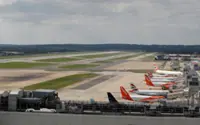
Drone technology has caused upheaval at airports for years, with London's Gatwick Airport among those to have had to suspend flights due to drone alerts pre-2020. However, a fresh wave of incursions linked to wars in Ukraine and the Middle East has sent those concerns into overdrive.
Technological advances recently unveiled in response have included a gun-shaped tool from U.S. firm Dedrone that can jam drones, and a Boeing autonomous 'wingman' that flies with fighter jets, carrying counter-drone jammers and weapons in an interchangeable nose.
The field is drawing billions of dollars of investment, moving well beyond military use to sectors including energy, shipping, data centres, hotels and airports.
Avinor, which owns and operates 43 airports across Norway, is one company to have already installed a drone detection system at its operations to address the "disruptions and delays" civilian drone incursions have caused to air traffic.
Reuters spoke to half a dozen executives at counterdrone firms who described a sharp rise in demand from governments, airports and civil infrastructure operators.
"There is a direct effect of a lot of people calling us," said Siete Hamminga, the CEO of RobinRadar, a Netherlands-based counter-drone company whose technology grew out of research into bird strikes affecting planes.
COUNTER-DRONE MARKET GROWING AT AROUND 20% A YEAR
Hybrid warfare tactics in Europe and the Middle East have highlighted the need to protect economic and civil bases like ports, oil fields and airports.
Drone strikes at Dubai airport, incursions in Baltic states, debris fires caused by drone interceptions at the Fujairah Oil Zone, and suspected drone alerts at airports in Munich and Copenhagen have all caused disruption in the last year.
Some European airport authorities told Reuters they were looking to beef up their use of counter-drone technology.
Ash-Alexander Cooper, an executive at Dedrone until June who spoke to Reuters before his exit, said calls began soon after the Iran war started in late February, with people asking for solutions that could be installed "ASAP".
"I imagine we are one of many companies being asked, after many more governments - not just in the Middle East - now realise how vulnerable they are, with the extent and nature of the drone threat evolving in real time," he said.
Analysts estimate the global counter-drone market to be worth some $3 billion to $7 billion, growing at around 20% each year. A report by MarketsandMarkets estimates it will hit $14.5 billion by 2030 from $4.5 billion now.
Eben Frankenberg, CEO of drone-detecting radar maker Echodyne, said investment in a new plant his company will open this year would multiply its annual capacity to over 30,000 units.
"In terms of the demand for our radars, we saw well over 100% growth last year, and that isn't slowing down," he said.
STRICT RULES OVER CIVILIAN USE OF COUNTER-DRONE TECH
Despite strong interest, regulatory challenges and questions over safety still limit the roll-out of counter-drone technology outside the military sphere.
Civilian airports have strict rules over what technology they can use against drones, and remain largely focused on detection tools.
Issues such as jamming and GPS interference can disrupt communications and navigation, making such systems unsuitable for use around airports. Nor can you normally use weapons to shoot down drones in a civilian environment.
"You simply can't use so-called kinetic effective means, such as machine guns or similar, near civilian infrastructure," a spokesperson for German radar maker Hensoldt said.
In terms of deciding how systems that work in a battlefield scenario can be used legally and safely in civilian scenarios, a lot is in the hands of national authorities.
"What is allowed is a regulatory question that needs to be answered by the governments," said Stephanie Lingemann, head of German drone and AI firm Helsing's air division. "We cannot make the decision."
'CAT-AND-MOUSE GAME'
Meanwhile, drones are multiplying, and getting more sophisticated.
"It's always a cat-and-mouse game," said Mike Schut, commercial director at DroneShield, which uses radio frequency sensing in its counterdrone system. "Somebody creates a drone, and we need to make sure we stay on top."
In the wider market, analysts cautioned that ever more sophisticated technology was expensive, reaching hundreds of thousands of dollars - and didn't always work.
"Right now it's just panic mode, and everybody is acquiring absolutely every tool they can find in their arsenal to feel like they have a little bit more control," said Greg Falco, a professor at Cornell University.
"I'm just seeing so much snake oil."
(Additional reporting by Federico Maccioni, Alessandro Parodi, Christoph Steitz and Timm Reichert; Editing by Adam Jourdan and Jan Harvey)