
SANTA FE, New Mexico: The flyers began appearing around campus in early December.
“THE WORLD W/Out A PHONE,” they read.
The posters were pasted in dorms at St. John’s College, a liberal arts school in New Mexico. Each one outlined an agenda for six days of abstinence from smartphones and other devices connected to the internet.
“A period of fasting,” the flyers promised. “A self-study. A challenge.” Students who were game were instructed to report to Murchison, a dorm on campus, at 6pm that Sunday.
Mary Claire Fagan was waiting for them. Fagan, 26, a junior, said that she and other students talked all the time about craving a break from their phones, which pulsed all day with distractions. They debated giving them up, but doing so seemed inconvenient and isolating.
Maybe the solution was to try it together.
On the dorm’s staircase that evening, 20 St. John’s College students who had decided to take part in Fagan’s experiment dashed off last messages to their friends.

Fagan thought the exercise should be choose-your-own adventure. She passed out commitment cards that allowed participants to select which items they wanted to leave behind, and why. They could also check off exceptions like “computer use in the library” and “calling my mother”.
Then she put a question to the group: Why are you here?
One by one, students spoke about feeling alienated from one another by their devices. They described turning to Instagram to numb themselves in moments of stress and sadness, or trying to lessen their reliance on their smartphones only to be tugged back in.
Matteo Ponzi, 19, a sophomore, said he hoped the students might fill the void left by their smartphones with in-person activities. Students followed him into his dorm room and dropped their devices into his suitcase.
He clasped it shut, climbed on his desk chair and slid it onto the top shelf of his closet. “Let’s just see what happens,” he said.
The first challenge was waking up on time for class Monday morning.
Most of the students participating in the fast were used to being roused by their iPhone alarms. The ones who didn’t have alarm clocks set up a system of wake-up calls carried out by students including A.B. Garrett, a sophomore who knocked on a classmate’s door at 9.30am Monday.
“I heard ‘Ugh,’ and then shuffling, and then ‘Thank you!’” Garrett, 19, said afterward.
Naomi Weiss relied on her internal clock to wake her up in time for her Greek class. (“A little risky,” she said.) Weiss, 20, a sophomore, said she had long felt stuck in a game of digital Whac-a-Mole – she would delete Instagram, only to find herself mindlessly scrolling through Google Maps.
St. John’s College, which has another campus in Annapolis, Maryland, is in some ways an ideal setting for such an exercise. The school’s Great Books curriculum is focused on reading original works of thinkers like Archimedes, René Descartes and Albert Einstein. Classes are discussion-based – no laptops allowed – and each dorm room on campus is equipped with a landline.
Several students participating in the fast said they could feel their focus sharpening. Still, the end of the semester loomed, and Samuel Gonzalez was considering just how tech-free he could go without taking a hit to the quality of his final papers.
“Unfortunately, there’s a practical reality that I have to produce 30 pages of writing in the next two weeks,” said Gonzalez, 29, a senior. He briefly pictured himself writing them on a typewriter, then decided to use his laptop, so long as it was in the school library.
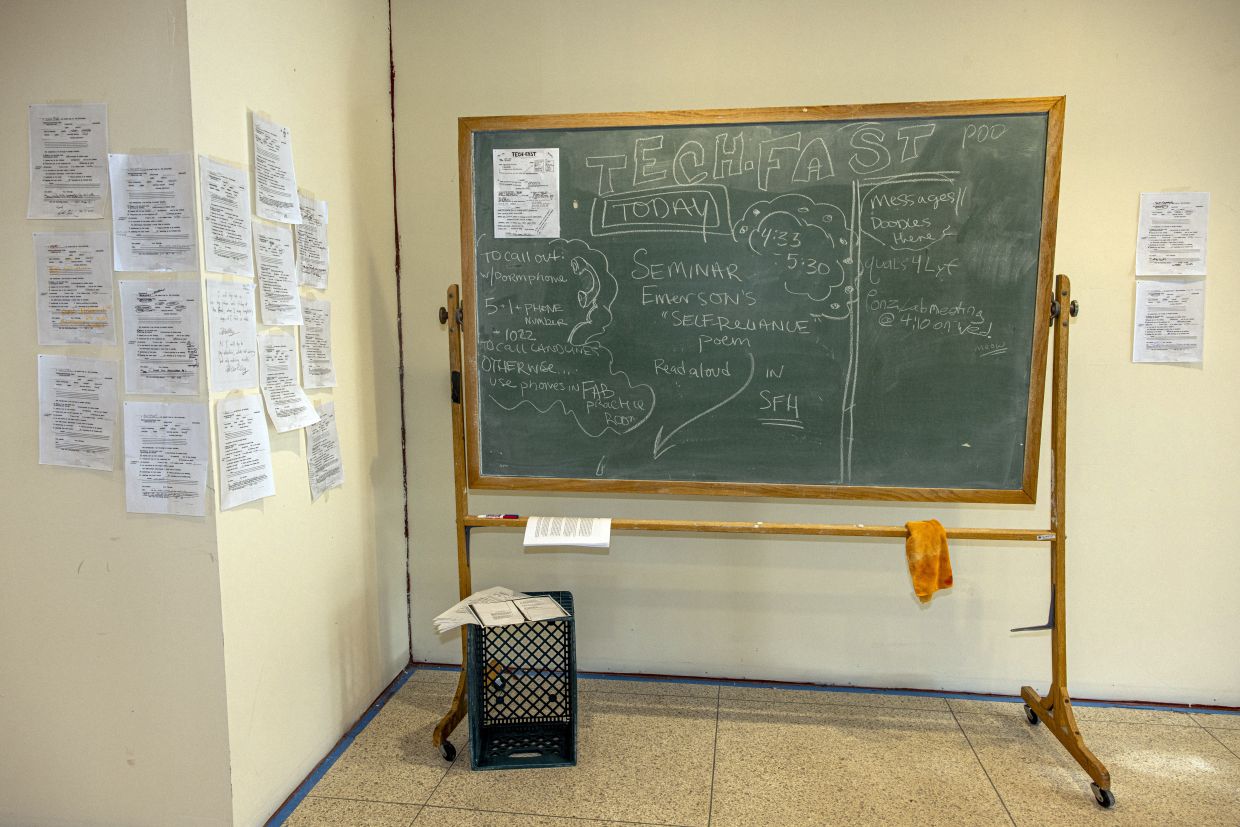
Others were realising just how much they relied on their phones to track one another down. Weiss had lent Ponzi a pillow but could not find him to get it back. Garrett was out of breath from racing around campus, trying to find a friend who had borrowed her car keys. In the dining hall, students had set up a blackboard where they could exchange notes.
“Looking 4 Eliza,” Garrett had written by Monday afternoon. “Did you find Eliza?” someone else followed up.
For these members of Generation Z, navigating life with landlines and sticks of chalk was something of a novelty. For much of the school’s faculty, it had simply been the college experience.
Sarah Davis, dean of the college’s campus in Santa Fe, New Mexico, remembered students gathering to watch ER in her dorm at Harvard. She had enthusiastically supported the phone-free experiment; she thought it was a good sign that young adults’ instincts were telling them to examine the hold that technology had on them.
“It’s not just depriving ourselves,” she said. “It’s actually investigating parts of ourselves that may not be fully expressed when we have so much of our time directed in this one way.”
By midweek, students said they felt more immersed in the world around them.
They could not text one another to say they were running late; they had to make plans in person and actually show up for them. Sometimes they found themselves reaching for their pockets reflexively, as if a phantom iPhone might still be there.
Everyone had hit some snag or another.
Annie Frost, 23, said she was happy about how little she craved her devices. But she was running low on clean laundry, and most of the machines on campus were operated via smartphone. “We’ve set ourselves up to not be able to put screens aside,” said Frost, a sophomore.
The students were also reckoning with the fact that smartphones were more necessary for some. Eliza Kaufman, 20, a sophomore who has jobs in the campus mail room and as an RA, had kept her phone accessible in case one of her residents had an emergency. When it came time to deposit her paychecks, she realised she could not do it efficiently without her mobile banking app.
“As college students, we are privileged; we are in an intellectual space where this kind of thought experiment and life experiment is one that’s supported,” she said. “But there is still a divide between – I mean, I’ve got to work, and so I’ve got to use technology to some degree.”
By the end of the week, there had been some cracks in the students’ resolve. Chaz Nomura, 20, had fallen back on his phone twice: to text his mother an invitation to the sophomore play that weekend, and to print sheet music for his Christian fellowship group. He felt guilty, as if he were doing something illicit. “I was like, ‘Oh, is anyone going to see me?’” he said.
But even with minor compromises, most students said they had gotten to know themselves better without their phones butting in all day long. Some had a fresh appreciation for boredom and inconvenience.
Then came the tough question: Now what?
When Fagan looked at her phone again, she had 307 text messages. She said she had not emerged from the week confident that she could give up her smartphone forever.
She planned to keep the phone out of her dorm room. Other students felt ready to make more drastic changes: Weiss hoped to push for Murchison dorm to shut off its WiFi permanently. Ponzi bought a flip phone.
On Sunday night, two days after the fast had ended, a few smartphones remained in the suitcase where Ponzi had stashed them. Their owners had not yet bothered to pick them up. – ©2026 The New York Times Company
This article originally appeared in The New York Times.