HELSINKI: The battle against fake news in Finland starts in preschool classrooms.
For decades, the Nordic nation has woven media literacy, including the ability to analyse different kinds of media and recognise disinformation, into its national curriculum for students as young as three years old. The coursework is part of a robust anti-misinformation program to make Finns more resistant to propaganda and false claims, especially those crossing over the 1,340-kilometer (830-mile) border with neighbouring Russia.
Now, teachers are tasked with adding artificial intelligence literacy to their curriculum, especially after Russia stepped up its disinformation campaign across Europe following its full-scale invasion of Ukraine nearly four years ago. Finland's ascension into NATO in 2023 also provoked Moscow's ire, though Russia has repeatedly denied it interferes in the internal affairs of other countries.
"We think that having good media literacy skills is a very big civic skill,” Kiia Hakkala, a pedagogical specialist for the City of Helsinki, told The Associated Press. "It’s very important to the nation’s safety and to the safety of our democracy.”
AI literacy becoming a vital skill
At Tapanila Primary School, in a quiet neighbourhood north of Helsinki, teacher Ville Vanhanen taught a group of fourth graders how to spot fake news. As a TV screen beamed a "Fact or Fiction?" banner, student Ilo Lindgren evaluated the prompt.
"It is a little bit hard,” the 10-year-old admitted.
Vanhanen said his students have been learning about fake news and disinformation for years, beginning with reading headlines and short texts. In a recent class, the fourth graders were tasked with coming up with five things to look out for when consuming online news to ensure it’s trustworthy. Now they are moving onto AI literacy, which is quickly becoming a vital skill.
"We’ve been studying how to recognise if a picture or a video is made by AI,” added Vanhanen, a teacher and vice principal at the school.
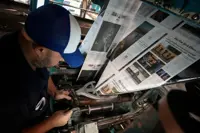
Finnish media also play a role, organising an annual "Newspaper Week”, where papers and other news are sent to young people to consume. In 2024, Helsinki-based Helsingin Sanomat collaborated on a new "ABC Book of Media Literacy,” distributed to every 15-year-old in the country as they began upper secondary school.
"It’s really important for us to be seen as a place where you can get information that’s been verified, that you can trust, and that’s done by people you know in a transparent way,” Jussi Pullinen, the daily newspaper’s managing editor, said.
Democracy is challenged through disinformation
Media literacy has been part of the Finnish educational curriculum since the 1990s, and additional courses are available for older adults who might be especially vulnerable to misinformation.
The skills are so ingrained into the culture that the Nordic nation of 5.6 million people regularly ranks at the top of the European Media Literacy Index. The index was compiled by the Open Society Institute in Sofia, Bulgaria, between 2017 and 2023.
"I don’t think we envisioned that the world would look like this," Finnish Education Minister Anders Adlercreutz said. "That we would be bombarded with disinformation, that our institutions are challenged – our democracy really challenged – through disinformation.”
And with the rapid advancement of AI tools, educators and experts are rushing to teach students and the rest of the public how to tell what's fact and what's fake news.
"It already is much harder in the information space to spot what’s real and what’s not real,” Martha Turnbull, director of hybrid influence at the Helsinki-based European Centre of Excellence for Countering Hybrid Threats, said. "It just so happens that right now, it’s reasonably easy to spot the AI-generated fakes because the quality of them isn’t as good as it could be.”
She added: "But as that technology develops, and particularly as we move toward things like agentic AI, I think that’s when it could become much more difficult for us to spot.” – AP