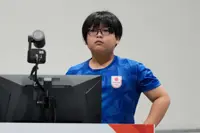
When Andrew Cheong was growing up in the 1990s – then a student at SMK Jalan Cochrane who occasionally played video games at the local cyber cafe with his friends – he never dreamed that he would one day be the national team manager for the Malaysian esports contingent headed for the SEA Games 2023.
From hobbyist gamer to content creator, esports hypecaster, analyst, coach and even university lecturer, Cheong has slowly but surely explored gaming in all its branches.
And what initially began as a pastime has morphed into a viable, exciting and fulfilling career option.
“It feels surreal,” he said during an interview with LevelUp days before leaving for the SEA Games in Phnom Penh, Cambodia.
“Being very involved in co-curricular activities at school when I was younger really built up my sense of ‘nationalism’. I am a very ‘Malaysia Boleh’ kind of person. Honestly, it’s a dream come true to have this opportunity to lead the Malaysian contingent!”
As team manager, Cheong manages the welfare of the 46-member contingent.
“I make sure our teams are well prepared, and I work with the coaches to ensure the players’ training and everyday performance are on track; I manage people issues and administrative business as well.”
Although it had never been a clear ambition of Cheong’s to be so involved in esports, the 37-year-old fell into the scene quite serendipitously.
“I have been playing games for as long as I can remember. My parents were open enough to allow me to, and there was always some kind of device or other at home,” Cheong shared.
The affable young man says that when he was just 13, he discovered cybercafes or “CCs” as he fondly calls them.
“It was 1999, and I guess it was the culture back then that friends would gather at CCs so they could play multiplayer games side by side ... games like Counter-Strike.”
Cheong, who today is well known in local gaming circles by the moniker “Sir Cloud” – once his handle in the MMORPG Utopia and a nod to Final Fantasy VII’s protagonist Cloud Strife – says he also had a decent computer and Internet connection at home, which meant he was able to play other games on his own too.
After secondary school, Cheong discovered a strategy game that soon dominated most of his playing time – Dota.
“I fell in love with it,” he said. “I had a lot of stamina in those days, and I would play into the wee hours of the morning, right through college and into my working life.”
Cheong started working in customer service while he was still studying.
“At 21, I was already leading a team at VADS Bhd. Along the way, I got an opportunity to join HR, and it was here that I learned that without a degree, it would be difficult for me to get promotions.
“This was one of those turning points in my life. I told myself I would not want my lack of education to be a barrier in my life.”

Today, he holds a Diploma in Mass Communications from TAR College (now Tunku Abdul Rahman University of Management and Technology or TAR UMT), a Degree in Communications, and a Masters in Human Resource Management from Open University Malaysia. Cheong is also currently pursuing his PhD in Psychology.
Along his journey, he has held many other positions in the corporate world, working for employers like Nestle, JobStreet and Grab.
“All the while, I was still casually gaming. After work, I would come home, play a few rounds, go to sleep, then go to work the next day.”
In 2018, while playing Dota 2 with random strangers, he realised that many people didn’t quite understand how to play the game.
“Instead of grumbling, I decided I would create educational content to teach people how to play because it really is a complex, complicated game.”
He began recording videos on his phone, editing them and uploading them to YouTube.
“At that time, I was not bothered about views. I just wanted to do something that would be helpful because I loved the game. This was the beginning of my own learning about content creation.”
Soon after, he uploaded his content to Facebook’s livestreaming platform.
“Viewers started coming in and asking me questions. I was still doing the same thing with my educational content, but now it was interactive.
“I didn’t have to spend so much time creating content anymore. I would just come home from work, turn on my computer and while I played, I would discuss my strategies and moves with my viewers.”
The next big step came when Sir Cloud was at a gaming networking meet-up one day and met a guy, Ken Lu, who suggested he try out commentary.
“Commentary had never crossed my mind before that. Back then, when we watched online live streams, it was usually some ‘Mat Salleh’ doing the commentary.
“But I am an adventurous person and so I was game to try anything,” he said, adding that he would turn on live games and do mock commentaries.
“I would also watch how others were doing it and was very inspired by Toby ‘TobiWan’ Dawson, a Dota 2 commentator at the time. It took me months of self practice – listening to what I was doing and trying to improve my skills.”

After gaining enough confidence, Sir Cloud wanted to level up and began approaching online tournament organisers, offering commentary for free, either in Bahasa Malaysia or English, as he was fluent in both languages.
He remembers bumping into a couple of “otai” commentators (old timers), Muhamad Ilham Kamarudin (aka Lin) and Adrian Hendriks, who advised him that if he wanted to be successful as a commentator in Malaysia, he would need to be able to do multiple game titles, not just Dota 2.
“I asked Lin to let me commentate with him for a PUBG Mobile tournament, and he was very obliging even though I had no idea what the game format was like.
“I thought that because I was able to comment on Dota 2, I would be able to do this also, but it was a totally different ballgame. It was like a football commentator trying to handle a golf game!
“I was totally out of my comfort zone, so once again I had to practise. But then I began looking for other opportunities to do commentary for Mobile Legends: Bang Bang, Counter-Strike, PUBG Mobile, and all the other popular video games at the time.”
Achievement unlocked
The next big step for Sir Cloud was when he signed up one day for a position as a PUBG Mobile caster and was called in for an audition.
“I had never been called for an audition before! They wanted to hire me as an English caster and only later did I find out that this was for PUBG Mobile Professional League Season 1! It was a huge show, the biggest stage for PUBG Mobile!”

This marked a new phase in Sir Cloud’s gaming career, replete with all the trimmings of the big league – pre-show photoshoots and video shoots, working in a studio with a green screen, and gaining experience with real professionals.
Then, when the pandemic struck in 2020, Cheong was devastated because he lost his job with a leading ehailing company.
Until then, gaming had only been a passion he pursued for enjoyment while working full-time and studying part-time. He never really had to depend on it as his staple income.
“But I was so lucky because during the pandemic, esports started shooting up. A lot more people were staying home, playing games and watching others play.
“I started to get more viewers and I had more shows to do. When I hit the pro league, people began to see me as a procaster and started paying me what I was worth.
“I was earning a decent salary. It took me eight or nine months before I realised that esports was a feasible way to earn an income for myself.”
By this time, his livestream had a decent amount of viewers (today, it stands at 53,000) and he was getting attention from fans and game organisers alike.
The following year, he earned Facebook’s partner title, which allows creators and publishers to monetise content consumed by their audience, and started to get monthly payments.

“I started seeing esports as a personal business and myself as an entrepreneur at age 34.”
It was during this time that he got a call from one of the pro teams, Damansara Flash Vision, which was looking for an analyst, whose job would be to do a bit of data crunching, look at patterns and possibilities and give suggestions on how the team could play the game.
An analyst, Cheong said, needs to know the game very well, and have a good thought process and critical thinking skills.
“I had already been working for more than a decade by this time, and I had a lot of problem-solving skills. When I was working in HR, we talked a lot about how we could use data to make decisions.
“So I feel that it kind of trained me up. I also had a good education by then. And I was able to combine all these different elements to analyse games, break things down, and logicize everything.
“I’d like to think that I can communicate well with people too. Knowing something is one thing, but conveying the message to someone else is another.”
But there was a catch – he would have to do the analysis for free. This didn’t stop Cheong.
“I wanted to feel what it would be like to be on a pro team, from a management and coaching perspective, so I agreed to take up the position.
“We lasted one season before we were relegated, but then I was approached by another team the following season.
“This time it was EVOS ViP ... a big team with thousands, maybe even millions, of fans in South-East Asia. Adventure kicked in and I went for it!”
One thing led to another until, last year, Sir Cloud found himself coaching the Brunei national team for the Vietnam SEA Games.
It was soon after the SEA Games that another plum offer came his way.
TAR UMT, his alma mater, had started an esports co-curriculum online and was looking for someone to teach.
“They were struggling to find instructors because it’s such a niche subject, and the lecturer had to be someone with a Masters degree or above, and had to have experience in the industry in either a coaching or management capacity. Guess what? I happened to check all the boxes!”
He explained that the syllabus revolved mainly around multiplayer online battle arena (MOBA) games like League Of Legends: Wild Rift, Mobile Legends: Bang Bang and Dota 2.
“I said yes, of course. This had always been something I wanted to do – to share my knowledge and to contribute to the next generation via education.”
Final analysis
Looking back, Cheong said that the career path in esports is very different from, say, becoming an engineer or a doctor.
“There is a system in place for those vocations already – you go to university, you graduate, you get an internship, you get a job. But in esports, there is no such pathway. It is still very much a self-starter industry. You need to do things first before someone recognises you and gives you an opportunity.
Cheong said: “If you look at my journey, for example, if I never started commentating for free, I wouldn’t be commentating at the pro league today. I wouldn’t have sharpened my skills and I wouldn’t have had a portfolio.
“So, if you want to be an esports producer, for instance, you need to start producing shows. Start small, do it just for fun, and you will learn how to use the digital tools.
“When you get good at using the tools, people will start noticing, and production companies will start to hire you.”
LevelUp with Sir Cloud
What traits do you need to get ahead in the world of esports?
If there’s one piece of advice I would give, it’s that learning never stops, keep on learning. You have to be willing to do anything within esports if you want to grow. If someone asks you to try your hand at production, for example, don’t be scared, just do it.
You may fail at first, but as long as you are learning something along the way, you’re winning in the long run. If you say no out of fear, then you lose that opportunity to someone else. You cannot just pigeonhole yourself and do one thing. Diversify – learn how to commentate, learn how to create content, and learn management and production skills. This will ultimately give you a more fulfilling career.
What are some of your favourite games?
In general, I really like MOBAs. For competitive titles, I love Dota 2 and for non-competitive games, Final Fantasy. Uncharted is also an amazing series.
What sort of gaming equipment did you grow up with?
Computers, I guess, from the MS-DOS days; some sort of Atari device – I cannot remember what it was exactly.
There was once a Nintendo in my life. And I played a lot of arcade shooting games at one point (my dad would take me to the Jusco in Maluri or Shaw Parade in Pudu). Next, I definitely had a PlayStation and PS2 ... skipped the PS3. I was old enough to buy a PS4 on my own, which is now collecting dust!
These days, I have a very good PC and a PlayStation Portable. I also have an ROG Phone 6 dedicated for games.
Already a subscriber? Log in
Get 20% OFF The Star Digital Access
Cancel anytime. Ad-free. Unlimited access with perks.