Commonly associated with video games, virtual reality technology is increasingly finding its way into healthcare applications.
From helping seniors feel less isolated to preventing brain injury in athletes, researchers are utilising VR to both study and develop solutions for various real-world issues.
Class is in session
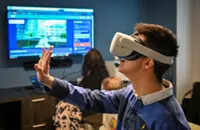
When the pandemic disrupted their studies, medical students at Musgrove Park Hospital in the UK turned to VR technology to continue their training.
Hand-held controllers and VR headsets allowed the students to immerse themselves in virtual hospital settings, learn how to explain diagnoses and discuss treatment plans, deal with difficult situations, and engage with patients’ families, all without in-person training.
The technology, by British startup Virti, also let the students virtually visit operating theatres, which in real life would be limited to only three or four people at once.
Surgeon and lead for skills and courses at the hospital Richard Bamford said the VR experience is reliable, realistic and based on a real-world setting.
“It gives them (the students) a good opportunity to train, particularly in times when training has been affected by different reasons, Covid being one of them,” he said to AFP.
Happy tech
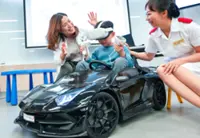
Residents at a Florida senior community centre have been using VR headsets with video and sound that let them choose to experience floating in outer space with astronauts, or visit Paris, Venice or other far-flung locales.
Stanford’s Virtual Human Interaction Lab is using VR at the senior centre as part of a study to see if it can be used to boost residents’ moods, improve relationships with staff and make seniors more open to technology.
“This particular study is focused on how using VR might reduce the residents’ feelings of isolation from the outside world – all the more important after the isolation we all faced during the pandemic,” the Stanford lab’s founding director Jeremy Bailenson said in an AP report.
Mind games
Dell Medical School at the University of Texas is conducting a study using VR and video games to attempt to rewire the brains of teenagers with epilepsy, according to a report by the Austin American-Statesman.
Teens who need brain surgery to stop their seizures and are enrolled in the study will have that area of their brains mapped to see what functions are located there.
Using specialty treadmill virtual reality game systems, participants will play specific video games to allow researchers to see how those areas in the brain are working in real time.
Researchers will also give the brain feedback using sensors and VR, with the goal of helping it perform specific functions such as movement or speech or language in different areas.
Their hope is that the brain will remember the new neural pathways created through playing the games repeatedly, to help minimise the amount of permanent damage caused by the surgery and thereby reduce the number of therapies needed by patients.
Fear not
Austin-based startup Rey is looking to help mental health patients learn to overcome phobias with VR in tandem with cognitive behavioral therapy, according to a report by the Austin American-Statesman.
The company’s technology allows people explore their fears in virtual environments with a virtual coach, who will guide them through exercises designed to reprogramme the brain’s response to specific triggers.
The startup is building on technology and research developed by Oxford University which showed that digital therapeutics can help people achieve clinical outcomes in as little as two weeks.
Apart from phobias, Rey is also using its technology to offer treatment for psychosis, post-traumatic stress disorder, fear of heights and social avoidance. It aims to include fear of public speaking and obsessive compulsive disorder in future treatments.
Heads up
To address growing concerns over brain injuries that have been linked to heading, a crucial part of football, VR has been tapped as a potential preventative approach.
UK software company Rezzil is working with top Premier League football clubs to enhance training for players through its latest VR headset ‘Player 22’, which focuses on heading drills.
The company’s co-founder Andy Etches told Reuters the technology will help to reduce the amount of times players make contact with a physical ball, while the virtual drills aim to teach them how to head the ball safely.
The company believes VR could help combat the risks of lasting brain injuries as a result of heading.
According to Greg Wood, senior lecturer in Motor Control at Manchester Metropolitan University, who are working with Rezzil on the technology: “We found that doing some heading movements in VR is up to five times less of an impact than heading an actual ball, so it has less impact on the head and on brain function.”
Already a subscriber? Log in
Get 20% OFF The Star Digital Access
Cancel anytime. Ad-free. Unlimited access with perks.