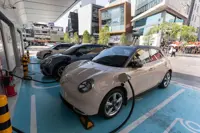
Electric cars have grown a reputation of being more dangerous when they go on fire. They've even been banned from underground garages in some countries. Do fire safety experts and accident researchers really agree there's a greater risk?
Images of burning electric cars regularly make the rounds on the Internet. Are these just isolated cases or are electrics genuinely a fire hazard?
“The fact is that, according to our findings, electric cars do not pose a higher risk of fire than conventionally-powered cars,” says Markus Egelhaaf, an accident researcher with vehicle inspection company Dekra.
Of course, electric cars can burn. In contrast to a diesel or petrol engined vehicle, where leaked fuel or hot surfaces in the exhaust system can spark a fire, other parts of an e-car are the potential danger points.
"The causes here can be, for example, damaged battery cells or defects in the battery management system," the accident researcher says.
A distinction also has to be made between the situation in which a fire arises, for example whether or not it's after an accident.
"In the event of fires following an accident, for example, from our experience there is no difference in the risk between electric cars and combustion engines," according to Egelhaaf.
In addition, fire brigades haven't found e-car fires to be harder to fight.
"Extinguishing an electric vehicle may be a little more difficult than fighting a fire in conventional vehicles, but is not more complex or dangerous than a fire in a conventional vehicle," says Peter Bachmeier, director of the German Fire Brigade Association (DFV).
A battery fire in an e-car has to be fought with a lot of water to cool down the storage cells. Because battery packs are mostly installed in the underbody and are well protected, the main task for the emergency services is to get the extinguishing water there quickly.
Doing that when the burning vehicle is in a garage is more difficult, but then that applies to vehicles of all drive classes.
The intensity of a car fire is less related to the type of drive than to the materials used, especially the plastics. When burned, they cause a lot of smoke and toxic gases.
However, it's highly unlikely that an electric car will catch fire after an accident. According to Germany's automobile association ADAC, electric cars often do better in crash tests than petrol or diesel cars.
Dekra came to a similar conclusion after several crash tests carried out with the Gottingen University Medical Centre.
In any case, it makes sense for drivers to have a fire extinguisher on board, regardless of whether they are driving a combustion engine or an electric car.
"With a small hand extinguisher, it is always possible to fight a fire originating in the 12-volt electrical system," Egelhaaf says.
However, drivers should never touch the components of the high-voltage system of an electric car, which are marked with the colour orange.
In addition, electric car drivers should always ensure that their vehicle is charged with charging cables that are in good condition and that are connected to a suitable network.
"Incorrectly repaired or defective charging cables can lead to fires, as can charging on insufficiently dimensioned building-side power installations," Egelhaaf warns. – dpa
Already a subscriber? Log in
Get 20% OFF The Star Digital Access
Cancel anytime. Ad-free. Unlimited access with perks.