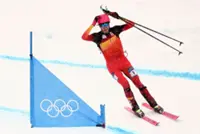
BORMIO, Italy, Feb 19 (Reuters) - Russian ski mountaineer Nikita Filippov became the first individual neutral athlete (AIN) of these Winter Games to win a medal on Thursday, when he secured silver in the first-ever "SkiMo" men’s sprint event at an Olympics.
There were no Russian flags in the stands for him, as per IOC rules, but Filippov’s friends were there to support him, chanting “Nikita, Nikita,” as the 23-year-old ascended the podium.
There was no contrasting booing to be heard from the crowds and also no friction among the athletes regarding the silver medallist’s nationality.
Filippov said that while he had not received any negativity about competing as a Russian while in Italy for the Games, he has received some negative comments online.
“I don't care about this,” he said of social media, focusing instead on the kindness of the SkiMo community.
“I'm very happy that Nikita is here and he can compete and show his level,” fifth-place finisher Ot Ferrer Martinez of Spain said.
Filippov’s second place came as no surprise to the SkiMo world. Earlier in February he won bronze in the sprint World Cup event in Spain. Olympic bronze medallist Thibault Anselmet of France, who had won the February event, says he is used to sharing the podium with Filippov, “Nikita is really strong, he's a great athlete,” he said.
For Filippov, the Olympic medal is a childhood dream come true and one that did not come to fruition without an extra dose of pressure ahead of the races. Scrolling social media, he said he saw people posting about the athlete being the “main hope” for an AIN medal.
“I told myself, ‘Just relax, Nikita, do your thing and the medal will come,’” he said.
“It's hard because I see other athletes with flags of their nations and wearing uniforms of their nations,” Filippov told reporters after his race, “But it's OK, everybody knows what country I am from, and I'm just happy to be here and to realise my childhood dream.”
He also expressed his hope that soon there won't be a need for neutral athletes.
"I hope next year, after the Olympics - in World Cups and overall in the world - we'll be no neutral athletes, where we'll be just like in the past."
(Reporting by Marleen Kaesebier in Bormio; Editing by Hugh Lawson)