THE future direction of Malaysian golf will come under the spotlight next Saturday when delegates gather in Miri, Sarawak, for the Malaysian Golf Association’s (MGA) annual general meeting, where a fiercely contested election could reshape the leadership of the national governing body.
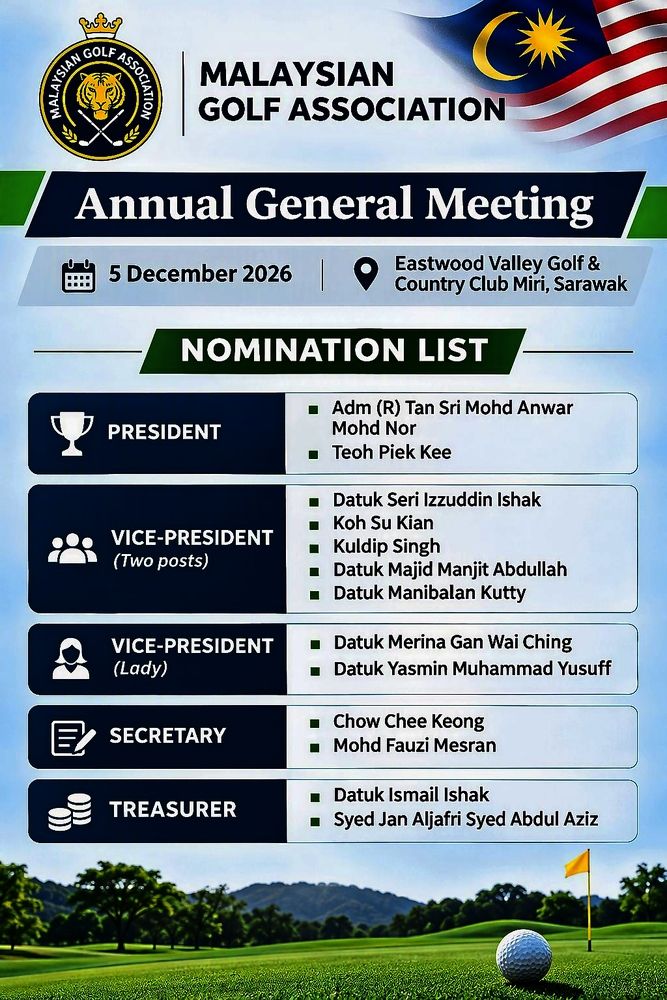
For the first time in years, the presidency is being seriously challenged, with incumbent Adm (R) Tan Sri Mohd Anwar Mohd Nor facing current vice-president Teoh Piek Kee in a contest that many within the industry view as a referendum on the MGA’s stewardship of the game.
Anwar, who has led the association for the past 15 years, is seeking another term at a time when concerns over finances, governance and the MGA’s relationship with clubs and stakeholders have become increasingly prominent.
While the presidential contest will attract the most attention, the battle for the two men’s vice-president posts appears set to be the most competitive race on the ballot. Five candidates: Kuldip Singh, Datuk Seri Izzuddin Ishak, Koh Su Kian, Datuk Majid Manjit Abdullah and Datuk Manibalan Kutty, are in contention.
The women’s vice-president post will be contested by incumbent Datuk Merina Gan Wai Ching and Datuk Yasmin Muhammad Yusuff of Royal Selangor.
Elsewhere, Chow Chee Keong, who has served two terms as treasurer and assumed acting secretary duties following the resignation of Datuk Zulkifli Ismail earlier this year, will face Mohd Fauzi Mesran for the secretary’s post.
The treasurer’s position will be contested for by Syed Jan Aljafri Syed Abdul Aziz and Datuk Ismail Ishak.
At the heart of the election is a debate over the MGA’s future direction. Critics have pointed to the body’s financial challenges, the absence of a clear national development pathway and what many perceive as a disconnect between the association and its stakeholders, including golf clubs, players, parents and sponsors.
Indeed, Anwar acknowledged this week that the MGA needed to become more “inclusive and engage more closely with clubs” while broadening its focus beyond the national squad.
Teoh, meanwhile, has campaigned on a platform centred on “restoring the association’s credibility, financial health, rebuilding industry confidence” and establishing what he described as a transparent and accountable player development system that caters to all.
Among the proposals put forward by Teoh’s team are the appointment of a national coach, a clearer pathway from junior golf to the national squad, independently reviewable selection criteria, the revival of the Malaysian Open and the introduction of term limits restricting office-bearers to a maximum of three two-year terms.
Teoh acknowledged that restoring confidence in MGA – especially in the eyes of the public and sponsors – would not happen overnight, but insisted that improving the association’s financial health can be the only starting point for any meaningful reform.
“Without financial stability, it becomes difficult to implement lasting change,” he said. “Our priority would be to rebuild trust and credibility so that both the public and private sectors are willing to support the association again.”
Among the key initiatives proposed by his team is a more structured player development framework designed to create a seamless pathway from junior golf through to the national squad and ultimately the professional ranks.
Teoh said greater consultation with prospective sponsors, golf clubs, coaches, parents and guardians, former and current national players and administrators would be central to that process.
He also pledged to introduce a transparent and independently a reviewable player selection system – a move aimed at addressing longstanding concerns within the golfing community over the consistency and fairness of selections for national programmes.
Another key aspect of the reform agenda would be the appointment of a national coach and the establishment of stronger support mechanisms at state level to ensure player development is not concentrated solely within the national set-up.
Teoh’s camp has also identified the revival of the Malaysian Open as a priority. Once a fixture on the European Tour (now the DP World Tour), the tournament has been staged only twice in the past decade, despite its historical importance to Malaysian golf and its ability to attract international attention to the local game.
Governance reforms also feature prominently in the challenger’s programme. Among the proposals being put forward is a limit of three consecutive two-year terms for elected office-bearers, which supporters argue would encourage renewal within the association while strengthening accountability.
While Teoh has outlined an agenda centred on reform and renewal, delegates will also weigh the case for continuity offered by the incumbent administration.
The outcome of the vote will signal how clubs view the MGA’s performance of the past decade and, perhaps more importantly, what they believe is required to move the game forward in the years ahead.
Anwar’s team was invited to share their outlook for this article. At the time of going to press, no reponse was received.
Already a subscriber? Log in
Get 20% OFF The Star Digital Access
Cancel anytime. Ad-free. Unlimited access with perks.