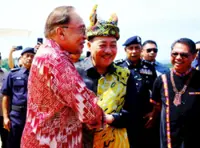
SOMETIMES a single photograph says more than pages of commentary. A recent image of three Malaysian healthcare personnel from Malay, Chinese and Indian backgrounds standing beside Tun Dr Mahathir Mohamad during the funeral of his late wife, Tun Dr Siti Hasmah Mohamad Ali, has done precisely that.
Dr Siti Hasmah, a pioneering physician and public health advocate, passed away on Sept 28 at the age of 100 and was laid to rest at Pusara Negara, Precinct 20, Putrajaya. Her death marked the end of a remarkable life of medical and public service.
Yet, amid the solemnity of the occasion, another message emerged quietly through the photograph.
Three backgrounds, one professional duty, one human being, one shared responsibility; the significance of the image is not simply that it shows ethnic diversity. It is that people of different backgrounds were united by a common responsibility: caring for another human being at a moment of vulnerability. That distinction matters.
We often encounter people through categories such as ethnicity, religion, nationality, language or culture. These identities are important, and they contribute to the richness of society.
But they should never become barriers to dignity, compassion or responsibility.
The photograph offers a simple reminder: When another person is vulnerable, the first question should not be, “Who are they?” It should be, “How can I help?”
This principle is consistent with professional medical ethics. The World Medical Association’s Declaration of Geneva places service to humanity, patient well-being and respect for human dignity at the heart of medical professionalism.
It also states that ethnic origin, religion, nationality, race and social standing should not interfere with a physician’s duty to a patient.
In this sense, the photograph gives a human face to a principle that professional responsibility can rise above social difference.
Malaysia is often described as a multicultural, multiethnic and multireligious nation. But diversity only becomes meaningful when different communities who live alongside one another are prepared to stand alongside one another.
Living beside someone requires proximity. Standing beside someone requires solidarity. The photograph captures that difference. The three healthcare personnel did not need to become identical to work together. Their backgrounds remained distinct, yet their professional responsibility brought them into a common space. Their differences did not prevent cooperation; they became part of the larger picture.
This is an important lesson for a plural society. Diversity alone does not guarantee harmony. What transforms diversity into social strength is mutual respect, justice, trust, responsibility and compassion.
Harmony does not mean removing difference. It means learning to live responsibly with difference.
There is also a deeper ethical lesson here. Healthcare professionals carry an amanah; a trust and responsibility towards those placed in their care.
But amanah extends far beyond medicine. A teacher has a responsibility towards students. A public servant has a responsibility towards society. A scholar has a responsibility towards knowledge and truth. A leader has a responsibility towards those affected by decisions. A neighbour has a responsibility towards the wider community.
In each case, integrity is demonstrated not only by what we say but also by what we do when
another human being needs us. The photograph therefore illustrates how ethical conduct can turn diversity into cooperation.
The message also has relevance beyond Malaysia. Societies around the world continue to grapple with questions of identity, belonging and social cohesion. No society is perfect, and Malaysia itself continues to face the challenge of maintaining trust and unity across differences.
Malaysia’s national framework also recognises the importance of unity. The Rukun Negara identifies closer unity among the community, justice, respect for diverse cultural traditions, courtesy and morality among its objectives and principles.
Social cohesion, however, is not created only by policies and institutions. It is also built through everyday acts of responsibility: a doctor caring for a patient, a teacher treating students fairly, a neighbour helping another neighbour or citizens refusing to let difference become a reason for indifference.
That is where the photograph becomes powerful. It shows that unity does not require sameness.
Perhaps the most important lesson is simple. When someone needs help, help them. When someone is suffering, stand beside them. When someone is vulnerable, protect their dignity. Do not allow ethnicity, religion, language or cultural background to become an excuse for indifference.
Malaysia’s strength should not be measured only by the diversity of its people. A deeper measure of social maturity is the capacity to transform that diversity into cooperation, mutual respect and shared responsibility.
The photograph is therefore more than a photograph. It is a small image of a larger aspiration: a Malaysia where differences remain visible, dignity remains protected, and humanity remains the common ground.
We do not need to be the same to stand together. We need only to recognise that our shared humanity creates responsibilities that transcend our differences.
Sometimes, one picture is enough to remind us of what we should never forget: Before we are different, we are human.
DR MOHAMMAD EISA RUHULLAH
Senior lecturer
Academy of Islamic Studies
Universiti Malaya
Already a subscriber? Log in
Get 20% OFF The Star Digital Access
Cancel anytime. Ad-free. Unlimited access with perks.