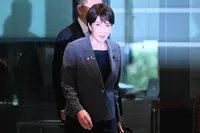

Xi has proposed the Global Civilisation Initiative (GCI), which advocates respect for the diversity of world civilisations, promotes common human values, emphasises inheritance and innovation, and strengthens international people-to-people and cultural exchanges and cooperation.
This provides a Chinese approach to promoting the progress of human civilisation and shared development and prosperity, continuously injecting civilisational momentum.
In today's era of globalisation, international relations are complex and multifaceted, and the relationship between China and Asean undoubtedly serves as a shining example.
As China's largest trading partner, Asean enjoys increasingly close economic and trade ties, deepening political mutual trust and ongoing dialogue.
Together, Asean and China are writing a new chapter of friendly cooperation between countries and regions.
Both China and Asean nations are driven by long-term interests and shared security that necessitate mutual learning and exchange.
First, China and Asean countries are geographically close and share a common destiny. Issues such as the South China Sea, cross-border security, and regional governance can only be addressed through dialogue and mutual understanding, reducing suspicion and avoiding confrontation.
Mutual learning and exchange essentially builds a "trust buffer" for regional stability.
Second, China and Asean are deeply intertwined economically, and cultural exchange facilitates smoother cooperation. They are each other's largest trading partners, the Regional Comprehensive Economic Partnership (RCEP) has been fully implemented, and industrial and supply chains are highly integrated.
Cultural similarities and people-to-people bonds reduce cooperation costs and institutional friction.
Third, China and Asean countries each possess unique development experiences, making them highly complementary.
China has rich experience in poverty reduction, infrastructure development, the digital economy and industrialisation. Asean has unique advantages in areas such as diversified governance, marine economy, cultural and tourism integration, and the development of small and medium-sized enterprises.
Mutual learning and exchange between China and Asean evolved from a concept into rich practices covering education, culture, media, intangible cultural heritage, youth and cultural tourism.
The China-Asean Education Exchange Week, for example, is a flagship intergovernmental platform, accumulating 2,203 educational cooperation agreements, establishing 26 educational alliances and 24 centres of cooperation, and promoting the deep integration of Chinese language and vocational skills.
The Chinese Language Education Network: 42 Confucius Institutes has been established in Asean nations, making Chinese a second foreign language in many countries.
More than 200,000 students have been involved in exchange programmes, making young people the main force in cultural dissemination.
The China-Asean Intangible Cultural Heritage Week gathers intangible cultural heritage from various countries, including Vietnamese opera, Thai Khon opera, Burmese lacquerware and Chinese Hakka Lei Cha (pounded tea), which promotes its living transmission through performances, markets and forums.
The China-Asean Literary Translation Project promotes the mutual translation of books in multiple languages, including China-Myanmar and China- Vietnam.
Meanwhile, "New Malay-Chinese Spoken Language" has become a textbook and cultural calling card for universities in China and Malaysia.
More than 160 events were held for the China-Asean Year of People-to-People Exchanges (2024-2025), covering all fields, pushing mutual learning and exchange to a new high.
The China-Asean Cultural Forum is an annual high-level dialogue platform to explore topics such as cultural heritage and digital culture, and to build consensus on cooperation.
Asean's inclusive attitude is rooted in its extensive diversity: in its political systems, ethnicities, languages, religions, cultures and dietary habits.
Although geographically fragmented, Asean has forged a powerful cohesive force through mutual respect, transforming diversity into a cooperative advantage.
This experience provides valuable lessons for the international community.
Civilisational exchanges and mutual learning are essential for advancing human civilisation and promoting world peace and development.
Confucius Institutes, as a vital platform for educational cooperation between China and Asean countries, have not only promoted Chinese language teaching but also deepened cultural exchanges among nations.
With the support of the Center for Language Education and Cooperation, the number of Confucius Institutes in Thailand has grown rapidly.
As of 2025, 17 Confucius Institutes and 11 Confucius Classrooms have been established, covering major cities such as Bangkok, Chiang Mai, Songkhla and Phuket, making Thailand one of the countries with the largest number of Confucius Institutes worldwide.
These institutes not only offer Chinese language courses but also organise diverse cultural activities.
As the saying goes, "amity between peoples holds the key to sound state-to-state relations, and heart-to-heart communication holds the key to amity between peoples".
Cultural exchanges and cooperation have played a positive role in fostering mutual understanding and affinity among the various countries, attaching great importance to people-to-people exchanges and cooperation, particularly among the youth, with an eye towards further enriching China-Asean interactions in future.
In today’s world, advocating for inclusive coexistence and mutual learning among civilisations holds special significance for our times. In an era of continuous advancements in artificial intelligence and information technology, there is a need for "bridges of communication" rather than "towering walls" to enhance understanding rather than widening divides, and to promote cooperation rather than create confrontation.
China, Thailand, Myanmar, Laos, Cambodia and Vietnam are eternal friendly neighbours "sharing the same river and a common future".
The Lancang-Mekong Cooperation mechanism stands as one of the landmark achievements advocating for inclusive coexistence and mutual learning among civilisations.
Cultural and artistic exchanges between China and Asean have become an important pathway connecting peoples, which resonates the long-standing history shared by the nations.
What they are creating together is a bright future of vibrant interactions among the youth of China and Asean countries.
Dr Li Renliang is an Associate Professor at the National Institute of Development Administration. The views expressed here are entirely the writer’s own.
The SEARCH Scholar Series is a social responsibility programme jointly organised by the South-Rast Asia Research Centre for Humanities (SEARCH) and Tunku Abdul Rahman University of Management and Technology (TAR UMT).
Already a subscriber? Log in
Get 20% OFF The Star Digital Access
Cancel anytime. Ad-free. Unlimited access with perks.