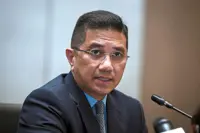
TRUE to his promise, Tan Sri Norza Zakaria did not overstay his welcome as the president of the BA of Malaysia (BAM).
Norza did not leverage on the fact that under his watch, BAM delivered a world title for the first time since 1977.

Neither did he go around and thump his chest for the 36 international titles registered by players under the BAM’s payroll, including 11 in 2023 alone, throughout his presidency.
His resignation as the 12th president of BAM since it was established 90 years ago by Ipoh-based lawyer John L Woods in November 1934, was announced officially on Aug 24 during the governing body’s council meeting, five days short of his 58th birthday.
With Norza shifting his attention to his presidency at the Olympic Council of Malaysia (OCM) and the vice-presidency of the Olympic Council of Asia (OCA), history will arguably reflect fairly on his tenure at BAM.
A one-time treasurer of the FA of Malaysia (FAM), Norza has left a list of policies in place as his legacy.
This includes key performance indicators and merit-based assessment for senior players, establishing the Badminton Academy of Malaysia (ABM) where elite junior badminton players are housed, initiated the AirAsia-BAM Junior League which saw the yearly participation of over 4,000 students from 280 schools and above all he has bequeathed his successor an association in a healthy financial state.
His result-oriented leadership was also evident in the unprecedented decision to bring in the consulting arm, Pemandu, to study and recommend changes to BAM’s structure, technology, and people management.
Deputy president, Datuk V. Subramaniam, who has been in the system since the 1980s, will serve as acting president until the national body holds their annual general meeting at the end of the council’s current term next year.
The incoming 13th president, whether it is Subramaniam or a high-profile corporate figure or a budding politician, will be tasked to continue developing the elite group.
But the bigger challenge is to continue to pull in the sponsors.
In his seven years at the helm, Norza succeeded in attracting Petronas, Affin Bank and Perodua among a few to bankroll BAM’s activities, that cost RM50mil to operate per year.
While the next president focuses on the financial sustainability of BAM, historian Dr Lim Peng Han has urged the secretariat to review their strategy if badminton is to finally land the elusive gold in Los Angeles Olympics.
“The Indonesian BA president, Try Sutrisno, implemented three key policies to meet their objective of winning gold medals at the Barcelona Olympics in 1992.
“The best coaches – Tang Hsien-hu, Christian Hadinata and Liang Chu Sia – each specialist coaches in their own respective areas such as men’s singles, men’s doubles and women’s singles were hired, while a training centre at Cipayung with living quarters was established, and a blanket contract with Yonex to provide all the necessary badminton equipment for the elite men’s and women’s teams was sealed.
“Susi Susanti delivered Indonesia’s first ever gold in the women’s singles before Alan Budi Kusuma won the men’s singles, while Ardy Wiranata and Hermawan Susanto bagged the silver and bronze respectively.”
BAM accomplished a similar strategy to regain the Thomas Cup in 1992.
In August 1985, the late Tan Sri Elyas Omar succeeded Tan Sri Khir Johari, took stock of the situation and launched the Thomas Cup-Uber Cup-Olympic Games or TUO Project, modified from a similar project by KLBA of which Elyas was president, in 1986.
It bore fruition with the 1992 Thomas Cup victory.
With due respect to the present BAM administration, the president has to have a Datuk Punch Gunalan by his side.
The late Gunalan, a mechanical engineer by training, was the engineer behind Elyas the architect. While Elyas designed the style and shape of the structure, Gunalan made sure it was sustainable and rock solid thanks to his background as a player, coach, marketing man and a strategist.
As chief coach of the victorious 1992 Thomas Cup squad, Gunalan did not leave any stone unturned.
Putting his engineering background into practice, Gunalan made modifications to the training courts, so that the team were exposed to sharper drops and shots.
To help prepare the shuttlers in reading the flight of the shuttlecock, Gunalan inserted screws into the cork base.
But the science of the badminton shuttlecock is much simpler than how the game is governed.
All the best to the new president.
Already a subscriber? Log in
Get 20% OFF The Star Digital Access
Cancel anytime. Ad-free. Unlimited access with perks.