IT’S been UN Week this past week, when world leaders converge in New York to give speeches at the United Nations General Assembly – in an august hall where you feel that important decisions about the fate of humankind are made.

But I digress. There were no documents to negotiate this UN Week but there were speeches galore. Most people have focussed on the outrageously clownish speech that the US president made where, among others, he railed against climate change and immigration, claiming that countries that accept migrants are all going to hell. It makes me wonder what he might say when he comes to Kuala Lumpur for the Asean meeting next month. Are our thick skins all ready?
Most of the leaders’ speeches were statesman-like, fiery, and dignified. They talked about the really important issues facing the world today. Climate change is real, even if the leader of a country that has suffered devastating floods and fires denies it.
Genocide in Gaza is an inescapable truth and 157 countries out of a total of 193 UN member states have recognised Palestine as a sovereign state including the United Kingdom, France, Spain, and Australia. Such recognition may have had the added benefit of limiting places where Israelis want to go on holiday, but the genocide won’t end unless those countries take concrete action.
Colombian President Gustavo Petro called for an international armed intervention to end the suffering of the Palestinians. Warning that the bombing of Gaza is just the precursor to worse things, President Petro said, “They will not just bomb Gaza, not just the Caribbean as they are doing already, but all of humanity that demands freedom. Washington and Nato are killing democracy and helping to revive tyranny and totalitarianism on a global scale.”
Fiery words indeed. But the one speech I enjoyed most and thought important and prescient was by Nobel Peace Laureate and journalist Maria Ressa. Noting that 72% of countries nowadays live under some form of authoritarian rule, Ressa argued for the need to ensure people’s right to accurate information. Information integrity, she said, is the mother of all battles, because every day people are assailed with floods of information that they can’t be sure is true or not.
Not enough is being done to ensure the integrity of what we read online and that’s because it serves some people to keep the flow of false information going. Nothing helps an authoritarian-inclined leader more than to keep people divided, and the use of social media is the best tool for such a person.
As Ressa said, “Algorithms reward outrage over empathy”. This is just the contemporary form of what British comedian John Cleese once pointed out many years ago when he talked about the advantages of extremism. “The greatest advantage of extremism,” Cleese said, “is that it makes you feel good, because it provides you with enemies”. The good thing about that is that “you can pretend that all the badness in the whole world is in your enemies and all the goodness is in you”.
To be fair, Cleese was talking about all kinds of extremisms, but this type of thinking has been amplified by technology to reach millions and millions more people than Cleese could have. Today, someone can say something that is completely untrue, like for example, that migrants are taking over a particular country. Since this is an outrageous idea, it quickly catches fire and goes viral in seconds.
How do you pull this back in this era of speedy short-form news? You can put up all sorts of stories about good, hardworking migrants but they do not get anywhere near the traction of the nasty ones. People like being outraged, and they are rewarded by that, as Ressa said, by being fed even more outrageous stories.
All of this has consequences. Ressa also pointed out in her speech that we are living in an “information Armageddon where lies spread six times faster than facts, on social media”. Online violence, she emphasised, has real world consequences. Violent speech on social media does not remain there. It can motivate people to take real world action. Hence we see refugees being attacked by strangers and mosques being attacked and burnt. Or people demonstrating in front of stores that have mistakenly flown flags wrongly or unknowingly sold inappropriately patterned socks.
Rarely are these perpetrators ever brought to justice. What we do know, however, is that this information Armageddon leads to impunity.
People believe lies, especially those told by their leaders, and then they take action knowing full well that they will not suffer punishment. After all, they are simply obeying what they perceive is the right thing to do. This is the danger that Ressa is warning us about. Indeed, she says that the biggest battle we face today is impunity, the license to do something without fear of a punitive response.
In our own country, we have seen how misinformation works. Fake news and outrage algorithms thrive when there is a vacuum, a dearth of reliable information from credible sources.
This is why freedom of the press and freedom of speech is important because it provides people with an alternative avenue to get information. But if people are constantly told that certain subjects are off limits even if they affect everyday lives, then it is no wonder that untruths and conspiracy theories abound.
Does it breed happiness and a benign feeling towards our leaders? I doubt it.
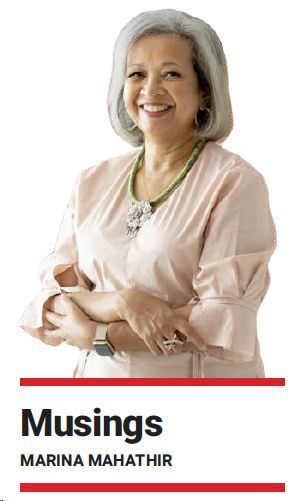
Marina Mahathir is steeling herself for October and hoping not to cringe too much. The views expressed here are solely the writer’s own.
Already a subscriber? Log in
Get 20% OFF The Star Digital Access
Cancel anytime. Ad-free. Unlimited access with perks.