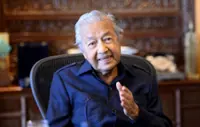
'What do Malaysians look like?'


Despite so many people around the world who insist on retreating into supposedly pure ethnic groups, people are mixing more and more, due to migration, studying and working abroad as well as in the arts like January Low and Orkestra Tradisional Malaysia (above). — OTM

A Malay, a Chindian and a Eurasian took a blind American woman to dinner.

If that sounds like the start of a joke, I’m sorry to say it’s not. Nor is it a particularly sad story. But it is instructive.

A few weeks ago, I had a speaker at my ZafigoX conference called Dr Mona Minkara. Dr Minkara is a Lebanese-American assistant professor of bioengineering at a university in Boston, Massachusetts. If that’s not already impressive, what’s even more remarkable is that Dr Minkara has been blind since she was seven years old. It’s a genetic condition called macular degeneration which her older sister also has.

Not only has Dr Minkara overcome many challenges to become a scientist, but she also loves to travel the world and experience new things. She has a YouTube channel called Planes, Trains and Canes in which she talks about her many experiences travelling the world as a blind person. It is a fascinating -and occasionally terrifying – series that every sighted person should watch. Dr Minkara, who is only 35, is a lively, friendly and humorous person who wants to prove that you can be independent and enjoy many things that life has to offer even if you must rely on only four of your senses.

For that dinner, we took her to a well-known Malay restaurant where she enjoyed all the different flavours and spices of our cuisine. As it was her first visit to Malaysia, my two colleagues and I had the job of describing what our country is like to her. One of the main things we described was our ethnic diversity, using our usual statistics about all the different groups.

Then she said, “I don’t know what Malaysians look like. Can you describe yourselves to me?” For a blind person like her, everything must be described verbally.

That was when we got stumped. My Chindian colleague said that she is the product of a Chinese mother and an Indian father. “But what does a Chinese person look like?” Dr Minkara asked.

Trying to describe ourselves physically to a visually disabled person is a lot more challenging than we think. How, for instance, do we describe a person of Chinese heritage, without resorting to all sorts of stereotypes? Do we generalise to say that every single one has slit eyes and long straight black hair? Is every Malay person brown-skinned? What exactly is a Eurasian?

Presented with this problem, we were all stumped. As sighted people, we recognise the visual clues that identify a person’s ethnic origin. We then confirm it with their names. But even then, we can make mistakes. I remember once thinking that the flight attendants on a Malaysia Airlines flight had deliberately swapped their name tags because none of them looked like the ethnicity that the badge on their chests suggested. Most recently I stayed at a longhouse in the Sarawak interior. Looking around the faces of the people who had gathered to welcome us, I could not pinpoint any faces that I could definitively say was Iban.

To me, this was a huge lesson that I learnt from Dr Minkara who is already an inspiring person as a blind scientist and traveller. When you’re blind, your skin colour and the skin colours of the people you encounter matter not at all. What matters is how you behave and how you talk. Yes, the culture you grew up with may influence your attitudes and actions but even then, it cannot encompass an entire people.

You can’t say that all people of a certain ethnic origin do not like disabled people, for instance. Or that they all speak loudly. Or that they don’t believe in having dustbins in the streets. Every time you try and generalise about any particular people, you are going to be stereotyping them. And you could wind up sounding racist.

(It has always astounded me when watching videos of children in Gaza how difficult it would be to describe a Palestinian child, since so many of them, with their blonde hair and blue eyes, look European. I suppose nowadays the identifying sign would be whether they had limbs or not.)

This experience was a revelation in the futility of dividing people by their race, especially in a country like ours that has long been the crossroads of all sorts of people from all over the world. At the same conference, we had a performance by the dancer January Low. January has a Chinese father and a Eurasian mother, and she learnt classical Indian dance from a Malay teacher. She exemplifies the wonderful mix that is Malaysia.

There are many more like her, as we intermarry and have children who also intermarry, sometimes with pairings that can be quite unusual. I know a pair of twin girls who are half-Chinese and half-Spanish. One of the interns in my office is half-Chinese and half-Japanese. I have friends who have half-Indian and half-German children. My older daughter is half-French, my younger one is half-Javanese and they have cousins who have halves and quarters that are Chinese, Indian, American, Irish and so on.

Despite so many people around the world who insist on retreating into supposedly pure ethnic groups, people are mixing more and more, due to migration, studying and working abroad or just the ability to travel. It makes for a rich mixture of genes that are usually beneficial for all of humankind. (Ironically, this is lost on the immigrant-hating President-elect Trump and Vice-President-elect JD Vance, both of whom are married to migrant women).

For that to happen, it needs a generosity of spirit and a reluctance to erect barriers to the meeting of different kinds of people. Yet what we see now is increasing prejudice and hatred towards people we classify as different, either because of their skin colour, religion or station in life. In fact, even our religious brethren are abhorred if their skin and circumstances are considered inferior.

In one of Dr Mona Minkara’s videos, she meets a poor village woman in the Philippines who is also blind. The conversation they had reduced everyone watching to tears. Both women may have been visually disabled but one was born in a country where she had all the resources, educationally and technologically, while the other did not even have a white stick to help her move around. It was an abject lesson to all of us that while we may think we are disabled in one way, we can in fact be supremely privileged in so many other ways.

Marina Mahathir believes that you never know when you will receive a life lesson. The views expressed here are solely the writer's own.

Get 20% OFF The Star Digital Access

Monthly Plan

RM 13.90/month

RM 11.12/month

Billed as RM 11.12 for the 1st month, RM 13.90 thereafter.

Best Value

Annual Plan

RM 12.33/month

RM 9.87/month

Billed as RM 118.40 for the 1st year, RM 148 thereafter.

Follow us on our official WhatsApp channel for breaking news alerts and key updates!
Marina Mahathir , Musings column

Next In Columnists

Guideline on vet fees will help rescuers
Healing the healthcare system
A sport where you never walk alone
A week of musical surprises
When the eyes go cloudy and dim
Messi soars, Ronaldo stumbles the GOAT debate has a new chapter
Leave only footprints on the hill
Beyond trade figures: Malaysia-China shared prosperity for an ageing society
Malaysia's rainforest resorts are the world's best-kept secret – and that has to change
Bidding farewell to the teaching profession�

Others Also Read