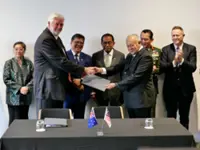
KINSHASA, July 2 (Xinhua) -- The Africa Centers for Disease Control and Prevention (Africa CDC) Director-General Jean Kaseya warned Thursday that the ongoing Ebola outbreak in the Democratic Republic of the Congo (DRC) remains "very serious," as the country has reported more than 400 deaths and a clinical trial has begun enrolling patients to evaluate potential treatments.
Kaseya made the remarks in Kinshasa during a visit by DRC President Felix Tshisekedi and his South African counterpart, Cyril Ramaphosa, to the country's National Institute for Biomedical Research.
Compared with previous Ebola outbreaks in the DRC and the West African Ebola epidemic at the same stage, the current outbreak has recorded a particularly rapid increase in both cases and deaths, Kaseya said.
"The objective is to contain this outbreak where it is today," he said. "We do not want this outbreak to last two years, as was the case in West Africa."
According to the latest situation update released by the Congolese government late Wednesday, the DRC had reported 1,406 confirmed Ebola cases, including 438 deaths, as of June 30.
Kaseya said the outbreak was still expanding to some extent, but the Congolese government was taking the right steps to interrupt transmission and bring the outbreak to an end.
Tshisekedi underlined the need for a regional response to the outbreak, saying that "health risks know no borders and call for a regional, coordinated and solidarity-based response founded on shared responsibility."
Ramaphosa urged financial pledges to be rapidly translated into concrete assistance for affected communities. He also called for a ceasefire in conflict-affected areas, saying that fighting was hampering the access of humanitarian aid and the deployment of health workers.
The South African president urged communities to protect frontline health workers from stigma and violence, while reaffirming Pretoria's support for African innovation in vaccine development.
DRC Health Minister Samuel-Roger Kamba called for accelerating clinical trials on monoclonal antibodies and the development of effective vaccines against Bundibugyo ebolavirus, for which no approved treatment currently exists.
The World Health Organization (WHO) said Thursday that a clinical trial had begun enrolling patients in the DRC to evaluate potential treatments for Ebola disease caused by the Bundibugyo virus.
According to the WHO, the trial will assess the monoclonal antibody MBP134 and the antiviral drug remdesivir, alone and in combination.
DRC Minister of Social Affairs, Humanitarian Action and National Solidarity Eve Bazaiba warned that the Ebola outbreak was unfolding against a severe humanitarian crisis, with about 15 million Congolese in need of urgent humanitarian assistance.
The country was caught in a "vicious circle," she said, where "Ebola is worsening the humanitarian situation, while the humanitarian situation is increasing the risk of the disease spreading."
Kaseya added that the DRC was not facing a single public health crisis. In areas currently affected by Ebola, many cases of cholera and measles have also been reported, placing additional pressure on the health system and humanitarian response.