HAMILTON: Iran's Foreign Minister Abbas Araghchi on Monday (March 9) dismissed the possibility of negotiating with the United States after a "very bitter experience".
Anadolu Ajansi reported that in an interview with PBS News, Araghchi responded to a question on whether Iran's new supreme leader, Mojtaba Khamenei, would be open to renewed talks or a ceasefire, saying "it's too soon for him to make any comment."
"But I don't think the question of talking with Americans or negotiation with Americans once again would be on the table because, you know, we have a very bitter experience of talking with Americans," he said, pointing to the 12-day war last June when the Israeli and US militaries targeted Iranian nuclear facilities amid talks between Tehran and Washington.
Citing the latest round of US-Iran nuclear talks that concluded in Geneva in late February, where both sides had described the atmosphere as serious and constructive under Omani mediation, Araghchi said: "But again, after three rounds of negotiation, and after the American team in the negotiation said itself that we made big progress, still, they decided to attack us."
"So I don't think talking with Americans anymore would be on our agenda," he said.
He also confirmed that the selection of the young Khamenei is a "continuity" of defiance to the US and Israel and also described it as "some sort of stability at the same time."
On the widespread oil disruptions, the Iranian minister told PBS News that "this is not our fault. This is not our plan."
Arguing that the production and transportation of oil are slowed down "because of the attacks and aggression made by Israelis and Americans against us," Araghchi also stressed that the attacks "have made the whole region insecure."
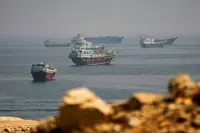
"This is why the tankers, the ships are scared to pass through the Strait of Hormuz," he said, affirming that Iran did not close the strait.
Araghchi also blamed the Israelis and Americans for making the "whole region insecure, unstable."
"The consequences are huge for not only us, but for the whole region, and now for the international community," he added.
When asked if Iran's strategy is limiting oil supply via attacks on oil facilities in the region, he claimed that Iran's actions are only to defend itself.
"We are facing an act of aggression, which is absolutely illegal, and what we are doing is the act of self-defence, which is legal and legitimate," he said.
Noting that Tehran had "already warned everybody in the region," he explained that "if the US attack us, since we cannot reach American soil, we have to attack their bases in the region, their facilities, their installations, their assets."
"And as a result, the war would be spread into the whole region," he said, adding: "We are not responsible for that." — Bernama-Anadolu