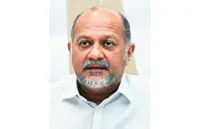
JOHANNESBURG, March 20 (Xinhua) -- South Africa's gross domestic product (GDP) grew 0.6 percent in 2024, with household consumption and lower inflation being the major contributors, the country's central bank said on Thursday.
Lesetja Kganyago, governor of the South African Reserve Bank (SARB), made the remarks on Thursday in Pretoria, the administrative capital, while announcing the decision of the Monetary Policy Committee (MPC).
Kganyago said South Africa's economic growth picked up in the fourth quarter of last year. "As expected, the uptick was led by the household sector, boosted by lower inflation and withdrawals from the two-pot pension system. That said, the overall growth picture was disappointing, with other sectors showing weakness."
"Growth for 2024 as a whole was 0.6 percent, marginally below our expectations, and slightly worse than in 2023. We have now revised down our 2025 growth forecast slightly, to 1.7 percent, while leaving the outer years unchanged," said Kganyago. "We attribute lower growth partly to subdued demand, and partly to lingering supply-side fragilities."
The governor pointed out that the global economy is facing unprecedented levels of uncertainty, with trade tension escalating. He said the MPC discussed the slowdown in the United States, with a weaker dollar and higher commodity prices, especially for gold.
"We also explored scenarios built around changes in South Africa's access to U.S. markets. If South Africa were to lose the African Growth and Opportunity Act benefits, we see some weakening of exports and slightly lower growth. If that were compounded with tariffs on South African exports, the effects would be larger," said Kganyago.
"The most severe scenario we considered added a sentiment shock, with a weaker rand, higher domestic inflation, and therefore, a tighter policy stance. In this case, growth would be lower by 0.7 percentage points, with the exchange rate depreciation offsetting some of the tariff effects on exports," he added.
Kganyago noted that South Africa should sustain domestic reforms that boost growth, while preserving macroeconomic stability. According to him, South Africa is addressing some of the challenges affecting the country, which include transport and logistics bottlenecks, power shortages, and low investment.
The governor also said South Africa should reduce the public debt levels and keep real wage growth in line with productivity gains.
He added that the South African economy is expected to grow 0.4 percent in the first quarter of 2025 and 0.5 percent in the second quarter. The SARB has projected GDP to grow between 1.7 and 1.8 percent in 2025.