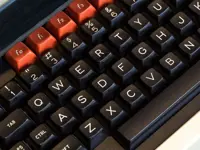
IF YOU have ever tried teaching a child how to type, you may have wondered, “Why on earth is the keyboard not in alphabetical order?”
Internet lore and trivia nights have long offered a dramatic explanation - early typewriter users were typing so fast that the mechanical keys kept jamming. This led inventor Christopher Latham Sholes to deliberately shuffle the alphabet into a chaotic, inefficient mess to slow everyone's fingers down.
Is it true that our modern QWERTY keyboard was deliberately engineered to slow typists down?
Verdict:

FALSE
When Wisconsin newspaper editor Christopher Latham Sholes, alongside his collaborators, filed their first typewriter patent in June 1868, the key layout looked like a miniature piano keyboard arranged strictly in alphabetical order.
The bottom row ran from A to M, while the top row ran from N to Z alongside numbers and basic punctuation.
Soon, however, it became a typing nightmare because with the early 1870s typewriters, the keys were attached to long metal typebars. When a key was pressed, its metal arm swung up to strike the ink ribbon against the paper.
In the English language, many frequently paired letters (like T-H, S-T, H-E, or I-N) sat right next to each other in the alphabetical layout. When typed rapidly, their adjacent metal arms collided in mid-air, tangling like a pair of clashing swords and jamming up the machine.
Sholes spent five years tweaking the layout through trial and error to fix the constant jams.
In 1873, Sholes sold the manufacturing rights to firearm and sewing machine maker E. Remington and Sons. Remington mass-produced the first typewriter with a Shift key for uppercase and lowercase letters in 1878.
A landmark 2011 study by historical researchers Koichi Yasuoka and Motoko Yasuoka at Kyoto University also revealed another major force behind QWERTY: Early beta-testers were telegraph operators transcribing Morse code.
An alphabetical keyboard was confusing for receiving telegraphers. In Morse code, the letter Z (`· · · ·`) is easily confused with the letter sequence SE.
Operators requested key movements to help them quickly distinguish and type ambiguous Morse sequences, leading to key placements like putting S, E, and Z near one another.
So, QWERTY was not created to slow anyone down. In fact, it was designed to help operators type faster by preventing mechanical jams and catering to the needs of 19th-century telegraph operators.
References:
https://www.bbc.com/news/technology-10925456
https://www.forbes.com/sites/quora/2019/01/10/why-was-the-qwerty-keyboard-layout-invented/
https://boosttyping.com/blog/post/history-of-qwerty-keyboard-layout