



PETALING JAYA: While scrolling through social media during her downtime, Anisa Abdullah often comes across content offering medical advice, aesthetic procedures and beauty services.
Many of these content creators have the prefix “Dr” in their social media handles with some even claiming to be surgeons and specialists in their fields.
However, she wonders whether these individuals are actually qualified, in light of reports of bogus practitioners.
“Their advice seems believable and convincing but doubts still linger in my mind due to previous cases of impersonation,” said the 29-year-old writer.
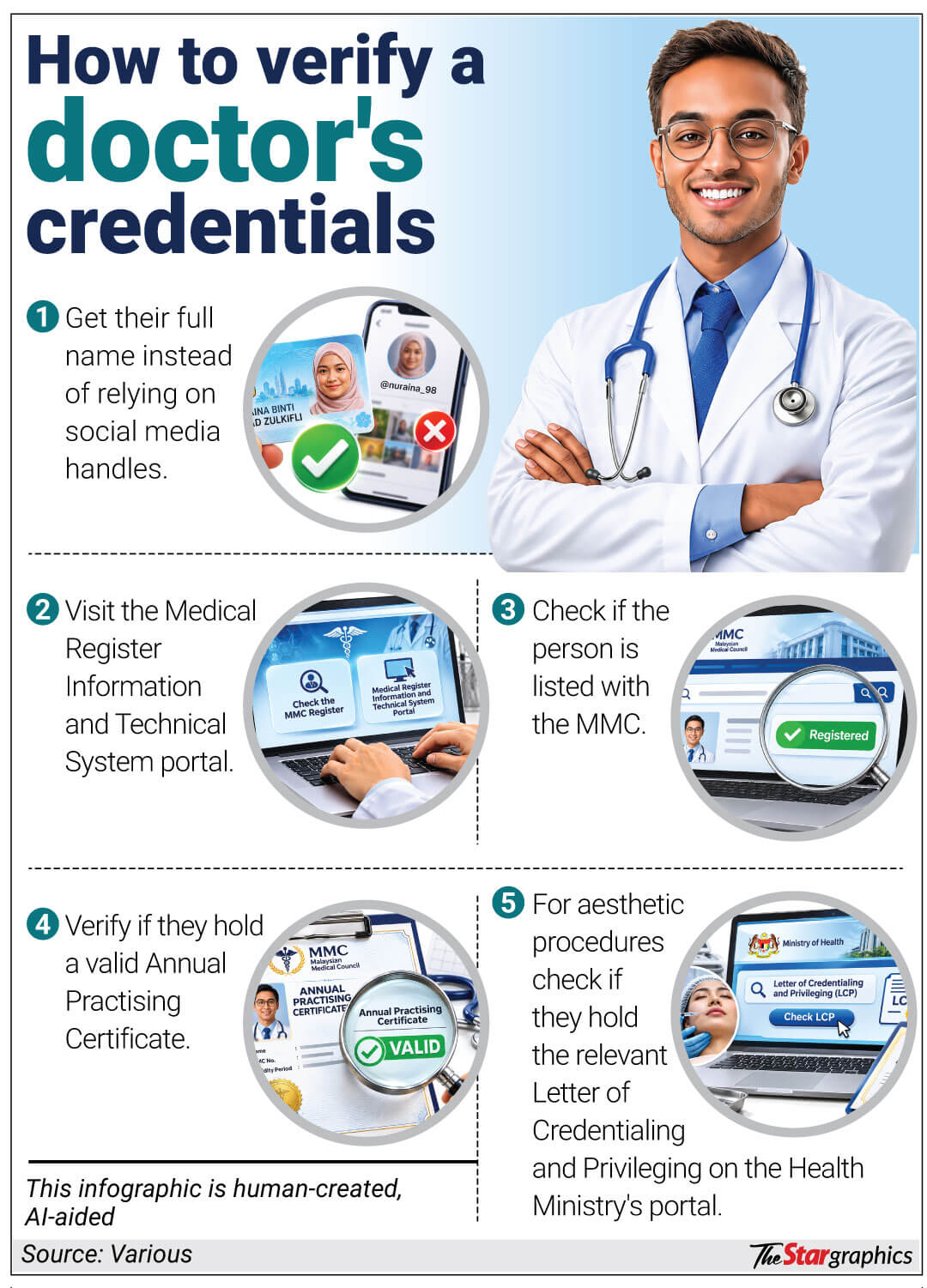
Her concerns reflect calls for greater scrutiny of medical content creators with the Malaysian Medical Association (MMA) warning that the use of the title “Dr” to promote medical products and services could have serious implications for public trust and patient safety.
“While the title ‘Dr’ is not exclusive to medical practitioners, the issue is when it is used to mislead the public into believing that an individual is qualified and legally authorised to practice medicine.
“Even possessing a medical degree does not automatically confer the right to practice medicine in Malaysia,” said MMA president Dr Sivanaesan Letchumanan.
Of particular concern, he said, are aesthetic treatments like botulinum toxin injections, dermal fillers, slimming injections and the promotion of weight-loss products and treatments.
He said MMA supports stricter requirements for the disclosure and verification of professional credentials on social media, particularly where medical advice, treatments or services are being promoted.
“Individuals presenting themselves as medical practitioners should be required to prominently display their full name, relevant qualifications, Malaysian Medical Council (MMC) registration number and current practicing status.”
Dr Sivanaesan said social media platforms should verify medical credentials before allowing individuals to advertise medical services and promptly remove misleading content and fraudulent accounts.
“A large social media following, a blue verification tick or a white coat is no substitute for legitimate medical credentials,” he said.
Lawyer Thulasy Suppiah said there may be a need to strengthen how existing laws apply online.
She said the Medicines (Advertisement and Sale) Act 1956 is among the laws already in place.
“What could be strengthened is the disclosure requirement where medical credentials are being used online,” Thulasy said.
The Medical Act 1971, she said, also deals with false representation.
“What needs to be clearer is how that applies online where the same impression can be created through a profile, username, livestream or the way someone presents themselves to an audience.”
Thulasy said the Consumer Protection Act 1999 also prohibits false or misleading representations.
Where there is a commercial transaction involving misleading medical credentials, Thulasy said the Consumer Protection Act 1999 may also apply.
For eligible consumer claims, she said it can be brought before the Consumer Claims Tribunal, which can hear claims of up to RM50,000.
“The claim must generally arise within three years.”
Thulasy said a civil claim can be considered as well.
“The consumer would need to show what was said or represented, that they relied on it and that, it caused the harm they are claiming for.
“Screencaps, videos, messages, receipts and medical records should all be preserved.”
She also said the authorities may investigate the person involved concurrently.
Thulasy said platforms need to take a more active role and verify that identity against the MMC registry.
