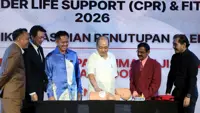
KUCHING: With 11 new faces and a traditional seat allocation, the Gabungan Parti Sarawak (GPS) candidate line-up reflects consolidation and cooperation within the four-party coalition.
GPS chairman Tan Sri Abang Johari Openg said the line-up consists of a mix of experienced and younger candidates.
“We have some candidates from the youth wings of the component parties.
“The Beting Maro candidate, Awang Nashfarini Awang Sarbini, is on of the youngest at 35,” he said when announcing the line-up at Parti Pesaka Bumiputera Bersatu (PBB) headquarters yesterday.
GPS comprises PBB, Sarawak United People’s Party (SUPP), Parti Rakyat Sarawak (PRS) and Progressive Democratic Party (PDP).
Abang Johari will defend Gedong while SUPP president Datuk Dr Sim Kui Hian, PDP president Datuk Seri Tiong King Sing and PRS president Datuk Seri John Sikie Tayai are retained in Batu Kawah, Dudong and Kakus, respectively.
Engkilili incumbent Johnical Rayong, who quit PDP on Sunday only to apply to join SUPP on Tuesday, was named to defend the seat.
GPS also named SUPP’s Kevin Lau, one of the new faces, to defend the Bawang Assan seat.
With the announcement, SUPP retained its traditional seats of Bawang Assan and Engkilili.
PDP had staked a claim on both seats after Rayong and Bawang Assan incumbent Datuk Seri Wong Soon Koh joined the party in 2024.
However, both announced their resignations from PDP on Monday, with Wong saying that he would not contest.
Universiti Malaya political analyst Prof Datuk Dr Awang Azman Awang Pawi said the Bawang Assan and Engkilili outcome showed that “the absorption of elected representatives from another party does not automatically confer permanent ownership of their constituencies”.
However, he said this was not necessarily a defeat for PDP, adding that it reflected Abang Johari’s role in managing competing interests within GPS.
The immediate issue for GPS, he added, is maintaining cooperation between SUPP and PDP beyond the election.
Prof Awang Azman said the share of new faces among GPS candidates had dropped from 29.3% in 2021 to 13.4% this time.
“GPS candidate selection reflects a strategy of consolidation rather than transformation,” he said.
“Retaining experienced representatives could also minimise internal dissatisfaction over dropped candidates.”
But fewer new faces raised questions about leadership succession, especially since Abang Johari had indicated this could be his last term, he added.
Another overwhelming mandate would strengthen GPS political legitimacy in negotiating with Putrajaya on matters such as the Malaysia Agreement 1963 (MA63) and oil and gas rights, said Prof Awang Azman.
He said federal leverage depended on GPS parliamentary seats, noting that the 23 it won in the 15th General Election had made it significant in forming the Federal Government.
“Constitutional rights under MA63 should not be regarded as political concessions in exchange for parliamentary support.
“They are constitutional and historical obligations that must be addressed regardless of electoral outcomes,” he said.
Universiti Malaysia Sabah political analyst Assoc Prof Dr Lee Kuok Tiung said SUPP emerged the clear winner after two years of overlapping claims with PDP.
He said the line-up eliminated multi-cornered confusion within GPS.
He called Rayong’s move to SUPP “a deliberate pressure-release valve engineered by the GPS leadership”.
“This honours SUPP’s historical claim to Engkilili and keeping Rayong also prevents him from running as an independent spoiler, which would have split the Dayak-Chinese vote,” he said.
Lee also said an open tussle over seats could affect support among urban Chinese voters, who have historically been swing-minded.
“Any open turf (war) will only look like power-brokering rather than service delivery, which can either push disillusioned voters toward DAP or depress Chinese voter turnout in close races,” he said.
Pragmatic urban voters weighed local allocations and development funding, he added.
“Tiong’s personal machinery in Dudong and SUPP’s backing from the state government give GPS strong institutional leverage that DAP cannot match from the opposition bench,” he said.