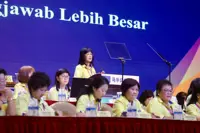
KUALA LUMPUR: Political cooperation has become part of Malaysia’s political landscape and can be discussed, but MCA will not compromise on its principles, says party secretary-general Datuk Chong Sin Woon.
He said political strategies could be adjusted, but the party’s stand must remain clear.
“Political cooperation is negotiable. Political principles are not,” he said at the 4th General Assembly of the 17th MCA Central Delegates on Saturday (Nov 21).
Chong said any future cooperation between Barisan Nasional and Perikatan Nasional must be carefully considered and not be based solely on electoral arithmetic or short-term political gains.
“We want cooperation based on principles, not cooperation without limits,” he said.
He said MCA must first establish whether a proposed partnership was in line with the party’s political principles; whether its partners upheld the values of a multiracial and multireligious Malaysia and the rights guaranteed under the Federal Constitution; and whether MCA would have an equal voice and role in decision-making.
The party must also be able to continue representing the Chinese community while protecting the legitimate interests of all Malaysians, he added.
“If there are no clear answers to these questions, we cannot rush into a decision merely for the sake of an election,” Chong said.
Chong said MCA, as a founding component party of Barisan, hoped the coalition would regain its multiracial, moderate, inclusive and consultative character.
He added that MCA could not remain a party waiting for others to allocate seats or decide its direction.
“MCA must have its own strength, its own voice and its own political value,” he said.
“MCA must be a partner, not a political appendage; a decision-maker, not an observer.”
The issue has come under sharper scrutiny following informal cooperation between PAS and Barisan during the Johor state election earlier this year.
Although there was no formal electoral pact between Barisan and Perikatan, PAS leaders called on their supporters to back Barisan candidates in constituencies where Perikatan was not contesting.
Questions over MCA’s position and bargaining power have also surfaced following developments in the Negri Sembilan and Melaka state elections, including concerns over seat negotiations and the implications of closer ties between Umno and PAS.
Chong said Malaysia was at a critical juncture, with economic opportunities accompanied by concerns over the rising cost of living, business costs and employment prospects for young people.
While the government had highlighted stronger economic growth, rising investment and Malaysia’s growing international profile, he said the benefits of such growth must be felt by ordinary Malaysians.
“Economic figures may rise, but it must not come at the expense of the people’s purchasing power,” he said.
Chong said development should not benefit only large companies and foreign investors, but must also support small and medium enterprises, local traders and ordinary families.
He said Malaysia’s increasingly complex political landscape meant parties that had once been rivals could now discuss cooperation.
However, he stressed that political stability could not be achieved by sacrificing principles or the country’s multiracial character.
“Malaysia was built on the foundation of a plural society. The diversity of race, religion, language and culture is our strength, not our weakness,” he said.
Chong said the country should reject politics based on hatred, racial division and extremism, which could further divide Malaysians.
He said MCA wanted a fair and inclusive Malaysia where every community had a place, every religion was respected, and every Malaysian had the opportunity to progress.