KUALA LUMPUR: Setting aside 30% of election candidacies for women is not enough if they are not fielded in seats with a strong fighting chance, says MCA Wanita chief Datuk Wong You Fong.
She said political equality should be measured by the number of women elected and involved in decision-making, not merely by the number nominated to contest.
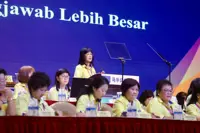
“Thirty per cent women candidates does not mean 30% women elected representatives,” she said in her policy address at the 4th General Assembly of the 17th MCA Central Delegates on Saturday (Nov 21).
Wong said women with ability and experience should be given a fair opportunity to contest in constituencies where they stand a reasonable chance of winning.
She pointed to MCA’s performance in the Johor state election, where the party fielded four women candidates.
The appointment of Chan San San as Johor deputy executive councillor, she said, showed that women could take on political leadership roles.
Wong said MCA’s central leadership should put in place a clearer mechanism to train and promote women political leaders.
This should include political training, grassroots experience, involvement in policy work and opportunities to contest elections, she said.
She also called on the party to attract more young women, saying their participation would bring fresh ideas and energy to MCA.
“MCA Wanita should not merely be a supporting wing. It must be an important participant in policy-making, political decision-making and the development of talent within the party,” she said.
MCA won eight seats in the Johor state election in July, two seats in the Negri Sembilan state election in August, and retained Machap Jaya and Kelebang in the Melaka state election earlier this month.
The party’s two victories in Negri Sembilan – Chennah and Repah – ended its 13-year absence from the state assembly.
Wong said MCA must remain clear about its political position amid an increasingly complex political environment.
As a party which stands for pluralism, moderation, rationality and constitutional principles, she said MCA would continue to defend Malaysia’s multicultural society, the multi-stream education system and the rights of all communities.
She said MCA opposed the use of religious and racial sentiment to create division, as well as policies that undermined social justice and national unity.
“MCA’s political position must not lose its principles because the political environment changes, and MCA Wanita’s direction must not waver because of the challenges it faces,” she said.
Wong said MCA must put the people’s interests first by scrutinising government policies rationally, supporting sound policies, pointing out weaknesses and putting forward practical proposals for reform.
She said MCA Wanita would continue to strengthen its grassroots organisation, develop women political leaders, promote women’s empowerment and take part in national policy discussions.
The wing would build on its three missions and five action plans, she added.
Wong said winning an election was only a starting point, while earning the people’s trust over the long term was the real test.
She said MCA Wanita must strengthen its grassroots work by combining surveys, community service and policy research to turn people’s concerns into practical policy proposals.
“We cannot go to the people only during election campaigns. We must be in the community at all times, listen to their views and help solve their problems,” she said.
She added that MCA Wanita must be more than an election machinery, and should play a role in serving society, developing talent, proposing policies and driving reform.
On Barisan Nasional, Wong said the coalition must continue to pursue practical and effective policies to help the people.
She said its priorities should include economic development, fair access to education, protection for women and children, the welfare of senior citizens and harmony in Malaysia’s multi-racial society.
“People do not only want to hear political promises. They want solutions to the problems they face in their daily lives,” she said.
Wong said all Barisan component parties should strengthen cooperation in identifying the people’s concerns and putting forward constructive policy proposals.
“The strength of Barisan is not measured only by the number of seats it wins, but by its ability to bring positive change to the people’s lives,” she said.
She said Barisan’s strength lay in the unity of its component parties and any differences should be resolved through mature consultation and in a spirit of mutual respect.
“When Umno, MCA, MIC, Parti Bersatu Rakyat Sabah (PBRS), and People’s Progressive Party (PPP) stand together, we can build a stronger, more moderate and inclusive political platform for Malaysia’s future,” she said.