Anwar calls for shared responsibilities toward emerging economies
PETALING JAYA: The better developed economies in the Asia-Pacific must do more to help emerging economies and developing nations by sharing investments, technology and opportunities.
To this end, fairer trade policies are needed that can bridge the gap between developed and developing economies, Datuk Seri Anwar Ibrahim said.
The Prime Minister said such policies would strengthen trade and innovation while accelerating progress in artificial intelligence (AI) and semiconductors.
Anwar added that the entire multilateral framework must change, now that the imperial colonialistic era has passed.
“We have entered into a new era with more confidence and assertiveness.
“Small countries and emerging economies must be treated with more respect, dignity and equality,” he said in his address at the Asia-Pacific Economic Cooperation (Apec) CEO Summit in Shenzhen yesterday.
Anwar added that remote countries in Africa, Asia and Latin America need this recognition.
“These nations have suffered immeasurably for decades of colonialism and oppression, and they need to breathe new life that can come about with this trading and investment framework,” he said.
Earlier, Chinese President Xi Jinping opened the summit with a pledge to open China’s market to more global products and services while upholding multilateralism and the rule of law.
Anwar, replying to Xi’s pledge, said it was meaningful for top business leaders and trading nations like Malaysia.
The Prime Minister added that countries in the Asia-Pacific region must retain the freedom to chart their destinies, with the fruits of economic integration shared equitably among the people.
Technological advancements, he said, must also serve humanity’s progress.
“Growth and development must serve the people. It should not lead to further inequities nor condone forms of neglect and oppression.
“Peace and prosperity must be within reach of every nation, community and person, regardless of the country’s size, wealth or political influence.
“It is necessary for us to look beyond immediate interests and recognise our shared responsibility for the world we leave behind,” the Prime Minister said.
The business community, Anwar said, plays an indispensable role in assisting and working together to shape the Asia Pacific’s future and its impact on the world.
“The investments undertaken, technology developed and partnerships forged will determine the economic landscape of the region for decades to come.
“With this influence comes a responsibility to ensure that opportunities created extend beyond centres of wealth and that technological advancements impact the entire community,” he said.
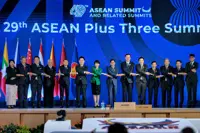
The Prime Minister arrived in Shenzhen, Guangdong province, just north of Hong Kong, from Manila at midnight on Tuesday to attend the 33rd Apec Economic Leaders’ Week (AELW).
Meanwhile, Xi is also expected to meet with Russian President Vladimir Putin and US President Donald Trump for unprecedented talks between the leaders of the world’s three biggest nuclear powers.
Apec is an intergovernmental forum for 21 member economies in the Pacific Rim that promotes free trade throughout the Asia-Pacific region, which represents nearly 40% of the world’s population, almost half of global trade and over 60% of the global economy.
Malaysia is among the 12 founding members of Apec. The others are Australia, Brunei, Canada, Indonesia, Japan, South Korea, New Zealand, the United States, the Philippines, Singapore and Thailand.
China, Hong Kong, Taiwan, Mexico and Papua New Guinea joined in 1993. Chile acceded in 1994, and in 1998, Peru, Russia, and Vietnam joined, bringing the full membership to 21.
Often described as China’s Silicon Valley, Shenzhen is home to some of China’s most influential technology giants, including Huawei, Tencent, BYD and DJI, cementing its reputation as the country’s leading innovation and technology hub.