
KUCHING: The coming Sarawak election is likely to see tight races in several urban Chinese-majority seats, with one or two potentially changing hands, say analysts.
They identified Padungan, Pending and Batu Lintang in Kuching, and Pelawan and Bukit Assek in Sibu as among the seats to watch, with candidate selection, local sentiments and turnout being important factors that could decide the outcome.
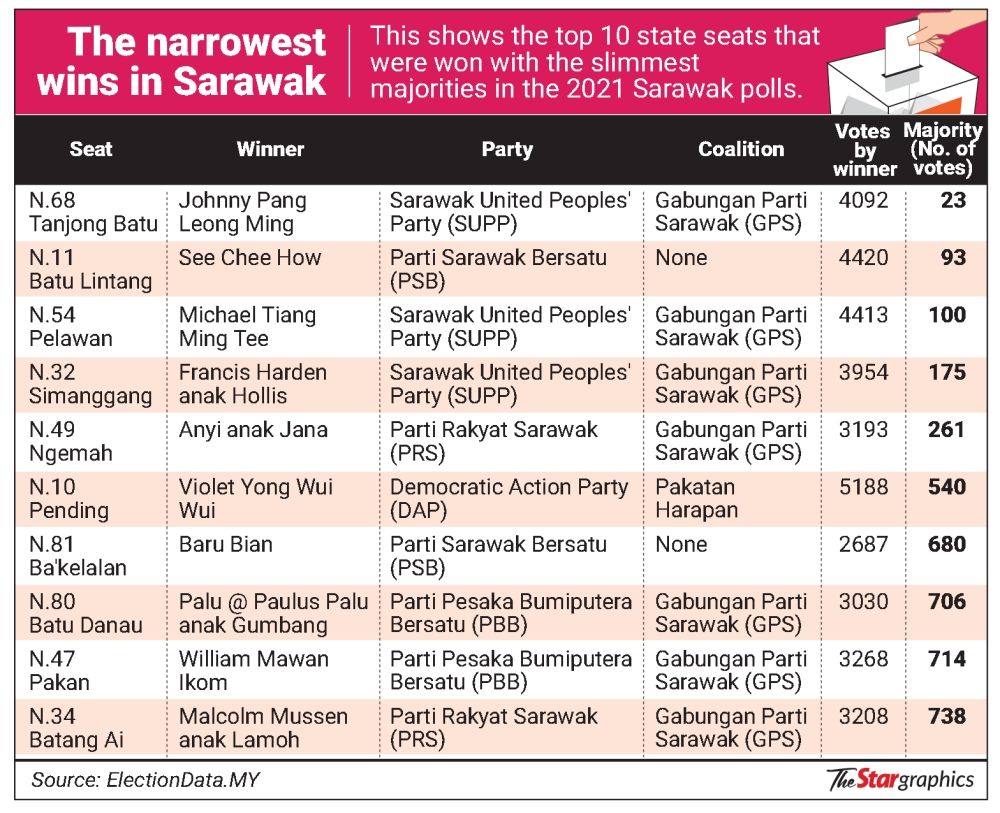
Prof James Chin from the University of Tasmania said Pending would be competitive if Gabungan Parti Sarawak (GPS) fielded Kuching South mayor Datuk Wee Hong Seng against DAP’s four-term incumbent Violet Yong, who won by a slim 540-vote majority in 2021.
He said the Sarawak United People’s Party (SUPP), one of GPS’ four component parties, has made flipping Pending a target.
“They have every reason to put up Wee because he has brand name recognition.
“Yong has a big advantage in that she’s very good in ceramah, but a big bloc of voters are new voters who may not go for her style anymore,” he said.
Prof Chin also noted that if Wee was fielded in Padungan instead, he would similarly put up a good fight against DAP’s incumbent Chong Chieng Jen.
However, he said Wee’s chances in Padungan depended on securing support from the local SUPP branch as he is a member of the Pending branch.
In 2021, Kuching SUPP, which oversees Padungan, dismantled its election machinery a week before nomination in protest over Wee’s candidacy. Wee lost to Chong by 1,198 votes in a four-cornered fight.
A similar dilemma may be brewing for SUPP in Batu Lintang, as incumbent See Chee How, who previously won as a Parti Sarawak Bersatu (PSB) candidate before quitting to become an Independent, applied to join SUPP last month.
Despite a multi-cornered fight which split the opposition vote in 2021, See won by 93 votes over his SUPP challenger.
“Batu Lintang is perhaps the most politically complicated constituency,” Universiti Malaya political analyst Prof Datuk Dr Awang Azman Awang Pawi said.
“See’s possible integration into SUPP creates an opportunity for GPS to consolidate support. Nevertheless, tensions over candidate selection and the local SUPP branch could undermine that advantage.”
In Sibu, Prof Chin expects one of Pelawan or Bukit Assek to fall to the opposition.
“What I’m hearing (from the local Chinese community) is that they overdid it in the last election. Everything went to GPS and they’re not happy about it.
“They feel that without one opposition voice in Sibu, nothing will get done.”
Prof Awang Azman said DAP’s reported intention to concentrate its resources in Pelawan, where it lost by 100 votes previously, could make the seat one of its strongest potential gains.
He identified Tanjong Batu as another highly competitive seat, which GPS flipped by 23 votes in 2021.
“A possible rematch between Johnny Pang (GPS) and Chiew Chan Yew (DAP) would be an important indicator of whether voters prioritise government representation or opposition accountability,” he said.
In Simanggang and Ngemah, where GPS won by 175 and 261 votes, respectively, in 2021, the main question was whether strong individual challengers could reproduce the previous close contests, he said.
“If opposition forces fail to maintain a comparable local candidate and organisation, GPS should benefit from its stronger machinery,” he said.