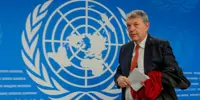
MANILA: Despite Asean’s achievements in promoting regional peace and stability, the worsening humanitarian crisis in Myanmar remains a serious concern, with United Nations Secretary-General António Guterres (pic) calling for greater protection of civilians and unhindered humanitarian access.
Guterres, speaking at the 16th Asean-United Nations Summit here on Monday (Nov 16), commended the regional bloc’s efforts in maintaining peace, including progress in negotiations on a Code of Conduct in the South China Sea and its role in sustaining the ceasefire between Cambodia and Thailand.
However, he warned that the continuing conflict in Myanmar demanded urgent attention, particularly as the humanitarian situation deteriorated.
“But I am deeply concerned by the continuing crisis in Myanmar. Human suffering has reached epic proportions.
“I call on all parties to protect civilians, uphold international law, and allow safe, sustained and unhindered humanitarian access,” he said.
Prime Minister Datuk Seri Anwar Ibrahim also attended the summit, leading Malaysia’s delegation.
Guterres also highlighted the plight of the Rohingya community, adding that nearly a decade after their forced mass displacement, many were still awaiting justice and the conditions necessary for their safe return.
“Nearly a decade after their forced mass displacement, the Rohingya still await accountability for grave violations and the conditions for safe, voluntary, dignified and sustainable return.
“Until these conditions are met, States have a duty to protect those fleeing violence and persecution,” he said.
He reaffirmed the UN’s commitment to supporting the implementation of Asean’s Five-Point Consensus (5PC) and an inclusive, Myanmar-led political solution.
Such a solution, he said, must address the root causes of the conflict, end violence nationwide and secure the immediate and unconditional release of all those arbitrarily detained.
It must also guarantee that the people of Myanmar can exercise their rights freely and peacefully.
On regional peace efforts, Guterres congratulated the Philippines on the successful conduct of elections in the Bangsamoro Autonomous Region in Muslim Mindanao (BARMM), describing the achievement as a significant milestone in consolidating the peace process.
“This should serve as an example well beyond the Philippines and this region,” he said.
Reflecting on the Asean-UN partnership, Guterres said cooperation had expanded considerably since he attended his first summit as Secretary-General in Manila in 2017.
He said the partnership now covered areas ranging from peacekeeper training and conflict prevention to climate resilience, human rights, technological innovation and sustainable development.
Nevertheless, he warned that the region continued to face mounting global challenges, including conflicts, climate change, rising humanitarian needs and increasing trade and energy costs.
He also called for reforms to the UN Security Council and international financial institutions to better reflect the growing economic and political influence of developing regions such as Asean.
Meanwhile, Philippine President Ferdinand Marcos Jr. said stronger international cooperation was essential to accelerate progress towards the Sustainable Development Goals (SDGs), with fewer than four years remaining until the 2030 deadline.
“With 2030 less than four years away, and only 36% of accessible Sustainable Development Goals targets are on track, achieving these goals requires renewed political will, stronger partnerships with the private sector and cooperation that is evidence-based and responsive to the needs of its members, especially developing countries,” he said.
Marcos said Asean-UN cooperation continued to encompass peace and security, economic integration, disaster management, climate action and the protection of vulnerable communities.
Guterres, who noted that this would be his final Asean-UN Summit as Secretary-General, said he would remain committed to the region’s continued progress.