PETALING JAYA: The planned Malaysia Transport Safety Bureau (MTSB) must be backed by stronger enforcement, safer infrastructure and transparent follow-up measures to reduce deaths, say safety experts.
Malaysian Road and Transportation Safety Association president MD Hairolazaman Muhamed Nor said setting up the board alone will not be enough without stronger enforcement and preventive measures.
“The MTSB must operate independently to ensure its findings are not compromised by conflict of interest, particularly when investigating accidents involving government agencies or transport operators.
“The board would need clear legal powers, specialised resources and strict transparency requirements to ensure its findings are translated into meaningful safety improvements,” he said.
Universiti Putra Malaysia Road Safety Research Centre head Prof Dr Law Teik Hua said while the board can identify the underlying causes of accidents and recommend preventive measures, investigations alone cannot address Malaysia’s road safety challenges.
“Tougher punitive actions are required against reckless behaviour such as excessive speed, hazardous manoeuvres, violation of traffic light regulations, drink-driving and drug-impaired driving,” he said.
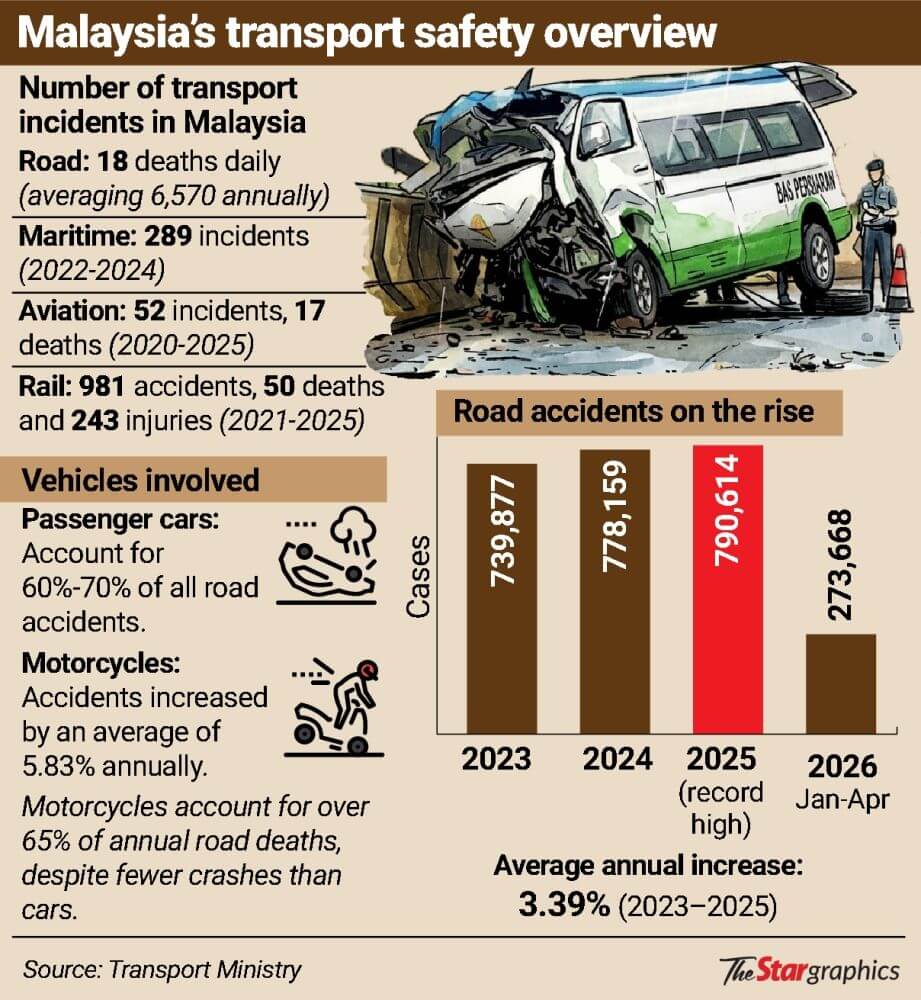
Particular attention, said Law, should be given to motorcycle safety as most fatal crashes involve motorcycle riders or passengers.
He also called for improvements to problematic road designs, vehicle safety features and high-risk locations, alongside public education and stronger enforcement.
ALSO READ: Preventing the same accidents
Malaysia’s Road Safety Plan 2022–2030, he added, aims to reduce road accident deaths by at least 50% from 2019 levels by 2030, but the challenge is translating the policy framework into practice.
“The MTSB must be legally protected from political, administrative or organisational interference, especially when investigations involve road design, maintenance, vehicle safety or regulatory oversight.
“The goal of independent investigations entails exposing systemic failures within the transport context and preventing future accidents,” he said.
The board, he pointed out, should have access to crash sites, relevant records, vehicles and infrastructure, as well as the technical expertise needed to investigate road design, vehicle engineering, human behaviour and transport operations.
He said agencies should be required to respond to the board’s recommendations and provide implementation timelines, with progress monitored and reported publicly.
Law said safety management in rail and aviation must also be prioritised, with regular audits and risk assessments covering railway maintenance, signalling systems, staff training, aircraft maintenance, pilot fatigue and air traffic control.
“Accident investigations should look beyond individual errors to identify technical faults, maintenance deficiencies and wider weaknesses in safety management,” he said.
“Effective investigations should prioritise preventive measures against recurring accidents over merely producing reports.
“The MTSB’s recommendations should be made public and relevant authorities and operators be held accountable for their responses and actions.”
Universiti Pertahanan Nasional Malaysia associate professor Ng Choy Peng agreed that setting up the MTSB would be a major step forward but said its effectiveness would depend on whether investigations lead to timely action.
“Malaysia needs to bridge the gap between road crash investigation and road crash prevention,” she said.
Ng called for consistent enforcement, appropriate penalties for repeat offenders and targeted use of Automated Awareness Safety System (AWAS) cameras at locations identified through crash and speed data.
She also urged authorities to address dangerous junctions, inadequate lighting, unsafe pedestrian facilities and unsuitable speed limits, while strengthening the oversight of commercial vehicle maintenance, driver fatigue and working hours.
On the MTSB’s independence, Ng said the board should be able to determine the scope of investigations, obtain evidence and publish findings without interference from the organisations under investigation.
“Public confidence depends on the assurance that no institution is beyond scrutiny and that safety findings cannot be altered or withheld to protect institutional interests.
“Relevant agencies and transport operators should be required to respond to recommendations within specified time frames, explain any decision to reject them and make implementation progress publicly available,” she said.