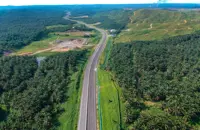
PETALING JAYA: Phase 1 of the Sabah Pan Borneo Highway has yet to be completed despite being in the works for 10 years, the Auditor-General’s Report finds.
"Overall, the Sabah Pan Borneo Highway (LPB Sabah) Phase 1 Project was planned as early as 2015, with the original construction and completion period set at 69 months, from April 11, 2016, to Dec 31, 2021. Phase 1 comprises 35 work packages spanning 706km," read the Auditor-General’s Report Series 2/2026, tabled in Parliament on Monday (Oct 5).
However, as at March 31, 2026, the overall project had yet to be completed, despite having been under planning for 10 years and with project management transferred from the Project Delivery Partner (PDP) to the Works Ministry on Sept 22, 2019, it added.
The audit found that only four work packages, with a total cost of RM567mil, had been completed, while the remaining 31 packages, comprising 88.6% of the project and valued at RM16.319bil, were still under implementation.
Nine work packages were classified as sick projects, while 13 were behind schedule and nine were ahead of schedule, according to the report.
"Several key issues require attention, including delays in project completion, project sites not being available before the commencement of works, utility relocation, design changes, weaknesses in project monitoring, non-compliance with regulations and contractual requirements, as well as various aspects of project governance and management.
"These findings show that the challenges faced involve not only on-site implementation and complex factors involving multiple stakeholders, but also planning, inter-agency coordination and comprehensive project monitoring," it added.
The audit identified weaknesses in project planning, implementation and monitoring that directly affected the completion period, implementation costs, achievement of project objectives and the benefits that should be enjoyed by the people.
The prolonged delays had also affected the achievement of development targets and the provision of safer and more efficient road networks for users in Sabah, said the Auditor-General.
"The extension of the overall project implementation period resulted in delays in project completion and an increase in the overall contract cost of the Sabah LPB Phase 1 Project from RM17.91bil to RM18.96bil.
"The current cost of Phase 1A is estimated at RM11.323bil, exceeding the original project ceiling of RM10.336bil by RM0.987bil, or 9.5%.
"The overall project cannot be completed unless additional funding is approved by the government," the report said.
The audit also identified non-compliance with contractual requirements and applicable regulations, including site works commencing before the environmental impact assessment (EIA) report was approved, delays in finalising contract documents, payments for inappropriate expenditure involving preliminary work items, and approval for variation orders exceeding the prescribed limits.
"Compliance with contractual requirements is essential to ensure that the government’s interests are protected, the risk of disputes is minimised, and any actions or decisions taken have a clear basis and justification," it said.
Irregularities identified in the report included RM6.03mil in government funds used for payments involving the Construction Industry Development Board (CIDB) levy, which should have been borne by the contractor.
In addition, the government had to bear RM32.95mil in bond and insurance payments due to differences between the actual amounts paid by the work package contractor (WPC) and the costs paid by the government to the WPC.
"Irregular payments amounting to RM163.64mil were also made in excess of the permitted limits due to delays in finalising the contract documents.
"Meanwhile, expenditure exceeding the contract value for items under the project information system amounted to RM0.89mil, while payments totalling RM4.08mil involving 19 invoices could not be made," it said.
The audit found issues relating to the management of variations to works, compliance with approval authority limits, fulfilment of contractual obligations, management of the project implementation period, and follow-up action on contractor delays and non-compliance that need due attention to prevent financial and legal implications for the government.
As for Sarawak, the audit could not assess the objectives of the Sarawak Pan Borneo Highway project as it had not been completed.
"Based on the preliminary report by the Sarawak Public Works Department (JKR Sarawak) and the audit findings, the project had a positive impact on economic and social activities along the project corridor, including the commercial, agricultural, tourism and construction sectors, as well as the development of new roads and increased revenue," it said.
However, due to issues relating to inefficient contract and agreement management and governance, the LPB Sarawak Project had yet to achieve comprehensive project completion and implementation, it added.
Among the issues identified were outstanding claims for utility relocation and reinstatement amounting to RM1.780bil; weaknesses in the management of the project information system, involving payments totalling RM32.07mil despite the system becoming inaccessible after the service period expired; failure to renew the project insurance policy; and unused facilities valued at RM20.18mil.