
Selangor has long attracted higher education institutions from both the public and private sectors.
One reason for this, especially for the private sector, is its proximity to various industries and companies, says Dr Teh Choon Jin.
The National Association of Private Educational Institutions deputy president said Selangor, one of the country’s main economic hubs, has emerged as a major education hub.
“Selangor has a strong concentration of industries, multinational companies, technology companies, manufacturing, healthcare, finance, logistics and services.
“Naturally, education institutions want to be where the jobs and opportunities are,” he said.
At the same time, he added, companies want to be where they can find talent.
“So, there is a kind of cycle. Students come to Selangor because there are education and employment opportunities.
“Institutions come here because there is demand from students and industry. Employers are also able to tap into a large pool of graduates,” he pointed out.
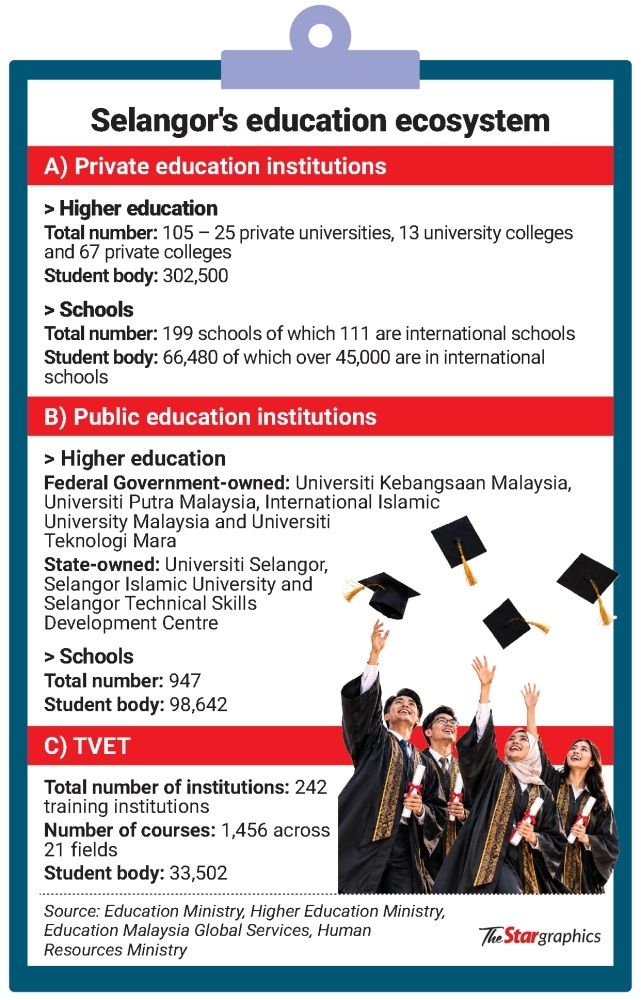
And the numbers show it, with Selangor having the most concentrated education ecosystems in Malaysia, said Teh, who is also Asia Pacific University of Technology & Innovation registrar.
“So, when we talk about Selangor’s education ecosystem, we should not look only at universities and colleges,” he said.
“Selangor offers a complete, continuous talent pipeline that starts right from early childhood and runs through international schooling, tertiary degrees and professional upskilling.”
He also said the economic impact goes far beyond tuition fees.
“Education institutions create jobs directly and indirectly,” he said, adding that the institutions provide thousands of jobs for academic faculty, administrative staff, facility management and support services.
Student spending is another contributor, with over 300,000 tertiary students and 66,000 private school pupils living in the state spending on housing, food, transport, retail and entertainment.
“International students bring in foreign direct spending that extends into medical insurance, visa processing and tourism when their families visit,” he added.
Teh also highlighted the intellectual value of universities, saying applied research, joint innovation labs and industry projects help local companies and SMEs test new ideas and solve operational challenges.
“When a strong education sector sits right next to a major commercial hub, both sides elevate each other. Research can lead to new products, new services or new ways of doing things.
“I would look at education as part of Selangor’s economic ecosystem. When you have a strong education sector alongside a strong industrial and business sector, the two can support each other,” he added.
While numerous institutions are spread across the state, certain fields remain particularly popular among students, including computing, artificial intelligence, cybersecurity, data science, software engineering, fintech, business analytics, healthcare and logistics.
However, just because numbers for these particular sectors are high, it does not mean the talent gap is close to being closed, said Teh.
“The more important question is whether the programmes are producing graduates with the skills employers need.
“Speaking of producing talents with the right skills, there tends to be a time gap between the technology being used in the industry today and what is being taught in classrooms,” he said.
“There will always be some level of mismatch between education and industry because industry can move very quickly.
“Employers also need people who can solve problems, communicate, work in teams and learn new things,” he said.
This type of agility needs to be embedded into programmes through micro-credentials, soft skills training and flexible modules, said Teh.
TVET talent
Sandra Segaran, who runs four skills training centres, said Selangor has the largest number of technical, vocational education and training (TVET) centres – both public and private – in Malaysia.
With around 150,000 school leavers enrolling in technical and vocational courses, he added that a Sijil Pelajaran Malaysia certificate is not enough to land a job.
“Skilled jobs will require at least a Sijil Kemahiran Malaysia certificate nowadays, with the exact level depending on the role,” he said.
“So, those who are not academically inclined, they will go for these skilled courses where they can focus on that particular skill they’re interested in,” he said.
Meanwhile, Assoc Prof Dr Razali Hassan of Universiti Tun Hussein Onn Malaysia’s TVET department said popular courses include those in advanced manufacturing, digital technology and Industry 4.0, as well as industrial technical services.
“The programmes attracting stronger interest are those where students and parents can see a clear connection between skills, technology, employment and income,” he said.
“We need to move away from promoting TVET simply as ‘hands-on education’. Modern TVET is technology-intensive, knowledge-intensive and competency-intensive education.
“If I were designing Malaysia’s TVET system for 2031-2036, I would build it around one principle, which is that talent development must follow the technology and economic needs of the country, not merely the existing programmes of our institutions,” added Assoc Prof Razali.
He also said Malaysia does not simply need more TVET graduates but a more seamless connection between training institutes and the industry.
“Industry provides authentic workplace learning; subsequently, professional bodies validate competence.
“These graduates then enter employment and continue lifelong learning,” he said.