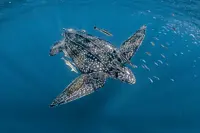
PETALING JAYA: Images of crowds surrounding a nesting leatherback turtle with flashlights and mobile phones have sparked urgent calls for clear crowd-control guidelines before the critically endangered species lands on local beaches again.
The incident occurred on Sept 22 at Pantai Kuala Abang in Dungun, where excited villagers swarmed a leatherback as it made its way back to sea after laying 70 eggs.
Addressing the controversy, Universiti Malaysia Terengganu (UMT) expert Assoc Prof Dr Mohd Uzair Rusli stressed that the focus should be on preventing future disruptions rather than assigning blame.
“Images of people crowding around the turtle naturally invite strong reactions,” Mohd Uzair said in a statement on Tuesday (Sept 29). “What is most important now is understanding why this happened and how we can better manage the next landing.”
Mohd Uzair, who heads UMT’s Marine Conservation Centre, noted that effective protection must begin in the water long before the animals step foot on land. Drawing on observations from Pulau Redang, he explained that turtles often approach shore as early as 3.00pm, when peak snorkeling and boat activities take place. He warned that heavily trafficked waters risk disturbing turtles before they can even reach the beach, advocating for targeted snorkeling restrictions in known nesting zones.
While acknowledging the public's excitement over rare leatherback sightings, particularly among younger generations, Mohd Uzair emphasised that conservation cannot rely solely on good intentions.
Drawing on over three decades of research at UMT’s Chagar Hutang Turtle Sanctuary, he urged authorities to establish a structured protocol for future landings. When a turtle emerges, only trained personnel should initially approach while the public remains at a safe distance. The turtle must be given complete space to select a site, dig its nest, and begin laying eggs before any controlled observation is permitted.
To achieve this, Dr Mohd Uzair urged authorities to establish clear, pre-determined rules on crowd sizes, lighting restrictions, spectator boundaries, and personnel training. Rather than resorting to blanket beach closures, he suggested that well-regulated turtle-watching could serve as a valuable educational tool while supporting coastal communities through trained local guides and eco-tourism.
“If we want turtles to keep returning and coastal communities to continue benefiting from them, both must be managed carefully,” he added.