PETALING JAYA: Enforcement action has been taken against more than 1,000 childcare and elderly care centres nationwide, says the Social Welfare Department (JKM).
This comes amid concerns raised by some quarters over the prevalence of such care centres operating in residential areas, including shop lots.
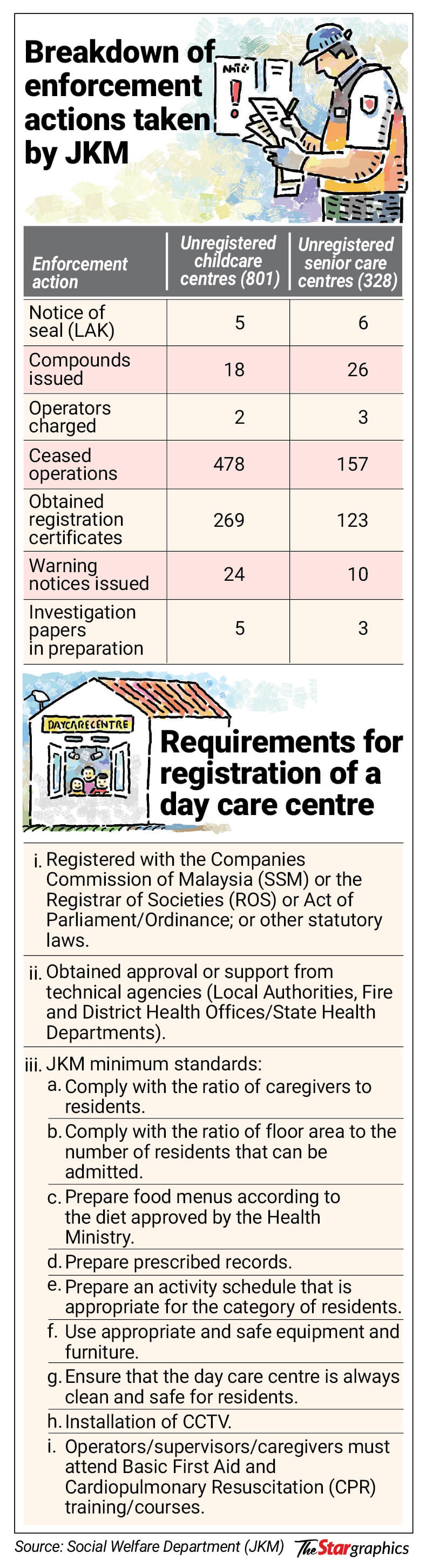
Since 2023, JKM said action has been taken against 801 unregistered childcare centres and 328 unregistered elderly care centres by a task force set up to tackle illegal premises.
The figures highlight the scale of non-compliance with the Care Centres Act 1993 (Act 506) and the Child Care Centre Act 1984 (Act 308), despite ongoing advocacy efforts, the department noted.
However, the department said not all centres offering services in residential areas are deemed “care centres” that require mandatory registration under Act 506.
“Some premises providing care-like services are instead regulated by other ministries, such as the Health Ministry or Education Ministry, depending on the type and function of the services offered.
“Each premises needs to be assessed based on its function, form of operation and applicable legal provisions before determining the responsible agency,” JKM added.
Such premises include those offering educational classes for children or providing palliative care for the elderly.
Under Section 2 of the Act, a premises is only considered a care centre if it meets the specific definition provided.
Currently, nursing homes, residential homes for the elderly, facilities for persons with disabilities, and day care centres fall under the purview of JKM.
This includes premises that receive four or more individuals for care for more than three hours a day, between sunrise and sunset, for at least three days a week.
The department noted that most unregistered childcare centres in the country remain illegal because operators can’t meet the minimum safety, structural and planning requirements.
This typically involves a failure to obtain the necessary approvals or support from local authorities, the Fire and Rescue Department and the health office.
“Each local council enforces its own by-laws based on its jurisdiction, and requirements can differ from one district to another.
“Many centres operate from premises that are unsuitable or lack planning permission, making registration impossible until these issues are rectified,” JKM added.
The department cited non-compliance with fire safety requirements, such as providing a second exit door and proper staircases, as examples of requirements that some centres fail to meet.
The department acknowledged that there should be a comprehensive and integrated approach to tackling unregistered care centres.
It said inter-agency cooperation must be strengthened, as the responsibilities for certain premises fall under different ministries and agencies, such as the Health Ministry, Education Ministry and local authorities.
“This coordination ensures that such centres are monitored by the agencies that have the proper jurisdiction,” JKM added.
The department urged those with information on suspected unregistered care centres to report the matter to the relevant authorities.