
PETALING JAYA: The education sector has been getting the highest allocation under the national budget each year, but calls have emerged that it is time to give healthcare the lion’s share as its needs are more pressing at this juncture.
Retired health ministry director Datuk Dr Zainal Ariffin Omar said the public healthcare system is in such a critical state that it requires a fundamental overhaul, including funding for a permanent workforce, new facilities, equipment and digitisation.
“Given the severity of the workforce shortages and warnings from experts, a strong argument can be made that the healthcare sector deserves the highest allocation this year to stabilise a system that is currently failing its people.
“Malaysia is facing a critical shortage of nearly 11,000 specialists and an 18% nursing vacancy rate which is straining public hospitals.”
He said that years of under- investment have led to overcrowding, burnout and staff leaving for the private sector.
“Building hospitals is ineffective without the staff to run them. In essence, the system is trapped between urgent understaffing and increasing patient demand, and the current budget measures don’t fully resolve the core workforce retention crisis,” he said.
Senator Dr RA Lingeshwaran said both health and education should be given high priority because these sectors are important for the country’s future, adding however that there is a strong case for greater investment in healthcare.
“The Health White Paper has set out the need to strengthen our healthcare system. And there has been discussions about moving towards a health spending of around 5% of the GDP.”
“But the focus should not simply be on building more hospitals and clinics. We must also have enough funding and manpower to operate them fully.
ALSO READ : MMA: Bigger budget needed to fix healthcare issues
“What is the point of spending hundreds of millions to build a new hospital if we do not have enough doctors, nurses and other healthcare workers to run it?” asked the former director of Hospital Sungai Bakap.
Bank Muamalat Malaysia Bhd chief economist Mohd Afzanizam Abdul Rashid said both education and health sectors would always be the priority.
However, he said the Out of Pocket Expenses (OOP) for health remains sizable. This, coupled with the rise in medical cost and other costs of living, would pose a serious challenge to healthcare financing.
“Getting more Malaysians to be insured medically is one way to address it. But beyond that, the allocation for healthcare would need to be gradually increased towards 5% of the GDP as the standard benchmark in order to reach universal healthcare coverage,” he said.
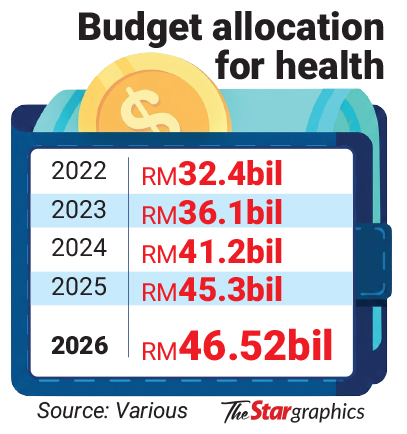
Sunway University economics professor Dr Yeah Kim Leng said the development allocation for health at RM7bil or 9% of the total development budget for 2026 is only half of that for education.
“Given the country’s relatively low public and private health-to-GDP at about 2% each, or around 4-5% in total, Malaysia needs to increase its public health spending,” he said.
“Additionally, given the ageing population, rising healthcare demand and inflation, the public healthcare system is overburdened, thereby increasing the urgency for higher allocation to expand manpower resources and capacity, including investment in advanced medical equipment and technology,” he added.