
Balabac now becoming a geopolitical hotspot
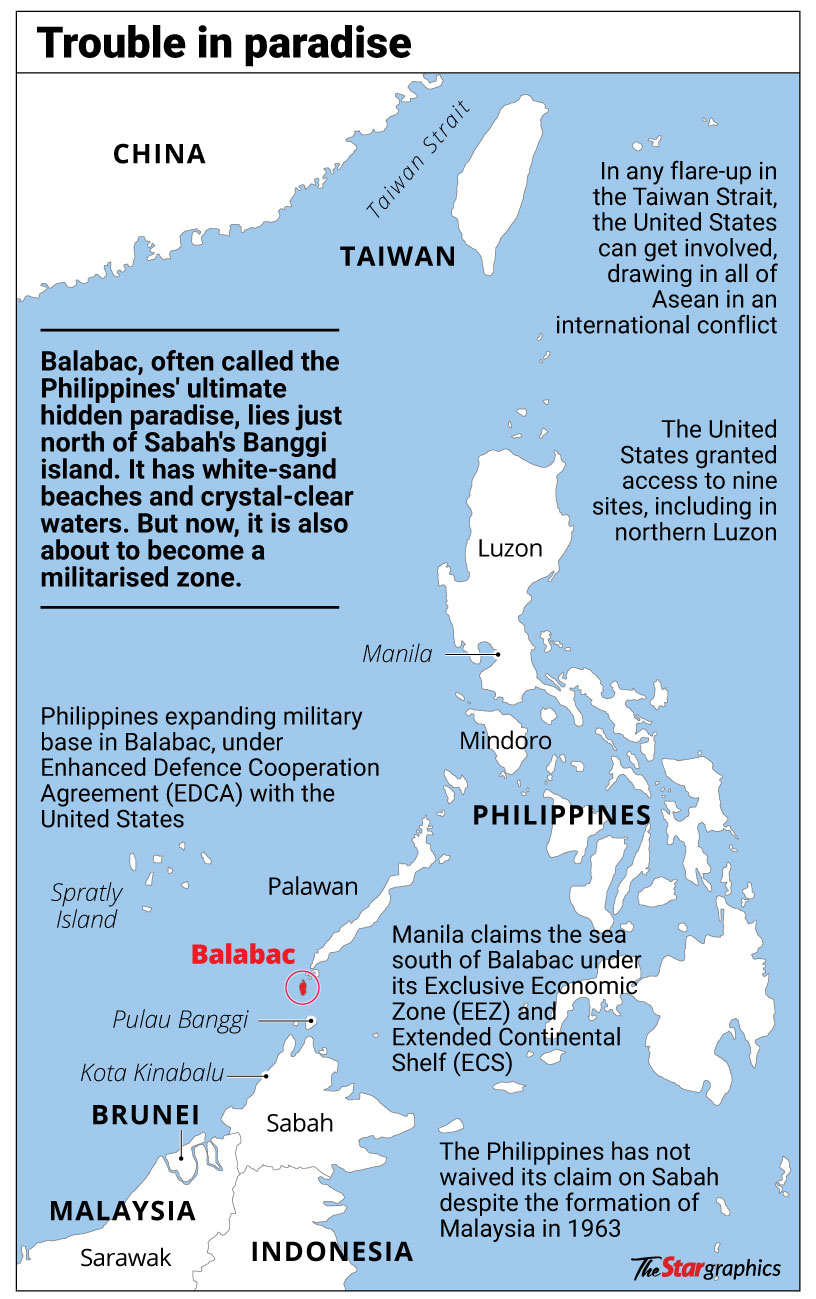
KOTA KINABALU: Balabac, the southernmost island of the Philippines, sits 50km north of Sabah’s Banggi Island, the two divided by the 12km wide Balabac Strait.
The strait connects Sulu Sea to South China Sea, and is a key chokepoint for vessels moving between the Philippines, Malaysia and beyond.
The people of both islands share close ethnicities, with family ties and barter trade existing long before international borders were formally drawn.
But quiet northern Sabah maritime corridor is now becoming a geopolitical hotspot.
The Philippines is expanding its Balabac military base under an agreement with the United States, granting US forces access to nine sites in the country.
Analysts said this has transformed Sabah into a frontline player in the intensifying rivalry between Washington and Beijing over the South China Sea and Taiwan.
It also casts an ominous shadow over Manila’s historical claim on Sabah.
Prime Minister Datuk Seri Anwar Ibrahim has voiced serious concern over the militarisation, warning that Malaysia cannot match the scale of facilities being developed but will strengthen its basic defence capabilities.
The challenge is compounded by overlapping claims by the two countries over the Exclusive Economic Zone. Both countries claim the sea north of Banggi and south of Balabac.
Manila’s legal framing also avoids implicitly recognising Malaysian sovereignty over Sabah, without waiving its own dormant historical claim on Sabah.
Balabac’s close proximity – a 10-minute flight or an hour’s naval crossing to Sabah – makes Malaysia vulnerable to spillover effects from any military build-up.
Prof Azmi Hassan, Senior Fellow at Nusantara Academy, said the build-up carries both symbolic and practical risks, given Manila’s continued claim over Sabah, which became part of Malaysia in 1963.
“The military expansion is a serious concern. The US interest is to counter China’s assertiveness in the area and prepare for a possible flare-up over Taiwan,” he explained.
Prof Azmi said Malaysia’s best-case scenario laid in Asean’s diplomacy to contain tensions.
“Malaysia must rely on international law, particularly UNCLOS (United Nations Convention on the Law of the Sea), to address militarisation without being dragged into the rivalry between the United States and China,” he said.
Echoing these concerns, Universiti Malaysia Sabah’s Prof Dr Ramli Dollah warned that any confrontation around Balabac could directly affect Malaysia.
“This is particularly sensitive because of the unresolved Sabah claim, overlapping maritime boundaries, and China’s activities in the South China Sea.
“If there is tension in the Taiwan Strait, Balabac could become strategically vital, bringing military activity closer to Sabah,” he said.
Both analysts agree that Malaysia must strengthen defence preparedness without entering an arms race or taking sides.
“Malaysia needs a balanced approach – build capacity while maintaining good relations with the US, China and the Philippines,” said Prof Ramli.
“Asean and bilateral channels should be used to promote transparency and confidence-building.”
However, Prof Azmi noted that with the Philippines as 2026 Asean chair, it would be difficult for Malaysia to put the issue on the agenda, as the host usually set the agenda.
He said Anwar, as the chairman of Asean last year, had used his position to cool down the South China Sea issue, and that the status quo should prevail.
“But we know Manila is more inclined to go head-to-head with China because the United States is behind the Philippines.
“It is going to be difficult for Malaysia (to use diplomacy),” he said.
Malaysia could bring the issue up at the Asean Summit or Asean Foreign Ministers’ Meetings, he explained.
For the analysts, the US presence in nine sites within the Philippines, including a northern Luzon site about 400km from Taiwan, provides the US critical operational depth should there be a flare-up over Taiwan.
“It is not about the Sabah claim. That is an issue between Kuala Lumpur and Manila.
“This is the United States having a strategic presence in case of a conflict escalating over Taiwan and presence in the South China Sea,” Prof Azmi contended.
If things go wrong, Balabac may become a frontline in the contest for influence across the South China Sea.
For Malaysia, the challenge is to defend sovereignty and livelihoods while ensuring that superpower rivalry does not turn Sabah’s waters into the next fault line of regional conflict.