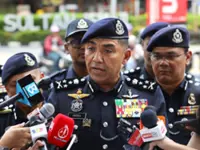
KUALA LUMPUR: Those driving vehicles on official duties must do so safely and with full awareness of their surroundings – even if they have blue and red warning lights on, say police.
Bukit Aman Traffic Investigation and Enforcement Department director Comm Datuk Seri Muhammed Hasbullah Ali said only six agencies are authorised to use blue and red beacons; namely the police, Fire and Rescue Department, ambulances, JPJ, Prisons Department and Customs Department.
"Under Rule 24B-1 of the Motor Vehicles (Construction and Use) Rules 1999 (2024 Amendment), motor vehicles are prohibited from being fitted with special warning lights unless they are listed under the Sixth Schedule.
"Any use of beacons outside the list of authorised vehicles requires approval from the Transport Minister upon the recommendation of the JPJ director-general, as provided under Rule 24B-2," he told reporters at Jalan Sultan Ismail on Thursday (Aug 20).
Comm Muhammed Hasbullah said even with beacons or emergency lights, vehicles must take into account traffic conditions, intersections and the movement of other vehicles.
"This applies regardless of the situation, whether it is an emergency, pursuing a suspect or others," he said, adding that the vehicle driver must ensure other road users have sufficient space and time to react.
Comm Muhammed Hasbullah said warning lights should not be misunderstood as giving the vehicle absolute priority, which could endanger other road users.
"Enforcement and emergency vehicles must ensure the route is safe before proceeding, including when crossing intersections or traffic lights," he said.
However, he said those who deliberately obstruct, block or tailgate an emergency vehicle could face action under the law.
"Under Rule 9 of the Road Traffic Rules 1959, road users are required to give way to enforcement or emergency vehicles carrying out official duties," he said.
Comm Muhammed Hasbullah also said police have authority to regulate, control and maintain traffic order, including directing road users to comply with instructions.
"We also have an exclusive role in escort duties, clearing routes or stopping traffic for dignitaries, VIPs or convoys on public roads.
"As such, other agencies or the public cannot block, stop or direct public vehicles to give way to their own convoys without the appropriate authority or permission," he said.
Earlier, Comm Muhammed Hasbullah, accompanied by Kuala Lumpur Traffic Investigation and Enforcement Department chief Asst Comm Mohd Zamzuri Mohd Isa and senior officers, inspected the scene of an accident that claimed the lives of three.
He the use of warning lights is to alert other road users but safe driving practices and proper vehicle control must not be disregarded.
He said in emergencies, prompt action is required but this must be balanced with the need to ensure the safety of personnel, the public and other road users.
He said enforcement agencies must comply with standard operating procedures (SOP), assess road conditions and ensure intersections and routes are safe when carrying out an operation.
He added that police conducted an engagement session with enforcement agencies on June 23 to ensure a common understanding and coordination on road traffic laws, including compliance with Rule 24B and the use of beacon lights according to the prescribed specifications.