GEORGE TOWN: The Natural Resources and Environmental Sustainability Ministry will undertake a comprehensive study and in-depth discussions on the proposed construction of more wildlife canopy bridges to address human-wildlife conflict.
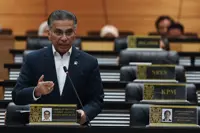
Natural Resources and Environmental Sustainability deputy minister Syed Ibrahim Syed Noh said the wildlife canopy bridge concept implemented by the Langur Project Penang (LPP) could be expanded to states with high populations of primates, such as dusky leaf monkeys and long-tailed macaques, which often venture into residential areas.
"The initiative by LPP has the potential to be an effective and animal-friendly solution. However, it requires thorough evaluation before being expanded to other areas. We will collaborate with the Department of Wildlife and National Parks (Perhilitan), state governments and stakeholders, including the private sector and communities.
"We want to avoid any harm to animals while ensuring human safety and well-being. Therefore, a detailed study covering habitat, behaviour and movement patterns of primates must be conducted before any decision is made,” he said after inspecting a canopy bridge in Batu Ferringhi here on Wednesday (April 29).
Also present were State Environment and Housing Committee chairman Datuk Seri S. Sundarajoo, Penang Perhilitan director Mohd Zaide Mohamed Zin and LPP founder and head Dr Jo Leen Yap.
The bridge, named ‘The Obscura’ after the scientific name of the dusky leaf monkey (Trachypithecus obscurus), functions as a safe crossing above roads for arboreal species to move between habitats, especially in forest areas fragmented by development.
Syed Ibrahim said the ministry, through Perhilitan, has data on human-primate conflict hotspots that can serve as a basis for planning, adding that the science-based approach implemented by LPP is a promising initiative in managing interactions between humans and animals, particularly monkeys and macaques in populated areas.
"The project focuses on providing safe crossings for animals to avoid road accidents while also helping to reduce conflict with humans.
"We want to start small but with strong cooperation between the government, agencies and the social sector so that implementation can be expedited without lengthy bureaucratic processes,” he added.
He also said the government has previously developed large-scale wildlife crossings such as viaducts and underpasses under the Central Forest Spine project in several states, including Perak, Johor and Pahang.
However, for primate species that frequently inhabit areas near residential zones, approaches such as canopy bridges are more practical and suitable. – Bernama