
PETALING JAYA: A push to move migrant workers out of residential neighbourhoods and into gated centralised dormitories has raised questions over the balance between public safety and human rights.
While some state authorities and developers want Centralised Labour Quarters (CLQ) to eliminate overcrowding and social friction, international labour advocates warn that such geographic segregation may infringe on the fundamental right to choose where one lives.
In Johor, the state government is already taking a proactive stance, encouraging developers to build dedicated hostels within industrial zones to curb the practice of houses in residential areas being rented out.

State investment, trade, consumer affairs and human resources committee chairman Lee Ting Han said migrant workers deserve accommodation that is neither crowded nor unsanitary.
ALSO READ : Hostel gaps push workers into condos
“The way forward is to have more dedicated hostels or dormitories, whether in new or existing industrial areas in Johor,” he said.
With the Johor-Singapore Special Economic Zone (JS-SEZ) now in place, Lee said demand for such high-standard accommodation was expected to be strong.
Housing workers within “gated and guarded” precincts, he said, would address persistent safety and social issues raised by locals.
“While locals are not against workers renting houses in their neighbourhoods, they still feel uncomfortable having them there,” Lee added.
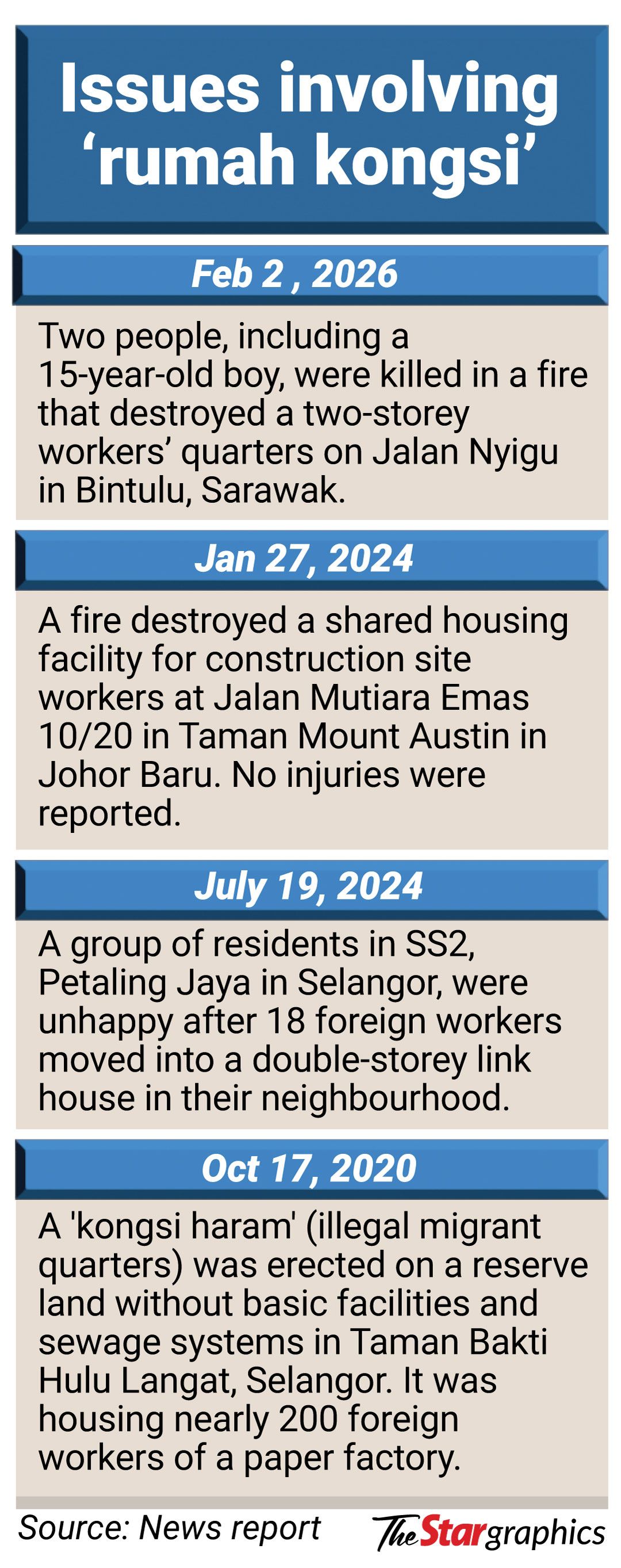
The human cost of the problem was underscored by a tragic fire in Pontian last August, which killed two Thai nationals working as cooks.
Lee said such incidents could be avoided if employers provided conducive housing equipped with essential facilities, such as proper kitchens and sleeping areas.
Olive Tree Property Consultants CEO Samuel Tan described CLQ as a “win-win” for both workers and employers.
He said centralised housing would prevent exploitation by third-party landlords and improve Johor’s image among global investors.
“These migrant workers contributed to our nation-building and economy, and they deserve basic human values from us.”
He added that while units might cater to specific nationalities, the larger compounds would allow for healthy social mixing.
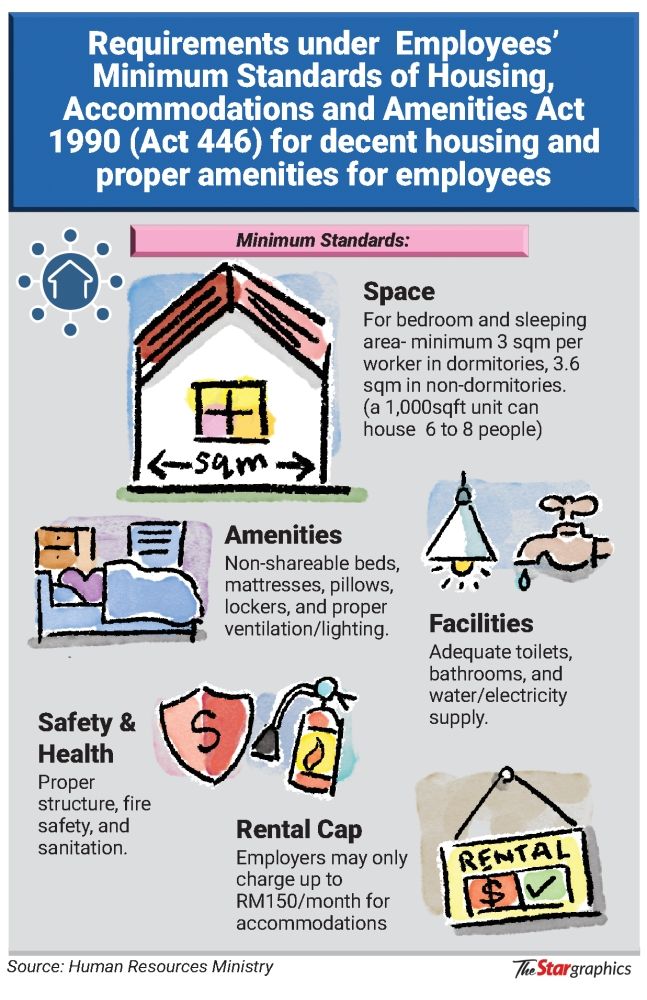
At the national level, the Labour Department is ramping up enforcement under Act 446 (Employees’ Minimum Standards of Housing, Accommodations and Amenities Act 1990).
As of Jan 31, the department has approved 8,014 applications for Certificates for Accommodation (COA), involving over 355,000 employees.
The Human Resources Ministry told The Star that while compliance has gradually improved since 2020, the penalties remain steep – employers failing to meet standards face fines of up to RM50,000 per offence.
The International Labour Organisation (ILO), however, has raised concerns about the long-term impact of the CLQ model.
While acknowledging Malaysia’s housing improvements since 2020, the ILO noted that there was significant non-compliance, at 63.5% in a previous inspection cycle.
The ILO also warned against mandatory “geographic segregation”, suggesting that workers should be free to choose their residence.
It also noted that Malaysia’s current space standards (3 to 3.5sq m per person) remain low compared to international benchmarks, such as New Zealand’s 6sq m per person.
The ILO noted that access to adequate housing is recognised as a fundamental human right and an element of adequate standards of living.
The ILO provides recommendations on workers’ housing with key principles like habitability, health and safety, location and access, affordability, non-discrimination, public responsibility, employer role and worker participation.
“Employers should generally not provide accommodation directly, except where necessary (eg remote locations or work requiring immediate availability of workers).
“The reasoning behind this is that workers should have the freedom to choose where they reside. At the same time, it is important to ensure, with respect to affordability, that migrant workers’ wages, before overtime, are commensurate with the cost of living so they can afford adequate housing,” the ILO said.
Asked if there should be centralised, gated dormitories for migrant workers within industrial zones, the ILO said safeguards such as avoiding or ending geographic segregation of migrant worker accommodation should be followed.
In 2022, the ILO published a report entitled Home Truths: Access to Adequate Housing for Migrant Workers in the Asean region, which highlights migrant workers’ living standards in Singapore, Thailand and Malaysia, and the steps needed to ensure decent and adequate accommodation.
It concluded that states should make efforts towards the full realisation of the right to health, without discrimination.
This includes states’ obligation to protect the right to health of migrant workers without third parties, such as employers, dormitory operators, housing providers or agents, interfering with that right.
These interferences include limiting access to health-related information and services or not addressing overcrowding or other harmful conditions in migrant worker accommodation.